Part 3 — War Conduct (Phases, Strategy, Technology, Logistics/Finance, Civilian Impacts)
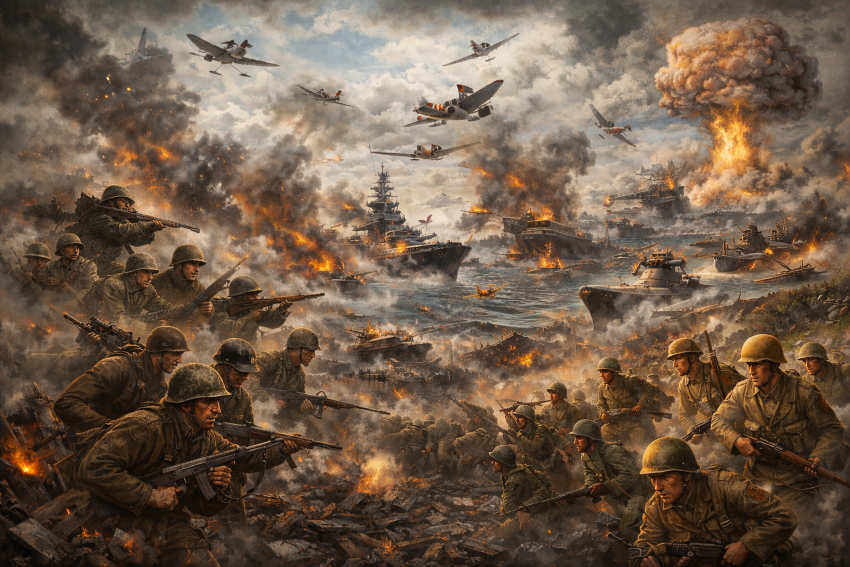
1) How the war was fought in broad phases (a fact-pattern with interpretive labels)
FACT (global sequencing): World War II opened in Europe with Germany’s invasion of Poland on 1 September 1939; Britain and France declared war on 3 September 1939. The war between Germany and the USSR began with Operation Barbarossa on 22 June 1941. The war in the Pacific began on 7/8 December 1941 with Japan’s attack on Pearl Harbor and associated strikes across the region.
INTERPRETATION (phase labels, attributed): Many general histories and reference syntheses describe a pattern of (i) early Axis operational initiative (1939–41), (ii) inflection/turning points concentrated in 1942–43, and (iii) sustained Allied offensives culminating in Axis surrender(s) in 1945. This framing is a heuristic; it compresses heterogeneous theaters into a single storyline and should be treated as an organizing device rather than a claim that “one battle decided the war.”
2) Europe and the Mediterranean: maneuver, attrition, and coalition warfare
2.1 Western Europe and air-sea control around Britain
FACT (1940 air campaign): After the fall of France (May–June 1940), Germany conducted an air campaign against Britain commonly dated July–September 1940 (with variations by definition), and the “Blitz” is commonly dated from September 1940 to May 1941.
FACT (civilian effects in Britain): Imperial War Museums summarizes that over nine months of raids, over 43,500 civilians were killed in bombing attacks focused on major cities and industrial centers.
INTERPRETATION (what mattered operationally, attributed): IWM argues that integrating radar into the Dowding System—an air defense network that fused radar, observer reports, and command-and-control—was “fundamental” to Britain’s chance of victory in the Battle of Britain. This is a judgment about relative importance; it is widely shared, but it remains a weighting decision rather than a simple fact.
2.2 The Eastern Front: scale, attrition, and operational depth
FACT (launch): Germany’s invasion of the USSR began on 22 June 1941.
FACT (Stalingrad as a hinge episode): Britannica dates the Battle of Stalingrad 17 July 1942–2 February 1943 and reports estimated Axis and Soviet casualties on the order of hundreds of thousands to over a million, with civilian deaths in the city estimated around 40,000 (noting the inherent uncertainty of wartime casualty accounting).
INTERPRETATION (turning-point claim, explicitly attributed): Britannica states that most historians consider Stalingrad a decisive turning point in the East—language that signals an interpretive consensus rather than a mechanically provable threshold.
FACT (Kursk timing): Britannica dates the Battle of Kursk 5 July–23 August 1943, commonly presented as a major armored confrontation and a further shift toward sustained Soviet offensives.
2.3 North Africa and Italy: amphibious entry points and multi-front pressure
FACT (North Africa milestones): Britannica dates the Second Battle of El Alamein 23 October–11 November 1942, and Operation Torch (Allied landings in North Africa) began 8 November 1942.
FACT (Italy’s volte-face): Britannica notes Italy’s surrender/armistice announcement on 8 September 1943, and the Allied landings at Salerno began on 9 September (illustrating how fast operational plans and political events collided).
INTERPRETATION (coalition strategy, cautiously stated): A common analytical view is that the Mediterranean campaigns combined operational opportunities (sea-based entry) with coalition politics and resource constraints, while also functioning as one way to apply pressure to Axis forces prior to (and alongside) the Western Front’s re-opening in 1944. This is an interpretation; the balance among “political,” “operational,” and “resource” drivers differs across historians.
3) The Atlantic: a campaign of logistics fought with technology, escorts, and intelligence
FACT (campaign scope): The Battle of the Atlantic is commonly dated 1939–1945 and is defined as a contest over control of sea routes essential for sustaining Britain and moving forces and materiel.
FACT (methods): IWM describes the core defensive method as organizing merchant ships into convoys protected by warships and (when possible) aircraft, while the threat centered on German submarines (U-boats) and other naval assets.
INTERPRETATION (technology “race,” attributed): IWM frames the Battle of the Atlantic as “a race of advanced technology,” emphasizing innovations in escort vessels plus sonar and radar and aircraft as vital in defeating the U-boat threat.
FACT (a commonly cited inflection in spring 1943): Britannica notes that in March 1943 German U-boats nearly succeeded in cutting Britain’s lifeline, but by May escort carriers and very-long-range aircraft expanded coverage; after losing 41 U-boats in May, they temporarily withdrew from the Atlantic.
FACT (signals intelligence claim, carefully bounded): GCHQ’s historical overview states that Bletchley Park produced intelligence that “saved thousands of allied lives.” This is a strong claim from an institutional source; the exact counterfactual magnitude is inherently uncertain and debated, but the operational relevance of signals intelligence to convoy routing and anti-submarine warfare is widely accepted.
4) The Pacific and Asia: carrier warfare, amphibious operations, and strategic bombing
4.1 From Pearl Harbor to mid-war turning points
FACT (opening shock): The Japanese attack on Pearl Harbor occurred on 7 December 1941 (with 8 December in parts of the Pacific due to the date line), and it coincided with attacks on other American, Dutch, and British installations.
FACT (Midway and Guadalcanal timing): Britannica dates the Battle of Midway 3–6 June 1942 and the Guadalcanal campaign August 1942–February 1943, both frequently treated as turning points toward a sustained Allied offensive posture in the Pacific.
4.2 Late-war naval and air operations; Japan’s surrender
FACT (major naval battle): Britannica dates the Battle of Leyte Gulf 23–26 October 1944, describing it as decisive in crippling Japan’s combined fleet and enabling U.S. invasion operations in the Philippines.
FACT (Tokyo firebombing): Britannica describes the 9–10 March 1945 firebombing of Tokyo (“Operation Meetinghouse”) and states that about 100,000 people died and about one-fourth of the city was destroyed.
FACT (atomic bombings and mortality uncertainty): Britannica dates Hiroshima (6 August 1945) and Nagasaki (9 August 1945) as the first use of atomic weapons in war, noting “tens of thousands” killed in the initial explosions and many more later. Britannica also provides an estimate of more than 170,000 deaths across both bombings (with uncertainty), including end-of-1945 tolls commonly cited as surpassing 100,000 in Hiroshima and totaling at least 70,000 by end of year in Nagasaki.
FACT (formal end): Britannica notes Japan’s formal surrender aboard the USS Missouri in Tokyo Bay on 2 September 1945.
5) Logistics, finance, and “total war” mobilization (what made sustained operations possible)
FACT (U.S. production scale, with specific figures): A National WWII Museum educational guide reports that from 1940 through Japan’s surrender the United States produced more than 300,000 aircraft, 86,000 tanks, and 12.5 million rifles, and built 107 aircraft carriers, 352 destroyers, and 35 million tons of merchant shipping.
FACT (Lend-Lease legal basis and scale): The U.S. National Archives summarizes the Lend-Lease Act as passed on 11 March 1941, enabling the U.S. to “lend or lease” supplies to nations deemed “vital to the defense of the United States.”
The U.S. State Department’s Office of the Historian notes that across the war the U.S. dispensed some $50 billion in Lend-Lease assistance via agreements with more than 30 countries; Britannica gives a closely aligned valuation (e.g., $49.1 billion).
INTERPRETATION (how logistics shaped strategy): Many analyses treat industrial output, shipping capacity, and coalition supply as constraints that set the feasible pace of offensives and the sustainability of losses. This is not controversial in principle; what varies is the relative weight assigned to production versus operational art, intelligence, and battlefield performance.
6) Civilian impacts during the conduct of war (numbers, ranges, and why they differ)
FACT (overall deaths, range): Britannica summarizes total World War II deaths as 40–50 million (a range reflecting major documentation gaps, definitional choices about indirect deaths, and uneven wartime recordkeeping).
FACT (Holocaust): The U.S. Holocaust Memorial Museum defines the Holocaust as the state-sponsored persecution and murder of six million Jews by Nazi Germany and collaborators.
The ICRC similarly describes the Holocaust as the extermination of six million Jews and notes the broader category of groups targeted for murder.
FACT (displacement in Europe): USHMM notes that after May 1945, 11 million people in Europe were “uprooted,” and that displaced persons included forced laborers, liberated camp survivors, and others unable or unwilling to return home.
FACT (Dresden casualty range and why it varies): Britannica reports that 25,000–35,000 civilians are thought to have died in the Dresden raids, while also noting much higher estimates (up to 250,000) tied to the difficulty of counting undocumented refugees and wartime population flux.
FACT (war-time famine example and contested attribution): Encyclopaedia Britannica states that about 3 million died in the Bengal famine of 1943.
A scholarly reassessment (Ó Gráda) discusses a wide claimed interval (0.8–3.8 million) and argues for a “consensus” estimate around 2.1 million, illustrating both measurement uncertainty and disputes over causal emphasis (weather, markets, governance, wartime disruption).
Key Sources Used
- Encyclopaedia Britannica, World War II overview and theater/battle entries (Barbarossa, Stalingrad, Normandy, Midway, Guadalcanal, Leyte Gulf, Battle of the Atlantic, Blitz context; atomic bombings; Dresden; Tokyo).
- Imperial War Museums, Dowding System/Battle of Britain; Blitz deaths; Battle of the Atlantic and convoy method/technology framing.
- U.S. Holocaust Memorial Museum, Holocaust definition and DP displacement figures.
- ICRC overview of the Holocaust framing in humanitarian history.
- GCHQ historical pages on Bletchley Park/WWII codebreaking.
- U.S. National Archives, Lend-Lease Act milestone document description and legal language.
- U.S. Department of State, Office of the Historian (Milestones), Lend-Lease scale (“some $50 billion”).
- National WWII Museum educational guide (U.S. production totals; “total war” mobilization framing).
- Ó Gráda (scholarly reassessment) on Bengal famine mortality range and “consensus” estimate.
Open Questions / Uncertainties (for Part 3 focus)
- Relative contribution of signals intelligence (ULTRA) to outcomes in the Atlantic and elsewhere (counterfactual magnitude). Confidence: Medium (material role is strong; quantification is debated).
- Effectiveness and ethical framing of strategic bombing as a war-winning tool versus a costly coercive strategy with mixed industrial effects. Confidence: Medium (large literature; conclusions vary by metric and theater).
- Civilian death accounting in major raids (Dresden is a canonical case of variance due to refugee flows and documentation gaps). Confidence: High that uncertainty is real; Medium on any single “best” point estimate.
- Atomic-bomb mortality totals (direct vs later deaths, definition choices) across Hiroshima and Nagasaki. Confidence: High that “exact” totals are not knowable; Medium on commonly cited aggregates.
- Bengal famine mortality and causation weighting (market dynamics, policy, war disruption, harvest conditions). Confidence: Medium (credible ranges exist; causal emphasis differs).
- Global civilian death totals and indirect deaths (famine, disease, occupation-related mortality) and how to separate war causation from baseline vulnerability. Confidence: Medium (ranges are robust; decomposition is contested).
- “Turning point” labels (e.g., Midway, Stalingrad) as explanatory devices versus retrospective narrative anchors. Confidence: Medium (useful shorthand; not uniquely determinative).