Part 2 — Road to War (trigger sequence, bargaining failure, mobilization, stated aims)
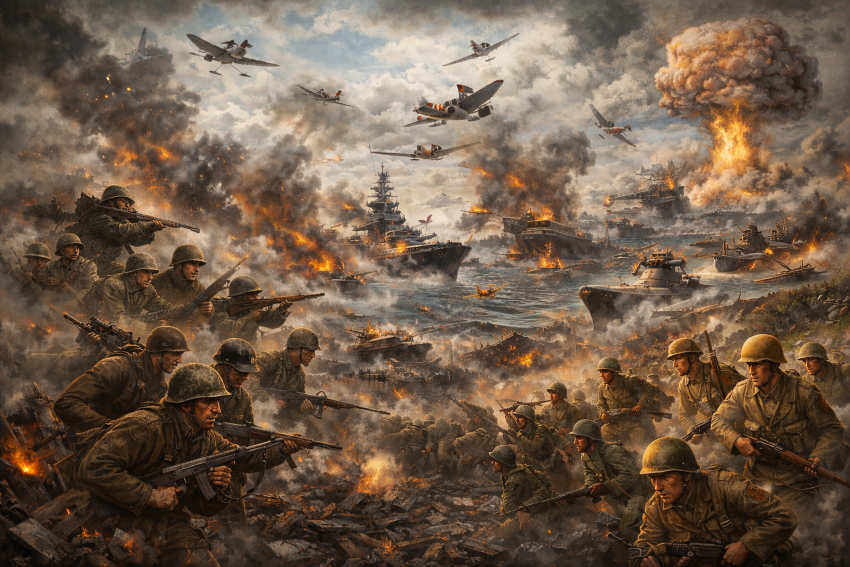
Scope note: This part explains how the conflict widened from a sequence of regional crises and wars into a formally declared, multi-theater world war by late 1941. Itser means diplomacy breaking down, alliances hardening, and economic/industrial mobilization accelerating.
Milestone timeline (1937–December 1941)
- 7 July 1937 — Fighting at the Marco Polo Bridge becomes the pivot into a full-scale Sino–Japanese War, reshaping U.S.–Japan and wider Pacific diplomacy.
- 30 September 1938 — The Munich Agreement permits German annexation of the Sudetenland (Czechoslovakia).
- March 1939 — German forces occupy Bohemia and Moravia and establish a protectorate (effectively ending Czechoslovakia’s sovereignty).
- 31 March 1939 — Britain publicly states an assurance/guarantee connected to Polish independence in Parliament (a marked change in British posture).
- March–August 1939 — Germany presses demands tied to Danzig and the corridor; diplomacy becomes time-compressed and ultimatum-like in late August.
- 23 August 1939 — Germany and the USSR sign the Treaty of Nonaggression; a secret additional protocol outlines spheres of influence in Eastern Europe.
- 1 September 1939 — Germany invades Poland; 3 September Britain and France declare war on Germany.
- 10 June 1940 — Italy declares war on Britain and France as France’s military position collapses.
- 22 June 1940 — The Franco-German armistice is signed; France is divided into occupied and unoccupied zones.
- 27 September 1940 — Germany, Italy, and Japan sign the Tripartite Pact (mutual assistance if attacked by a power not already involved).
- 22 June 1941 — Germany launches Operation Barbarossa, invading the Soviet Union.
- 26 July 1941 — The U.S. issues Executive Order 8832 (freezing Japanese assets, enabling tighter trade restrictions), amid escalating confrontation in the Pacific.
- 14 August 1941 — Roosevelt and Churchill issue the Atlantic Charter, a public statement of principles framing Allied war aims.
- 26 November 1941 — The U.S. delivers a proposed basis for agreement to Japan (often associated with the “Hull note” framework).
- 7–11 December 1941 — Japan attacks Pearl Harbor (7 Dec); the U.S. declares war on Japan (8 Dec); Germany declares war on the U.S. (11 Dec).
1) Europe: from crisis bargaining to general war (1938–1939)
Facts: what happened in the bargaining sequence
- Munich (September 1938) created a settlement in which Britain and France accepted German annexation of the Sudetenland.
- March 1939 then saw Germany occupy Bohemia and Moravia and establish a protectorate—widely treated by contemporaries as proof that the Munich settlement had not “closed” German territorial revision.
- Britain’s 31 March 1939 Commons statement tied Britain (and implicitly France) to Poland’s independence, signaling a shift from flexible crisis management toward a firmer deterrent posture.
- Germany pressed demands concerning Danzig and extraterritorial access across the corridor; Poland refused.
- In late August, diplomacy narrowed to hours: Imperial War Museums’ summary describes German “minimum conditions” being presented, including concession of Danzig and the corridor, with a rapid deadline for Polish representation—conditions Warsaw and London did not accept.
- The Germany–USSR nonaggression pact (23 Aug 1939) removed the immediate prospect of a two-front war for Germany and included a secret protocol envisioning spheres of influence in Eastern Europe.
- Germany invaded Poland on 1 September 1939; Britain and France declared war on 3 September 1939.
Interpretations: why bargaining failed (with attribution)
- Appeasement as strategy vs miscalculation. One scholarly line argues British concessions and delayed confrontation can be read as an attempt to buy time for rearmament and coalition-building rather than pure naivety; Ripsman and Levy explicitly frame appeasement as potentially consistent with balance-of-power logic under constraints.
- Commitment and credibility problems. Another common analytical interpretation in the international-relations literature is that repeated revisionist challenges combined with partial settlements degrade credible commitments: once one side doubts agreements will be honored, even “reasonable” bargains can become unstable. (This is an interpretive framework, not a single-document “fact”; it is used to explain why late-1939 negotiations compressed into ultimatums rather than reciprocal concessions.)
- Soviet alignment as a variable in deterrence. Contemporary diplomatic records and later syntheses treat the August 1939 pact and its secret protocol as pivotal because it changed expectations about what a Poland crisis would trigger and who would intervene.
2) From “European war” to “world war”: coalition hardening and escalation (1940–June 1941)
Facts: key escalation steps
- In 1940, Germany’s victories in the west culminated in the 22 June 1940 armistice with France.
- Italy entered the war on 10 June 1940, declaring war on Britain and France.
- The Tripartite Pact (27 September 1940) formalized a political–military alignment between Germany, Italy, and Japan. Its text describes mutual assistance if one signatory were attacked by a power not already involved in the relevant wars, and it frames “new order” leadership in Europe (Germany/Italy) and “greater East Asia” (Japan).
- On 22 June 1941, Germany invaded the Soviet Union (Operation Barbarossa), transforming the European conflict into a mass, multi-front war involving the USSR as a principal belligerent.
Interpretations: why the war widened (with attribution)
- Some historians emphasize that the widening is best explained not as a single “trigger,” but as the interaction of multiple revisionist projects and imperial systems. Richard Overy, for example, argues against reducing origins to a single actor and stresses broader imperial and systemic dynamics (this is an authorial thesis, not a neutral “fact”).
- The Tripartite Pact is often interpreted as partly deterrent signaling aimed at the United States, given Article Three’s “attacked by a power not presently involved” language; that inference is consistent with the pact’s structure, though the pact text itself does not name the U.S.
3) The Pacific: from a China war to U.S.–Japan rupture (1937–December 1941)
Facts: diplomacy, economic coercion, and failed settlement
- The U.S. Office of the Historian describes U.S. policy evolving between 1937 and 1941 amid the Sino–Japanese war: U.S. officials opposed Japanese incursions but were also reluctant to fight over China, with domestic and strategic constraints shaping policy.
- By 1940–41, U.S. policy shifted toward material support for belligerents opposing the Axis, including arrangements and later a large aid program under Lend-Lease.
- In July 1941, the U.S. tightened economic pressure through measures including the asset-freeze framework captured in Executive Order 8832 (26 July 1941).
- Negotiations continued into late 1941. The U.S. note of 26 November 1941 proposed broad principles and concrete steps, including Japanese withdrawal of forces from China and Indochina and reciprocal removal of asset-freeze restrictions as part of an agreement.
- Japan attacked Pearl Harbor on 7 December 1941; the U.S. declared war on Japan on 8 December.
Interpretations: what “made war likely” (with attribution and limits)
- A frequent interpretation is that economic coercion (asset freezes, oil restrictions) raised the perceived costs of delay for Japan and narrowed the perceived bargaining space. The National WWII Museum summarizes the July 1941 asset freeze as effectively cutting off Japan’s access to U.S. oil (interpretive emphasis; the executive order itself is the primary document).
- Conversely, other interpretations emphasize that negotiations—and uncertainty about each side’s bottom lines—continued until the final weeks, meaning “inevitability” is a retrospective judgment rather than a contemporaneous certainty. The 26 November U.S. proposal shows the U.S. still presenting a structured settlement concept days before Pearl Harbor.
4) Stated aims (as expressed in major documents)
Axis alignment and war framing (document-based)
- Tripartite Pact (27 Sep 1940):
- Publicly recognizes German/Italian leadership in a “new order” in Europe and Japanese leadership in “greater East Asia,” and commits to mutual assistance if attacked by a non-belligerent power.
Anglo-American principles as the U.S. moved from neutrality to belligerency
- Atlantic Charter (14 Aug 1941):
- Declares principles including no aggrandizement, no territorial changes without consent, and a postwar peace concept tied to security and economic collaboration.
- U.S. Note to Japan (26 Nov 1941):
- Frames settlement principles (territorial integrity, non-interference, equality of commercial opportunity) and proposes reciprocal steps, including withdrawal from China and Indochina.
What is well-established vs what is disputed (Part 2 focus)
Well-established (high confidence):
- The core sequence of dated events—Munich (1938), occupation of Czech lands (1939), Nazi–Soviet pact and secret protocol (Aug 1939), invasion of Poland and declarations of war (Sep 1939), Tripartite Pact (Sep 1940), Barbarossa (Jun 1941), U.S. asset-freeze measures (Jul 1941), Pearl Harbor and cascading war declarations (Dec 1941).
- The textual content of major documents (Tripartite Pact, Atlantic Charter, U.S. note to Japan) and their stated principles/commitments.
Disputed/contested (medium confidence unless otherwise noted):
- Whether British and French pre-1939 concessions are best explained as “buying time” vs misjudgment (debated in scholarship).
- Whether the Tripartite Pact’s primary function was deterrence of U.S. entry vs internal Axis coordination (inferred from structure; debated).
- Whether U.S. economic measures in 1941 “forced” Japan’s decision for war vs being one factor among several (interpretations vary; primary documents show coercion and continued negotiation).
Key Sources Used (Part 2)
- British Parliamentary record (Hansard), 31 March 1939 statement.
- Imperial War Museums (IWM), “How Europe Went to War in 1939.”
- Avalon Project (Yale Law School): Treaty of Nonaggression and Secret Additional Protocol (23 Aug 1939); Tripartite Pact (27 Sep 1940); Atlantic Charter (14 Aug 1941); U.S. Note to Japan (26 Nov 1941).
- U.S. Office of the Historian (history.state.gov) milestones and FRUS documents (Japan road to Pearl Harbor; Lend-Lease context; Executive Order 8832).
- Encyclopaedia Britannica topic pages for key dated events and campaigns.
- Ripsman & Levy on appeasement as “buying time” logic (scholarly framing).
Open Questions / Uncertainties (Part 2)
- Counterfactual bargaining space in August 1939: how much room remained for a durable settlement over Danzig/corridor once alliance commitments and mobilization timelines locked in (confidence: Medium).
- Relative weight of drivers of escalation to Pearl Harbor: oil/funds restrictions vs military planning vs diplomatic expectations (confidence: Medium).
- Interpretation of Tripartite deterrence: extent to which drafters expected it to prevent U.S. entry or shape U.S. calculations (confidence: Medium–Low, because inference goes beyond the pact’s plain text).