Part 3 — War Conduct (1914–1918): Phases, Methods, Technology, and Civilian Impacts
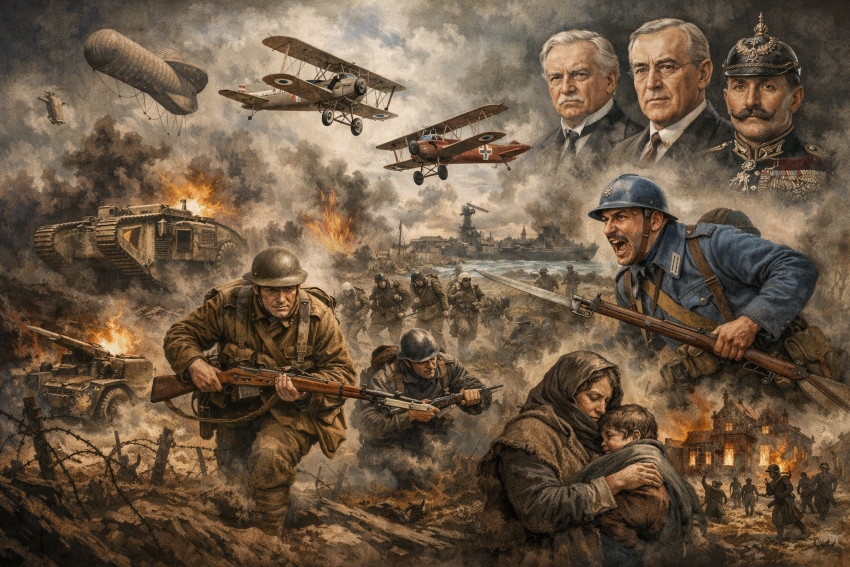
World War I’s fighting was not a single continuous “front,” but a set of interlinked campaigns across Europe, the Middle East, Africa, and the world’s oceans. Military conduct varied sharply by theater (e.g., trench systems in northern France vs. maneuver on parts of the Eastern Front), yet belligerents increasingly faced a common problem: how to translate industrial capacity—guns, shells, shipping, fuel, rail, food—into battlefield advantage over a long war.
Milestone timeline (war conduct-focused, 1914–1918)
- Autumn 1914: The Western Front largely stabilizes into trench systems and fortified zones after early maneuver campaigns.
- 22 Apr–25 May 1915: Second Battle of Ypres; the first major chlorine gas attack on the Western Front becomes a landmark in the escalation of chemical warfare.
- 25 Apr 1915–Jan 1916: Gallipoli campaign (landings and later evacuation), a major Allied amphibious effort in the Dardanelles theater.
- 31 May–1 Jun 1916: Battle of Jutland, the largest fleet action of the war.
- 21 Feb–15 Dec 1916: Battle of Verdun, a prolonged Western Front battle associated with high casualty rates and sustained artillery combat.
- 1 Jul–18 Nov 1916: Battle of the Somme; massed artillery and infantry offensives, and the first battlefield use of tanks (September 1916).
- 4 Jun–Sep 1916: Brusilov Offensive on the Eastern Front, a major Russian operation that contributed to large Austro-Hungarian losses.
- 1 Feb 1917: Germany resumes unrestricted submarine warfare; Allied countermeasures (including convoying) expand during 1917.
- 6 Apr 1917: The United States declares war on Germany, adding major manpower and industrial capacity to the Entente side over time.
- 24 Oct–19 Nov 1917: Caporetto on the Italian Front; a Central Powers breakthrough contributes to an Italian retreat and Allied reinforcement of Italy.
- 3 Mar 1918: Treaty of Brest-Litovsk removes Soviet Russia from the war with the Central Powers, reshaping the Eastern theater.
- 21 Mar 1918: German Spring Offensives begin (Operation Michael), using infiltration tactics and intensive artillery preparation.
- 8 Aug–11 Nov 1918: Hundred Days Offensive begins with Amiens and ends with the Armistice.
1) Phases and theaters of fighting
Western Front (France/Belgium): from maneuver to fortified attrition, then “combined arms”
FACTS: By late 1914, much of the Western Front had become a fortified, trench-based system in which firepower (especially artillery and machine guns) and fieldworks made rapid breakthroughs difficult. Repeated offensives often depended on artillery programs (including creeping barrages) and faced severe constraints from communications limits and the difficulty of coordinating infantry, guns, and later tanks/aircraft.
FACTS: Verdun (21 Feb–15 Dec 1916) and the Somme (1 Jul–18 Nov 1916) exemplified prolonged battles with massed artillery and sustained casualty rates; they also served as laboratories for evolving methods—counter-battery fire, barrage techniques, and later more integrated “combined arms” approaches.
INTERPRETATIONS (attributed): Many military historians describe the mid-war Western Front as a contest of industrialized firepower and endurance, where operational success was constrained as much by shell supply, transport capacity, and command-and-control as by tactical skill.
Eastern Front: larger spaces, periodic maneuver, and major offensive cycles
FACTS: The Eastern Front featured longer distances and, at times, more maneuver than the West, but it also saw positional warfare and heavy artillery engagements. The 1916 Brusilov Offensive is widely treated as one of the war’s most significant Eastern operations, with innovations in attack methods and major attrition of Austro-Hungarian forces.
Italian Front: repeated offensives and crisis at Caporetto
FACTS: The Italian Front involved repeated offensives (notably along the Isonzo) under severe terrain constraints. In late 1917, Caporetto (24 Oct–19 Nov 1917) produced a major breakthrough and retreat, after which Allied support and reorganization contributed to stabilizing the front.
Maritime war: fleets, blockade, and submarine commerce warfare
FACTS: Naval power mattered globally for trade, supply lines, and access to overseas resources. Jutland (31 May–1 Jun 1916) was the major fleet battle, but much of naval impact came from blockade and attacks on merchant shipping.
FACTS: Submarine warfare escalated over time; unrestricted submarine warfare resumed on 1 February 1917, and convoying became an increasingly important countermeasure.
Middle East, Africa, and “imperial” theaters
FACTS: Campaigns outside Europe—across Ottoman domains and in African colonies—connected military operations to imperial logistics (shipping, coaling, rail, pack transport) and to local political economies. These theaters rarely determined the war alone, but they shaped resource allocation, manpower deployments, and postwar territorial settlements (covered in Parts 4–5).
2) Strategy and operational methods: what commanders tried to do, and how it changed
Firepower-centric battle and the “problem of the breakthrough”
FACTS: On the Western Front, infantry advances were often “scheduled” to artillery plans (creeping barrages, timed lifts), reflecting the centrality of guns to suppressing defenses. However, period communications and battlefield friction made real-time adaptation difficult, and early offensives frequently stalled once artillery support moved ahead of infantry or once defenders reorganized.
FACTS: Over the war, both sides experimented with methods to restore maneuver: improved artillery calibration, counter-battery techniques, flexible small-unit tactics, and (by 1918) more mature integration of aircraft, artillery, infantry, and armor in some armies.
Infiltration tactics and 1918 offensive methods
FACTS: The 1918 German Spring Offensives began on 21 March 1918 and employed intensive artillery preparation and specially trained assault units using infiltration tactics; tactically impressive gains did not automatically translate into strategic decision.
INTERPRETATIONS (attributed): Many analyses treat 1918 as a culmination of wartime learning: tactical and operational methods advanced, but success still depended on sustaining supplies, moving guns forward, replacing losses, and coordinating across arms—often harder than achieving an initial penetration.
3) Technology that mattered: what changed battlefield possibilities
Artillery and ammunition (the core system)
FACTS: Artillery dominated many battlefields. The “shells crisis” that emerged during 1914–1915 illustrates how quickly consumption could outstrip prewar assumptions and industrial capacity, turning a battlefield constraint into an economic and political problem.
Chemical warfare
FACTS: Chemical warfare expanded during the war, with major escalation on the Western Front in 1915. The first significant gas attack at Ypres in April 1915 (chlorine) became a reference point in contemporary and later accounts; subsequent adaptation included protective equipment and evolving delivery systems.
Tanks and armored warfare (early, limited, but conceptually important)
FACTS: Tanks were developed to address trench stalemate. Early battlefield use (associated with the Somme in 1916) faced major limitations—mechanical reliability, terrain, doctrine—yet tanks signaled a pathway toward later combined-arms maneuver warfare.
Airpower: reconnaissance first, then control of the air and bombing
FACTS: Aerial reconnaissance and observation were central missions; aircraft helped locate enemy positions and adjust artillery fire. Over time, air war expanded into fighter combat (to contest reconnaissance), tactical support, and strategic bombing efforts.
Communications (wires, wireless, and the limits of control)
FACTS: Command-and-control constraints shaped operations. Wireless and other communications technologies expanded across ground, air, and sea domains by 1918, but historians still debate how decisively these changes altered outcomes relative to other factors (firepower, logistics, manpower).
Submarines and anti-submarine measures
FACTS: Submarine warfare targeted merchant shipping and thus the economic foundations of coalition war. After unrestricted submarine warfare resumed on 1 February 1917, convoying and other countermeasures expanded; the interaction of submarine pressure, neutral reactions, and coalition logistics became strategically consequential.
4) Logistics, finance, and “war economy” as war conduct
FACTS: WWI conduct cannot be separated from production and distribution systems: shells, rifles, food, coal, and shipping space. The 1915 shells crisis highlights how battlefield plans could fail—or be constrained—because procurement and industrial organization lagged behind artillery-centric tactics.
FACTS: Food supply and nutrition became operational issues, not only “home front” problems: blockade, agricultural labor shortages, transport disruption, and rationing affected civilian morale, labor productivity, and (in some cases) military readiness.
INTERPRETATIONS (attributed): Scholarship on “war economy” in 1914–1918 commonly emphasizes path dependency: states improvised new ministries, controls, and ration systems as the war lengthened, and those choices shaped both military endurance and political stability.
5) Civilian impacts during war conduct (occupation, refugees, mass violence, and disease)
Occupation regimes and coercive labor
FACTS: Large civilian populations lived under occupation, notably in Belgium and northern France. Occupation policies included requisitions, administrative restructuring, and the extraction of labor and resources for war efforts, with complex and varying local outcomes.
Refugees and displacement
FACTS: The German invasion of Belgium produced major flight. A 1914–1918 Online synthesis estimates that around 600,000 Belgian civilians settled abroad during the war (roughly 8% of Belgium’s population at the time), with additional waves of flight earlier in 1914.
Food insecurity and malnutrition
FACTS: Food and nutrition problems were widespread across belligerents, shaped by blockade, production shortfalls, and distribution failures. The historical record documents rationing regimes, black markets, and malnutrition in several countries, with substantial variation by year and region.
Mass violence in the Ottoman Empire (1915–1916) and the genocide classification dispute
FACTS: In 1915, Ottoman authorities initiated mass deportations of Armenians from many areas, and large numbers of Armenians died through killings, starvation, and exposure during deportations; death estimates vary across sources.
INTERPRETATIONS / DISPUTE (attributed): Many scholars and institutions describe these events as the Armenian Genocide, while the Turkish state has historically disputed the genocide label and frames the deaths within broader wartime suffering and civil conflict. Scholarly debates also address intent, documentation, and how to interpret decision-making within the Ottoman wartime state.
Influenza pandemic (1918–1919) overlapping with late-war mobilization
FACTS: The 1918–1919 influenza pandemic was closely connected to WWI mobilization and movement patterns; one widely cited estimate places global deaths at roughly 50 million, though exact totals and pathways remain debated across epidemiological histories.
What is well-established vs. what is disputed (Part 3)
Well-established (high confidence)
- Western Front trench stalemate from late 1914 and artillery-centric offensives as a defining feature.
- Key dates and broad character of Verdun (Feb–Dec 1916) and Somme (Jul–Nov 1916) as prolonged, high-intensity battles.
- Escalation of chemical warfare in 1915 and the landmark status of gas at Ypres.
- Resumption of unrestricted submarine warfare on 1 February 1917 and the growth of convoying thereafter.
- Major Belgian refugee flows and large-scale overseas settlement (hundreds of thousands).
Disputed / debated (medium to low confidence, depending on sub-claim)
- Verdun “intent” narratives: Some accounts emphasize Falkenhayn’s plan to “bleed” France; historians debate how premeditated that strategy was and how to interpret Falkenhayn’s documents versus later rationalizations.
- Total mortality attributable to blockade-induced malnutrition: sources differ on definitions (direct starvation vs. broader excess mortality), data quality, and attribution.
- Armenian Genocide classification disputes: broad scholarly/institutional recognition vs. state denial/dispute; debates persist over framing, intent evidence, and comparative interpretation.
- Influenza death toll and causality pathways: global totals and the degree of wartime causation vary across medical histories and datasets.
- Refugee counting methods: “fled at least temporarily” vs. “settled abroad,” and registration gaps across host countries can yield different totals.
Key Sources Used (Part 3)
- 1914–1918 Online: Western Front
- 1914–1918 Online: Military Developments of World War I
- 1914–1918 Online: Shells Crisis of 1915
- 1914–1918 Online: Gas Warfare
- 1914–1918 Online: Tanks and Tank Warfare
- 1914–1918 Online: Submarines and Submarine Warfare
- 1914–1918 Online: Refugees (Belgium) and Refugees (general)
- Imperial War Museums: Verdun, Jutland, Hundred Days
- U.S. Holocaust Memorial Museum / Britannica / 1914–1918 Online (Suny): Armenian deportations and genocide debate
- 1914–1918 Online: Influenza Pandemic
Open Questions / Uncertainties (to carry into Parts 4–5)
- How should “effectiveness” be measured across theaters: territorial gains, attrition ratios, coalition cohesion, or economic degradation?
- Which innovations were decisive versus merely adaptive (e.g., tanks in 1916–17; communications; airpower’s contribution to artillery)?
- Comparative attribution of civilian mortality: blockade effects, state capacity, and public health (including influenza) remain methodologically contested.
- How different archival traditions and political contexts shape interpretations of wartime mass violence in the Ottoman Empire.
- The relative weight of U-boat pressure vs. countermeasures vs. U.S. entry in explaining the 1917–18 maritime balance.