Part 2 — Road to War (1914): Trigger Sequence, Bargaining Failure, Mobilization, Stated Aims
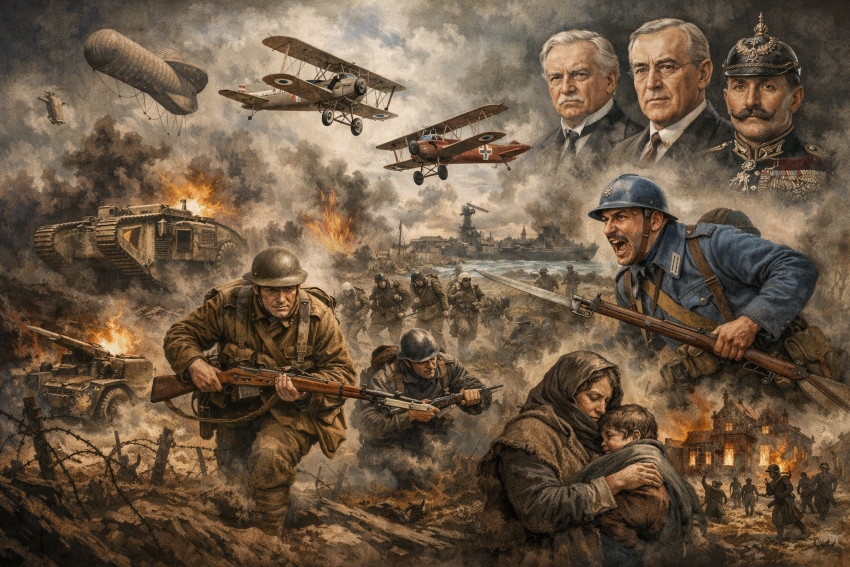
Part 2 covers the July Crisis—the five-week escalation from the assassination at Sarajevo to general European war—focusing on the trigger sequence, the breakdown of diplomacy, and the way mobilization plans and alliance expectations constrained choices.
Core premise (FACT)
The July Crisis began with the assassination of Archduke Franz Ferdinand on 28 June 1914 and culminated in Britain’s declaration of war on Germany on 4 August 1914.
Core premise (INTERPRETATION, attributed)
Annika Mombauer emphasizes that while Europe was tense, a general war was not mechanically inevitable; some leaders sought mediation “until the last moment,” while others accepted (or risked) escalation from a localized Balkan conflict into a wider war.
Timeline of key escalation milestones (FACT)
- 28 June 1914 — Franz Ferdinand and Sophie are assassinated in Sarajevo.
- 5–6 July — Austro-Hungarian emissaries consult Berlin; German leaders provide strong assurances of support (“blank cheque” in later historiography).
- 23 July (6 p.m.) — Austria-Hungary delivers a 48-hour ultimatum to Serbia.
- 25 July — Serbia replies, accepting many demands while qualifying others (notably where sovereignty/legal procedure was implicated); Austria-Hungary breaks relations shortly thereafter.
- 28 July — Austria-Hungary declares war on Serbia.
- 30 July — Russia orders general mobilization.
- 1 August — Germany declares war on Russia.
- 2 August — Germany issues a formal request to Belgium for free passage of German forces.
- 3 August — Germany declares war on France.
- 4 August — Britain enters the war after German pressure on Belgium and the Belgian neutrality issue becomes acute in British parliamentary statements.
(Other dated steps exist within each day—mediation proposals, partial mobilizations, and ultimatums—but the above captures the hinge points most relevant to “road to war.”)
1) Trigger sequence: from Sarajevo to the ultimatum
Sarajevo and attribution of responsibility (FACT)
The assassination was carried out by Bosnian Serb nationalists; post-assassination investigations revealed links to Serbian nationalist/irredentist networks (including the “Black Hand”), while distinguishing between conspirators and the formal Serbian government’s direct authorization as a separate question.
The “blank cheque” and Vienna’s choice set (FACT)
On 5 July 1914, senior Austro-Hungarian representatives met German leaders; Bethmann Hollweg assured Vienna of support for whatever measures Austria-Hungary chose against Serbia.
The ultimatum (FACT)
At 6 p.m. on 23 July, Austria-Hungary delivered a 48-hour ultimatum to Serbia. Mombauer notes it was timed to create “maximum inconvenience” for France and Russia.
The ultimatum demanded, among other measures: suppression of anti-Habsburg propaganda, dissolution of nationalist organizations, changes in education, dismissal of implicated officials, arrests of named individuals, and cooperation with Austro-Hungarian authorities in suppression and judicial inquiry.
Serbia’s reply and immediate diplomatic rupture (FACT)
Serbia’s reply accepted many points but qualified others; Mombauer summarizes that on paper Belgrade “agreed to almost all” demands, which made Vienna’s rejection appear predetermined to some contemporaries and later historians.
2) Bargaining failure: why the crisis did not stabilize
This section distinguishes constraints that are directly documented from interpretations about why bargaining collapsed.
A) Documented bargaining constraints (FACT)
Hard time limits and prestige risks. The 48-hour deadline compressed diplomacy and made “backing down” more costly in domestic and alliance terms.
Sovereignty and enforceability issues. Some demands implied intrusive oversight. Even where Serbia accepted many points, the remaining disputes were not easily “split” because implementation touched internal policing and judicial powers.
Private instruction to break relations. Mombauer reports that the Austro-Hungarian minister in Belgrade was instructed that whatever Serbia’s reaction, relations were to be broken and “it must come to war.”
Divergent preferences among Great Powers. Mombauer observes that some governments sought mediation, while “in Vienna and Berlin… there was no such desire” for another conference or mediation.
B) Competing explanations for bargaining failure (INTERPRETATION, attributed)
Interpretation 1: Germany’s “blank cheque” reduced Vienna’s incentive to compromise (Medium confidence).
William Mulligan’s overview stresses that German support was pivotal in “bolstering” Austro-Hungarian leaders toward war against Serbia, and that German leaders made assumptions about speed and containment that later proved faulty.
Interpretation 2: Leaders were managing a “risk of escalation” they believed they could control (Medium confidence).
Mombauer describes a mix of actors: some trying to avert escalation, others willing to risk it. This supports an account where decision-makers accepted danger, expecting a localized outcome or a manageable general war.
Interpretation 3: The ultimatum and response were a commitment problem—even concessions could not credibly reassure (Medium confidence).
Mombauer’s description of Serbia’s reply as largely accepting demands, alongside Vienna’s rejection and the prior instruction to break relations, is consistent with the idea that neither side believed paper concessions would reliably change behavior or security conditions.
3) Mobilization and the “timetables” problem
Russia’s general mobilization (FACT)
Russia ordered general mobilization on 30 July 1914.
Why mobilization mattered (INTERPRETATION, attributed)
The 1914-1918 Online entry on the Russian Empire emphasizes that Russian military authorities regarded partial mobilization as operationally problematic and pressed for general mobilization; Nicholas II ultimately ordered it on 30 July.
This supports a broader interpretation common in July Crisis scholarship: once general mobilizations began, leaders perceived shrinking windows for diplomacy because reversing steps risked strategic disadvantage and domestic credibility costs. (This is an interpretation of the mechanism, not a claim about any one actor’s “true motive.”)
4) From localized war to general European war: the widening logic
Declarations and operational decisions (FACT)
Austria-Hungary vs Serbia: war declared 28 July.
Germany vs Russia: Germany’s declaration of war followed on 1 August; the German declaration text frames the situation as one in which Germany “accepts the challenge” and considers itself at war with Russia.
Germany vs France: Germany declared war on 3 August; the declaration text (as preserved in document compilations) alleges hostile acts and frames war as a response to French actions.
Belgium and Britain (FACT)
On 2 August, Germany formally requested free passage through Belgium (offering assurances tied to postwar independence while threatening adverse consequences if refused).
In Parliament, Sir Edward Grey emphasized that Britain could not “bargain away” obligations tied to Belgian neutrality and reported Belgium’s intent to uphold neutrality “to the utmost of her power.”
Interdependence of decisions (INTERPRETATION, attributed; Medium confidence)
The International Encyclopedia’s July Crisis account depicts a system in which alliance coordination, expectations about who would support whom, and the sequencing of mobilization decisions created compounding pressure. In this view, diplomacy failed not simply because one offer was rejected, but because each side interpreted others’ actions through worst-case assumptions under time pressure.
5) Stated war aims at entry (with attribution and limits)
A key limitation: public war aims in early August 1914 were often framed defensively, while fuller annexation/settlement aims were debated and refined after the war began. The most reliable statements for this period come from official notes, parliamentary speeches, and early war-aims discussions summarized by specialist scholarship.
Austria-Hungary (FACT + attributed framing)
Austria-Hungary’s immediate demands are visible in the ultimatum text: suppression of anti-Habsburg activity, legal and administrative measures, and cooperation with Austro-Hungarian organs in Serbia.
On declared aims, the Austria-Hungary war-aims overview notes that in July 1914 Vienna asserted it sought no territorial gain from the war with Serbia—while internal discussions of possible acquisitions emerged thereafter.
Germany (FACT + attributed framing)
Germany’s war-aims discussion entry emphasizes that after 1 August 1914, debate over German war aims intensified; this is consistent with the observation that aims were not fully settled at the moment of entry.
Germany’s diplomatic note to Belgium on passage shows an operational aim (movement through Belgium) justified through diplomatic language and assurances.
France (INTERPRETATION, attributed)
The France war-aims overview summarizes French aims as oscillating between border security (including territorial adjustments) and placing Germany within some international framework; this reflects the evolution of aims after entry rather than a single fixed “August 1914” manifesto.
Russia (INTERPRETATION, attributed)
The Russian Empire war-aims overview portrays Russia’s entry as tied to great-power status and alliance commitments, with territorial desiderata articulated early in the war and expanding after Ottoman entry; again, this highlights evolving aims rather than a single statement at outbreak.
Great Britain (FACT + attributed framing)
The Great Britain and Ireland war-aims overview states Britain entered with aims that were “simple” at entry: restore Belgian sovereignty (linked to the 1839 treaty framework) and maintain the European balance by defending France and constraining Germany.
Grey’s parliamentary remarks underscore Belgium’s neutrality as an immediate focal point in British decision-making.
What is well-established vs what remains disputed (Part 2 focus)
Well-established (High confidence)
- The dated escalation sequence from Sarajevo through the ultimatum, declarations of war, and Belgium neutrality crisis is well documented.
- German assurances of support to Austria-Hungary on/around 5 July are supported by specialist syntheses and are central to the crisis narrative.
- Russia ordered general mobilization on 30 July.
Disputed/contested (Medium to Low confidence; framed as historiographical questions)
- Intent behind the “blank cheque”: escalation-seeking vs localization-seeking interpretations persist (Medium confidence that both were present across German leadership; Low confidence in any single “one motive” claim).
- Whether Vienna’s war decision was effectively fixed before Serbia’s reply: Mombauer reports an instruction implying war regardless of reply, but the degree of “predetermination” and its internal political drivers are debated (Medium confidence).
- The extent to which mobilization timetables made war unavoidable once triggered: widely argued, but the counterfactual “could leaders have stopped it?” remains debated (Medium confidence).
- Britain’s decision threshold: how far Belgium neutrality versus broader balance-of-power considerations determined entry is debated in emphasis (Medium confidence that both mattered).
Key Sources Used
- Annika Mombauer, “July Crisis 1914,” 1914-1918 Online (specialist synthesis; includes ultimatum timing, mediation context, and crisis dynamics).
- William Mulligan, “Germany’s Blank Cheque to Austria-Hungary,” 1914-1918 Online (historiographical framing and decision context).
- Primary texts (English translations) of the Austro-Hungarian ultimatum (23 July) and the Serbian reply (25 July), via university-hosted document PDFs.
- UK Parliamentary record (Hansard): Sir Edward Grey’s statements on Belgium and related diplomatic exchanges (3 August 1914).
- World War I Document Archive (BYU): German declaration of war on Russia; German request for free passage through Belgium (primary-document repository).
- 1914-1918 Online war-aims entries for Great Britain, France, Austria-Hungary, and Russia (context on stated and evolving aims).
- Imperial War Museums (IWM) explainer for the date sequence of declarations and entry (accessible synthesis aligned to standard chronology).
Open Questions / Uncertainties (for follow-on Parts)
- Decision calculus under uncertainty: which specific intelligence assumptions (about Russian readiness, British entry, French commitments) most shaped “go/no-go” decisions in Berlin and Vienna?
- Counterfactual mediation: which proposals (and on what dates) plausibly could have paused mobilization without collapsing alliance credibility?
- Domestic politics vs strategic planning: how strongly did leaders fear internal political consequences of compromise relative to external military risk?
- Public vs private aims divergence: to what extent were early “defensive” justifications decoupled from internal settlement thinking that emerged later in 1914?