Part 1 — Pre-War System: The Late Zhou Multi-State Order (5th–3rd century BCE)
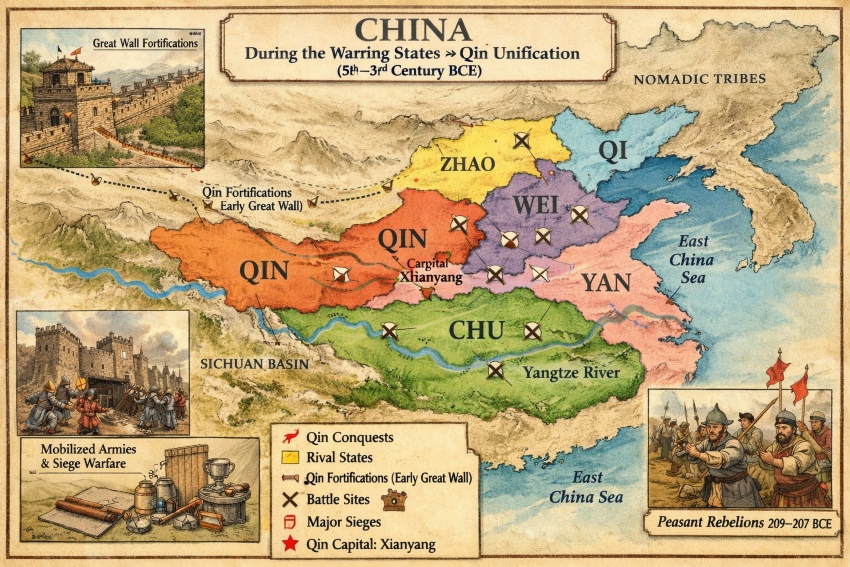
Conflict Snapshot
- Conflict label: Warring States → Qin unification
- Dates (broad): Commonly dated 475–221 BCE (with some scholarly variance on start markers).
- Type: Prolonged interstate competition and warfare among successor states within the Eastern Zhou political-cultural sphere; not a single continuous “war,” but a system-wide series of conflicts culminating in conquest and unification.
- Primary actors (late period “Seven Powers” framing): Qin, Chu, Qi, Yan, Han, Zhao, Wei (with additional smaller polities and frontier groups relevant at different moments).
- Theater: Predominantly the North China Plain and Yellow River basins, extending into the middle Yangtze and toward the southwest (Sichuan/Chongqing) and northern frontiers; administrative-geographic reconstructions commonly rely on historical GIS and dynastic geography scholarship.
- Outcome label: Qin conquest of rival states and imperial unification (221 BCE); establishment of the Qin dynasty (221–207 BCE).
- Casualties (ranges) & why they differ:
- No reliable aggregate exists for total deaths across the centuries-long period: surviving evidence is uneven, often narrative, and frequently filtered through later compilation.
- Some campaign-specific figures are large in traditional accounts (e.g., Britannica’s summary of ~50,000 killed in battle and ~400,000 surrendered troops killed in the 260 BCE catastrophe associated with Zhao’s defeat). These numbers are widely repeated but remain difficult to verify to modern demographic standards, and they may reflect genre conventions, political messaging, or transmission issues as much as measured accounting.
- Displacement: No systematic displacement totals survive; population movement and forced resettlement are discussed in later sources for specific episodes, but quantification is not robust for this period.
- Last updated: 2026-01-15
Timeline: 12 Dated Milestones (system milestones, not exhaustive)
- 453 BCE — De facto dissolution/partition dynamics of Jin accelerate the consolidation of large successor states (a common political marker for the “Warring States” system taking shape).
- 403 BCE — Leaders of Zhao, Wei, and Han partition Jin (a frequently cited consolidation point for the “Three Jins”).
- 475 BCE — Conventional start date for the Warring States period (475–221 BCE) in many modern reference works.
- 341 BCE — Wei suffers a major defeat against Qi (a signpost in shifting hegemonic capacity among eastern states).
- Mid-4th century BCE (traditional dating) — Intensification of state-building reforms (law, administration, mobilization capacity) across multiple states; Qin’s reformist trajectory becomes a key structural factor in later imbalance.
- 316 BCE — Qin conquers Ba (Sichuan/Chongqing region), expanding strategic depth and resource access in the southwest.
- 314 BCE — Qi crushes Yan (illustrative of shifting power before Qin’s late rise to dominance).
- 286 BCE — Qi annexes Song (further evidence of high-intensity interstate competition before Qin’s final sequence).
- 260 BCE — Catastrophic defeat of Zhao by Qin (often treated as a strategic turning point in later narratives).
- 256 BCE — Qin eliminates the Zhou royal house, removing residual dynastic symbolism of Eastern Zhou overlordship.
- 230–221 BCE — Qin’s final conquest sequence against rival states culminates in unification (key conquest years below).
- 221 BCE — Qin absorbs the remnants of Qi, completing unification; the Qin state becomes the Qin empire.
1) What “Pre-War System” means for this case
This conflict differs from many wars covered in modern datasets: it is best understood as a multi-century interstate system undergoing structural transformation. The “pre-war system” is therefore not a calm baseline but the institutional and strategic order that made repeated large-scale wars possible and, eventually, made conquest-based unification feasible.
A central organizing observation in modern scholarship is that the period saw the replacement of an older Zhou aristocratic order by territorial monarchies capable of extracting resources directly from households and translating that extraction into sustained military power. Mark Edward Lewis summarizes the system change as a shift from a “league of cities ruled by the Zhou nobility” to “territorial states built around unchallenged monarchs,” with officials used to “register and mobilize” peasant households—especially to impose universal military service.
2) Actors: who the system was made of
Core “great powers” (late period)
Modern summaries often highlight seven states as the principal contenders by the late Warring States: Qin, Chu, Qi, Yan, Han, Zhao, Wei.
This “seven powers” framing is a useful simplification for the endgame, but it can obscure earlier decades when other players and shifting coalitions mattered.
The Zhou royal house as a declining but symbolically significant actor (until 256 BCE)
Even as the Zhou court’s coercive capacity declined, the Zhou kings retained residual ideological and diplomatic significance in some narratives of legitimacy—until Qin’s elimination of the Zhou line in 256 BCE.
Peripheral polities and frontier pressures
“China” in this period was not a fixed political territory. Scholarship emphasizes changing borders, expansion southward/southwestward, and the importance of frontier dynamics. Lewis notes that the Zhou world was “reinvented as a geographic entity,” including expansion to the south and southwest and new patterns of mobility and status.
For modern geographic work, historians often rely on curated historical GIS resources (e.g., CHGIS) to align texts with places and administrative units over time.
3) Institutions: how states governed, extracted, and fought
From aristocratic networks to bureaucratized territorial states (FACT pattern; INTERPRETATION on pace and causality)
FACT (broad, well-supported in syntheses): Many accounts describe a secular trend toward centralized rule, formal law, and administrative subdivision. Britannica’s overview of the Qin trajectory emphasizes centralization, “a rigid system of laws,” and division into administrative units ruled by centrally appointed officials (commandery/prefecture logic), as Qin grew into a major power.
INTERPRETATION (attributed): Lewis frames the transformation as institution-building driven by systemic competition, in which rulers commanded “dependent officials” who could directly organize households for war.
Registration of households and the fiscal-military state
A distinguishing feature of the period is the effort to make households legible to the state—registered, taxed, and liable for service. Lewis explicitly links registration/mobilization to “universal military service” and the emergence of mass armies.
This matters for a “pre-war system” diagnosis because it implies that war capacity was not episodic; it could be planned, staffed, and resourced as a recurring function of government.
Intellectual labor as part of state competition (strategists, persuaders, and court factions)
Lewis also highlights the growth of specialist roles: military specialists and “theorists of stratagem and persuasion” produced by diplomatic maneuvering.
At the same time, he cautions that transmitted writings are rarely neutral institutional reporting; books often reflect the agendas of groups “defined…through loyalty to a common master,” making them pragmatic and factional.
This observation is directly relevant to evaluating claimed “aims,” “doctrines,” and “causes,” because the sources themselves are frequently participants’ arguments rather than detached chronicles.
4) Stakes: what states competed over (without assuming motives)
Survival, autonomy, and resource control (STRUCTURAL stakes)
At minimum, the stakes included survival of ruling houses, control of agricultural cores and population, and the ability to deny rivals strategic corridors (river valleys, passes, plains). The Qin state’s base in the Wei River valley is frequently noted as strategically significant in later imperial formation narratives.
Qin’s acquisition of Ba (316 BCE) illustrates that territorial acquisition could increase depth and resources, though historians differ on how directly such acquisitions translate into decisive advantage.
Claims of “unification” as an expressed objective (PRIMARY text; caution on interpretation)
A transmitted passage in the Shiji’s “Basic Annals of the First Emperor of Qin” describes Lü Buwei attracting retainers and “wishing to unify all under heaven” (欲以并天下).
Interpretive caution: This is a Han-era compilation describing earlier events, and historians debate how literally to read such phrasing as contemporaneous state policy versus retrospective framing. Scholarship on Qin historiography emphasizes that Qin history in the Shiji may incorporate systematic narrative choices and biases.
5) Constraints: why war was persistent and why bargaining failed (attributed, not assumed)
Multipolarity and shifting coalitions (FACT pattern; INTERPRETATION on mechanisms)
FACT (broad): The period features repeated wars, coalition-making, and reversals of fortune among leading states. Britannica’s state entries (e.g., Wei’s rise and later decline after a major defeat in 341 BCE) illustrate this instability.
INTERPRETATION (international-relations framing): Hui argues that the Warring States system resembles early modern Europe in being a multi-state competitive arena where systemic pressures can produce intense conflict and institutional change.
This is not a claim about what any single ruler “wanted,” but about how a competitive environment can reward states that convert resources into coercive capacity.
Information, credibility, and documentation limits
Even if some leaders preferred negotiated outcomes at particular moments, the system faced enduring constraints: uncertain information about rivals’ strength, difficulty enforcing commitments over time, and repeated incentives to revise bargains as power shifted. Those constraints are inferred by many historians and political scientists from the observed patterns of repeated conflict and alliance failure, but the underlying evidence remains largely narrative rather than archival accounting.
What is well-established vs what is disputed
Well-established (high confidence)
- The Warring States period is commonly dated 475–221 BCE in standard references, and it follows the Spring and Autumn period.
- By the late period, Qin, Chu, Qi, Yan, Han, Zhao, Wei are widely treated as principal contenders (“seven powers” shorthand).
- The era involved major state transformation toward territorial monarchies using officials to register/mobilize households and field mass armies (as synthesized by Lewis).
- Qin completed unification in 221 BCE, establishing the Qin empire/dynasty.
- Qin eliminated the Zhou royal house in 256 BCE (end of Eastern Zhou political-symbolic continuity).
Disputed / contested (medium to low confidence, depending on item)
- Exact “start date” of the Warring States: 475 BCE is conventional, but other markers (e.g., Jin partition dynamics) are also used; this is largely a periodization choice.
- Reliability of very large casualty figures for specific battles/campaigns (e.g., the 260 BCE Zhao catastrophe): figures are frequently repeated, but verification is difficult and historiographic bias is a recognized issue.
- How to interpret “unification” language in transmitted texts: whether it reflects contemporaneous strategy, later editorial framing, or both.
- Relative weight of reforms vs geography vs coalition dynamics in explaining Qin’s advantage: scholars disagree on causal primacy; many accounts synthesize multiple factors.
Key Sources Used
- Mark Edward Lewis, “Warring States Political History,” The Cambridge History of Ancient China (Cambridge University Press).
- Encyclopaedia Britannica: “Warring States (475–221 BCE).”
- Encyclopaedia Britannica: “Qin dynasty (221–207 BCE)” and related Qin state centralization summary.
- Encyclopaedia Britannica: State entries (Zhao; Wei; Qi; Ba) for specific dated claims used in the timeline.
- Oxford Academic, Oxford Handbook of Early China (chapter abstract on Warring States historical background and sources).
- Victoria Tin-bor Hui, War and State Formation in Ancient China and Early Modern Europe (excerpt emphasizing multi-state system features and the Zhou end date).
- Yuri Pines (1994), “Biases and Their Sources: Qin History in the Shiji” (Qin historiography and bias concerns).
- T. McKay (2018), “Identifying the Textual Sources of Shi ji” (methodological constraints on Shiji as a compiled text).
- Shiji (transmitted text), “Qin Shi Huang benji” passage as accessed via web edition (for expressed “unification” phrasing).
- China Historical GIS (CHGIS), Harvard Center for Geographic Analysis (for geographic/administrative reconstruction context).
Open Questions / Uncertainties
- Casualty magnitudes for major campaigns (e.g., 260 BCE events): what portion reflects record-keeping, what portion reflects later narrative conventions, and how far archaeology/demography can constrain plausible ranges.
- Timing and content of “reform packages” across states: how comparable were reforms, and how directly did they translate into battlefield performance versus administrative endurance.
- Coalition dynamics vs internal state capacity: in the final century, how much did alliance failure matter relative to Qin’s mobilization and logistics advantages (a live interpretive debate).
- “Unification” as policy vs retrospective framing in transmitted histories: how to weight Shiji language alongside excavated texts and archaeological evidence.
- Geographic reconstructions: how precise we can be about frontiers, commandery-level control, and routes for specific decades, given changing place names and administrative layers.