Part 3 — War Conduct (campaigns, methods, logistics, civilian impacts)
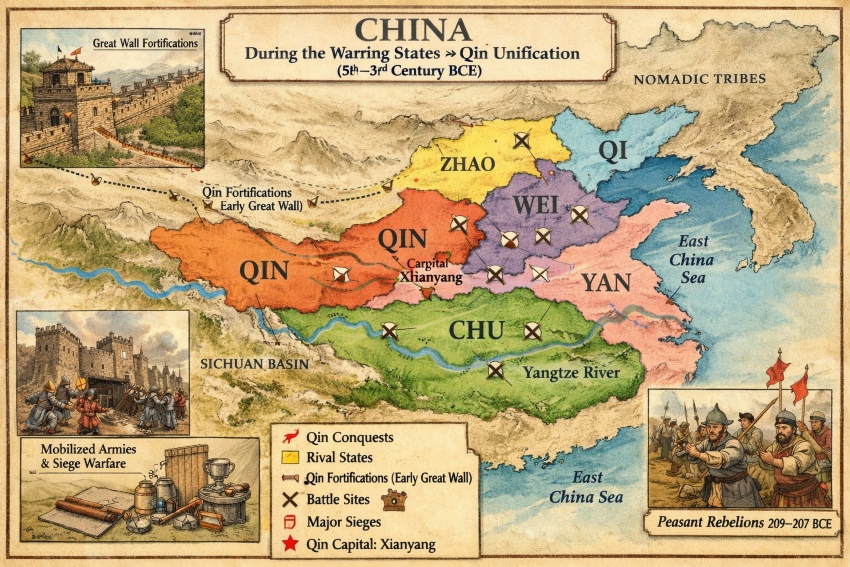
1) How war was fought in the late Warring States system
Facts (source-grounded):
- By the Warring States (Zhanguo) era, battlefield primacy had shifted toward mass infantry forces (foot soldiers), supported by cavalry, with chariots largely relegated to auxiliary roles (including command platforms).
- Major states used conscription to recruit able-bodied male citizens, while a class of professional commanders and specialized training/organization emerged to manage large formations and extended operations.
- Waterways and river-adjacent terrain could function as barriers, logistical corridors, and (when conditions allowed) offensive tools, especially in siege contexts and river-crossing operations.
Interpretations (attributed):
- Yuri Pines characterizes late Warring States warfare as operating at “large-scale” and long-distance levels (armies moving “hundreds and thousands” of kilometers), implying a mature capacity for sustained campaigning—while also stressing the documentary limits of what can be reconstructed with precision.
2) The Qin unification campaigns as a “war of sequential conquest” (230–221 BCE)
Facts (source-grounded):
- A commonly cited operational sequence for the final unification phase is: Han (230 BCE) → Zhao (229–228 BCE) → Wei (225 BCE) → major operations against Chu (mid–late 220s BCE) → Yan (227–222 BCE) → Qi (221 BCE), culminating in Qin’s political unification under King Zheng (later Qin Shihuang).
- These campaigns were not isolated field battles only; they included sieges, capitulations, and administrative absorption (annexation) of conquered territory into Qin’s expanding structure. The end of Wei as an independent state in 225 BCE is widely recognized in reference works.
Interpretations (attributed):
- The HarvardX lecture framing (a modern synthesis aimed at general audiences) emphasizes the campaigns as a coordinated, multi-year conquest program rather than a single decisive battle. That framing is consistent with the conquest chronology, but it necessarily compresses regional variation and the uneven tempo of operations.
3) Milestone timeline for “War Conduct” (230–221 BCE)
(These are operational milestones rather than a comprehensive event list.)
- 230 BCE: Qin conquest/absorption of Han.
- 229–228 BCE: Qin defeats/absorbs core Zhao territories.
- 225 BCE: Qin ends Wei as an independent state; siege warfare central to the outcome.
- 225 BCE (reported method): Daliang/Kaifeng, then Wei’s capital, is described in modern scholarship as destroyed after a three-month siege and flooded via redirected waters (Yellow River and a canal).
- Late 220s BCE: Escalation into sustained operations against Chu, often treated as the most demanding theater.
- 227–222 BCE: Qin defeat of Yan (including northern follow-on operations).
- 221 BCE: Qin conquest of Qi; political unification conventionally dated to this year.
4) Siege warfare, engineered landscapes, and “water as a weapon”
Facts (source-grounded):
- The Warring States environment featured an expanding density of fortified cities (with thicker/higher walls) and hydraulic features such as moats linked to rivers—assets for defense but also vulnerabilities to deliberate flooding.
- Technical and tactical writing associated with the period (e.g., material preserved within the Mozi siege chapters, as discussed in modern scholarship) includes “water” as an element in the siege “toolkit,” along with countermeasures (drainage channels, wells, and active disruption of enemy dikes).
- For the Wei capital Daliang (Kaifeng), an applied-archaeology study summarizes the traditional historical account: in 225 BCE the city was destroyed after a multi-month siege and was flooded by Qin through redirected river/canal waters; the siege “marked the end” of Wei’s independence and its incorporation into Qin.
Interpretations (attributed):
- W.K. Tse’s synthesis on rivers in early Chinese warfare argues that rivers served simultaneously as logistical infrastructure and, in favorable terrain, as a destructive instrument—a pattern consistent with reported “flood siege” episodes (though each episode’s details and scale still depend on the quality of transmitted accounts and later retellings).
5) Scale, manpower, and the reliability problem (why the numbers vary)
Facts (source-grounded):
- Many late Warring States narratives contain very large troop figures. A modern scholarly paper reviewing the tradition reports that the Chu campaign is sometimes associated with numbers such as 600,000 troops, while also stressing that early Chinese “numerals are hard to interpret,” that figures can be exaggerated, and that modern historians (e.g., Bodde; Lewis) treat some totals as potentially “notional.”
- Pines notes that the period’s source base is uneven: major losses of documentation and chronologies, plus later compilations, complicate confident reconstruction of exact sequences and magnitudes for many events.
Interpretations (attributed):
- A prudent reading is that relative scale (large armies, sustained mobilization, repeated campaigns) is more robustly supported than exact headcounts. Pines’ discussion of army movements over long distances strengthens the “large-scale” inference, while the same scholarship cautions against over-precision.
6) Technology that mattered: crossbows, cavalry, and standardized manufacture
Facts (source-grounded):
- Crossbows were a salient component of late Warring States/Qin-era armament. A study of Terracotta Army-associated triggers describes the crossbow trigger as a “complex and important piece” of Warring States and Qin-period military equipment and analyzes variation/standardization patterns.
- Another analysis of Qin bronze trigger mechanisms argues that observed standardization is consistent with tightly controlled manufacture (and discusses implications for production organization), though the specific archaeological sample and interpretive model are part of the scholarly debate.
- Cavalry’s growing importance—especially for northern states including Qin, Zhao, and Yan—is explicitly noted in reference syntheses of Zhanguo military change.
Interpretations (attributed):
- Archaeological weapon standardization is frequently used by historians to infer state capacity (quality control, workshop coordination, and supply reliability). The inference is plausible but should be treated as an interpretation drawn from material remains rather than a direct statement of battlefield performance.
7) Logistics and “war-making capacity”: agriculture, canals, and interior lines
Facts (source-grounded):
- Pines highlights Qin’s earlier acquisition of Sichuan (Ba and Shu) and notes resources and infrastructure relevant to sustaining state power, including metallurgical and agricultural bases (and the broader point that such assets mattered in interstate competition).
- A technical-historical survey describes the Zheng Guo Qu (Zhengguo Canal/Aqueduct) as a major water project whose construction began around 246 BCE, with substantial irrigation effects in the Guanzhong region (in later accounts, often associated with strengthening Qin’s economic base).
Interpretations (attributed):
- The International Commission on Irrigation and Drainage (ICID) explicitly frames the Zhengguo project as laying an “economic foundation” for Qin unification—an interpretive claim that aligns with a general logic (food supply and transport capacity enabling armies), though translating irrigation gains into specific military outcomes remains difficult to quantify for this period.
8) Civilian impacts (what can be said without over-claiming)
Facts (source-grounded):
- Mass conscription meant war drew directly on commoner manpower, not only aristocratic specialists, and large operations required extensive organization and training.
- Siege warfare necessarily involved urban populations. The Mozi siege material, as discussed in scholarship, includes defensive preparations that explicitly encompass noncombatant households (e.g., hostage-taking in training contexts; civic labor; water defenses).
- For Daliang/Kaifeng, scholarship summarizes destruction by siege and flooding, implying major disruption to an urban community and its built environment.
Interpretations (attributed):
- Pines’ emphasis on the era’s scale and the migration/expansion dynamics implies significant demographic and social disturbance, but the magnitude of displacement, mortality, and coercion cannot be consistently quantified from surviving sources; modern scholarship is therefore cautious about precise totals.
What is well-established vs what is disputed
Well-established (High confidence)
- Macro-conduct: late Warring States warfare relied on large infantry forces with conscription, supported by cavalry; professional command and sustained campaigning existed.
- Chronology (broad): Qin’s final conquests culminating in 221 BCE are consistently represented across syntheses (even if details vary).
- Siege relevance: fortified cities and hydraulic environments mattered; “water” appears in the siege repertoire described in period-linked materials and modern analyses.
Disputed / uncertain (Medium to Low confidence on specifics)
- Exact troop strengths in major campaigns (e.g., figures like 600,000): frequently transmitted, but often treated as uncertain or inflated; modern scholars debate interpretation of numerals and reporting conventions.
- Micro-level operational detail (timelines within campaigns, exact battle sequences, and local decision-making): constrained by source loss and later compilation issues.
- Civilian harm totals (mortality, displacement): plausible that impacts were large, but the record does not support consistent quantification across theaters.
Key Sources Used
- Encyclopaedia Britannica, “China: The rise of monarchy” (military transformation, conscription, cavalry).
- HarvardX transcript (general synthesis of the unification campaign sequence and dating).
- Yuri Pines (Oxford University Press chapter PDF excerpt), on scale, movement distances, and source limitations.
- Bevan et al., Heritage Science study of Terracotta Army crossbow triggers (complexity/importance; manufacturing signals).
- Wilkins (Antiquity), on Qin bronze crossbow trigger standardization (manufacture/organization inference).
- MDPI Remote Sensing article (historical summary of Daliang/Kaifeng’s 225 BCE siege and flooding).
- ICID note on Zhengguo Canal (project description and interpretive linkage to Qin’s economic base).
Open Questions / Uncertainties
- Troop counts and mobilization ceilings: What proportion of transmitted large numbers represent fielded combatants vs broader mobilized labor/auxiliaries? (Confidence: Low–Medium)
- Operational sequencing inside the “Chu theater”: How should we periodize Chu operations (border pressure vs decisive thrusts) given uneven chronology? (Low–Medium)
- Mechanics and scale of “flood sieges”: For cases like Daliang, what can be established about engineering feasibility, timing, and urban outcomes beyond the high-level narrative? (Medium)
- Logistics causality: How directly can we connect specific hydraulic/agricultural projects (e.g., Zhengguo) to campaign endurance and force size, as opposed to broader state capacity? (Medium)
- Weapons standardization vs battlefield performance: To what extent does archaeological standardization translate to tactical advantage (rate of fire, reliability, repairability) in the 230–221 BCE campaigns? (Medium)