Part 2 — Road to War: From Multipolar Rivalry to Qin’s Final Conquest (c. 4th century–230 BCE)
1) What counts as “Road to War” in this case
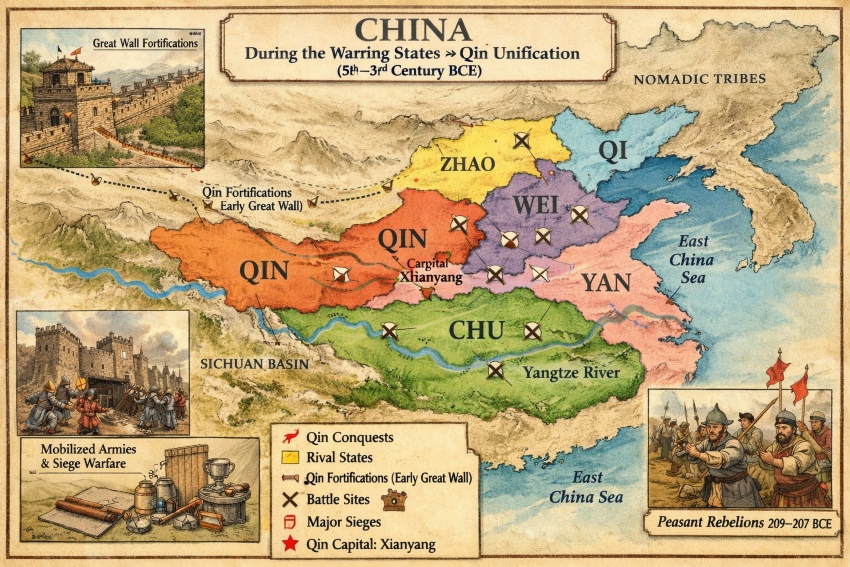
Unlike a single outbreak crisis, “war” here is best treated as a systemic escalation that culminated in Qin’s late-3rd-century conquest campaign (230–221 BCE). The “road to war” therefore spans (a) institutional capacity-building that made sustained mass war feasible, (b) diplomatic bargaining and coalition dynamics that repeatedly failed to stabilize the system, and (c) a shorter trigger sequence in which Qin’s court consolidated authority and began a systematic elimination of the remaining rival states.
2) Evidence constraints (why sequencing and intent are hard to pin down)
FACT: A core limitation for this period is the loss and unevenness of contemporaneous historical records. Pines notes that Qin’s 213 BCE order to burn certain books, coupled with earlier losses, left later historians with gaps; Sima Qian complained that what survived (notably “Qin records”) was sketchy, sometimes lacking day/month dating, and incomplete.
FACT: Pines also warns that key narrative materials used to flesh out diplomacy—especially the Zhanguo ce (Stratagems of the Warring States), compiled under Liu Xiang—contain rich vignettes but were not designed as a historical treatise, and their accuracy is often uncertain because speeches and event framing serve argumentative goals.
INTERPRETATION (attributed, medium confidence): Because late Warring States political history often relies on compiled narrative sources, modern reconstructions of “why war happened when it did” tend to rest on converging plausibility (institutions + incentives + coalition patterns) more than on archival-quality decision records.
3) Structural preconditions: how states made large-scale war sustainable
3.1 Mass mobilization and household registration
FACT: Lewis describes the Warring States transformation toward territorial monarchies staffed by dependent officials who registered and mobilized peasant households, “primarily for the sake of imposing universal military service,” enabling the fielding of mass armies and supporting specialized military and diplomatic expertise.
FACT: Pines (encyclopedia entry) details Qin-era mechanisms linking population control to mobilization: mutual-surveillance groupings and recruitment rules (e.g., one man per family filling a squad), alongside penalties for absconding. He notes that by the unification wars Qin reportedly could send up to one million soldiers to fronts, “probably including auxiliaries.”
INTERPRETATION (attributed, high confidence): Together, these accounts support a “fiscal–military” reading of the period: war capacity increasingly rested on administrative reach into households, not only aristocratic retinues.
3.2 An interstate labor market for advisers and strategists
FACT: Pines characterizes the era as one of high mobility in which ambitious statesmen crossed borders for employment, captured in the phrase “serving Qin in the morning and Chu in the evening” (朝秦暮楚).
FACT: Lewis similarly links diplomatic maneuver to “theorists of stratagem and persuasion” who formulated new models of interstate relations.
INTERPRETATION (attributed, medium confidence): This mobile adviser environment plausibly increased short-term bargaining complexity: states could access sophisticated persuasion and deception techniques, while rivals struggled to verify intentions and commitments. (This is an inference consistent with the source descriptions rather than a directly attested “cause.”)
4) System bargaining and its failures: alliances against Qin and their erosion
4.1 Anti-Qin alliances as a recurring stabilizing attempt
FACT: Pines explicitly frames a major arc of the late period as (1) the rise of Qin, (2) attempts to block it through anti-Qin alliances, and (3) the collapse of these alliances followed by accelerated Qin expansion in the 3rd century BCE.
INTERPRETATION (attributed, medium confidence): This suggests a repeated bargaining pattern: coalitions formed to balance Qin, then fractured—leaving individual states exposed to Qin pressure.
4.2 Why did alliance-based bargaining fail?
Because the sources are not meeting-minutes of negotiations, this is necessarily interpretive; below are competing explanations commonly used by historians and political scientists, stated as such.
- Credible-commitment and defection problems (system logic)
INTERPRETATION (attributed, medium confidence): Hui’s comparative approach treats the Warring States as a competitive multi-state system in which shifts in relative power and enforcement limits make bargains hard to sustain over time. - Diplomatic manipulation and inducements (court practice)
FACT (stated practice in a tertiary synthesis): Britannica’s biography of Qin Shi Huang notes Qin’s use of “espionage” and “extensive bribery” as part of how rival states were eliminated “one by one.”
INTERPRETATION (attributed, low-to-medium confidence): If bribery/espionage were systematically used, they would tend to weaken coalition cohesion and intensify mistrust—though the scale and consistency of such practices are hard to measure from surviving narratives. - Domestic political constraints within coalition partners
INTERPRETATION (attributed, medium confidence): Pines emphasizes Warring States internal bureaucratic consolidation alongside interstate dynamism; coalition choices may have been constrained by internal court factions, succession politics, and administrative priorities, not only external threats.
5) The nearer-term trigger sequence: Qin court consolidation and the pivot to systematic conquest
5.1 Qin’s political consolidation under King Zheng (future First Emperor)
FACT (Britannica): Zheng (later Qin Shi Huang) formally ascended the Qin throne in 246 BCE at age 13, with Lü Buwei heading the government until Zheng was declared of age in 238 BCE. Britannica describes Zheng’s early actions as including the execution of his mother’s lover, the exile of Lü, and the rescinding (at Li Si’s urging) of an order to expel “aliens” from Qin.
FACT (primary, Shiji as transmitted): The Shiji “Basic Annals of the First Emperor of Qin” says Lü Buwei recruited guests and roaming retainers and “wished to unify/annex All-under-Heaven” (欲以并天下). It also lists key figures (e.g., Li Si) in the Qin court orbit during the king’s youth.
INTERPRETATION (attributed, medium confidence): Read conservatively, these sources support a near-term precondition: by the late 240s–230s BCE, Qin leadership had both (a) a more consolidated central court and (b) administrative mechanisms supporting large mobilization.
5.2 The decision-problem: why shift from rivalry to a “one-by-one” elimination campaign?
Here, “motive” claims are intrinsically contestable; below are framed as competing interpretations.
- Interpretation A — Security and preemption logic (Medium confidence): Qin’s leadership may have viewed partial settlements as unstable and sought a terminal solution in a system prone to coalition recombination and renewed war. This aligns with system-logic arguments but is rarely directly stated in “we did this because…” form in surviving sources.
- Interpretation B — Ideological “tianxia” universalism (Low-to-Medium confidence as a driver): Primary phrasing about “unifying All-under-Heaven” exists in transmitted texts, but historians debate how much such language reflects contemporaneous guiding ideology versus later narrative framing around an accomplished outcome.
- Interpretation C — Opportunity from coalition collapse and rival weakness (Medium confidence): Pines’s emphasis on the collapse of anti-Qin alliances and accelerated Qin expansion in the 3rd century BCE supports a reading in which the “trigger” was less a single incident than a strategic opening.
Road-to-War Timeline (10 milestones focused on escalation toward 230 BCE)
- 453 BCE — De facto dissolution of Jin as a structural marker for the intensified multi-state order.
- 403 BCE — Formal recognition of the Three Jins (Han/Wei/Zhao), often used as a consolidation milestone.
- 4th century BCE (broad) — Expansion of household registration, mass mobilization practices, and specialized military/diplomatic expertise across states (synthesis-level).
- 260 BCE — Zhao catastrophe in the Qin–Zhao rivalry (often treated as a major strategic inflection in later narrative traditions; figures disputed).
- 256 BCE — Qin ends the Zhou royal house, removing remaining symbolic Zhou suzerainty.
- 246 BCE — Zheng ascends as King of Qin (age 13), with Lü Buwei as leading minister in Britannica’s account.
- 238 BCE — Zheng is declared of age; Britannica describes removal of Lü and reversal of an “expel aliens” order after Li Si’s memorial.
- 3rd century BCE (broad) — Anti-Qin alliances form and collapse; Qin territorial expansion accelerates (Pines’s framing).
- 231–230 BCE — Qin enters the final decade of conquest; HarvardX transcript summarizes the “one by one” eliminations beginning with Han in 230 BCE.
- 230 BCE — Campaign against Han begins the terminal sequence of interstate war leading to unification.
What is well-established vs what is disputed (Part 2 focus)
Well-established (high confidence)
- The period’s narrative record is uneven, and later reconstructions rely heavily on transmitted texts plus archaeology/paleography; Pines explicitly discusses this constraint and the unreliability risks of anecdotal sources like the Zhanguo ce.
- Warring States states increasingly built administrative capacity for mass mobilization, including household registration and large armies (Lewis; Pines).
- Anti-Qin alliance formation and subsequent collapse are a central feature of late-period interstate dynamics in modern synthesis.
- Qin’s final conquest sequence begins in 230 BCE and ends in 221 BCE (as summarized in HarvardX).
Disputed / uncertain (medium to low confidence)
- How directly “unify All-under-Heaven” language (e.g., 欲以并天下) maps to a stable, decades-long Qin policy objective versus retrospective framing.
- The causal weight of factors behind alliance collapse (bribery/espionage vs structural commitment problems vs domestic court politics). Evidence is suggestive but not decisive.
- The precise timing and mechanism by which Qin shifted from competitive rivalry to a fully systematic “one-by-one” elimination campaign; surviving sources support the sequence but thinly document deliberations.
Key Sources Used
- Yuri Pines, “The Warring States Period: Historical Background,” The Oxford Handbook of Early China (OUP, 2020 online).
- Mark Edward Lewis, “Warring States Political History,” The Cambridge History of Ancient China (Cambridge University Press).
- Yuri Pines, “China, imperial: Qin dynasty, 221–207 BCE” (encyclopedia entry; mobilization mechanisms and reported manpower).
- Shiji (Sima Qian), “Qin Shi Huang benji,” Chinese Text Project (primary transmitted text for stated aims language).
- Encyclopaedia Britannica, “Qin Shi Huang” (for dated early-reign sequence and policy episode).
- HarvardX/edX course transcript “Forging a Unified Empire: Qin” (for concise conquest-sequence dating).
- Victoria Tin-bor Hui, comparative interstate-system framing (for bargaining/commitment interpretation context).
Open Questions / Uncertainties
- Alliance mechanics: Which specific alliance episodes (and defections) can be corroborated across independent textual traditions and archaeology, versus being primarily rhetorical reconstructions?
- Decision chronology inside Qin: How much of the “pivot” to total conquest was planned centrally versus emerging opportunistically from sequential successes?
- Mobilization scale: Pines reports “up to one million” (including auxiliaries) as a tradition; how far can demography, excavated administrative texts, and logistics estimates bound plausible totals?
- Intent language: How should historians weight Shiji “unification” phrasing against the text’s known compilation challenges and possible narrative smoothing of earlier contingencies?
If you want me to proceed, Part 3 will cover War Conduct: campaign phases (especially 230–221 BCE), operational patterns, technology/logistics that mattered, and civilian impacts—while keeping numbers and causal claims tightly sourced and clearly separated from interpretation.