Part 3 — War Conduct (Phases, Strategy, Technology, Logistics/Finance, Civilian Impacts)
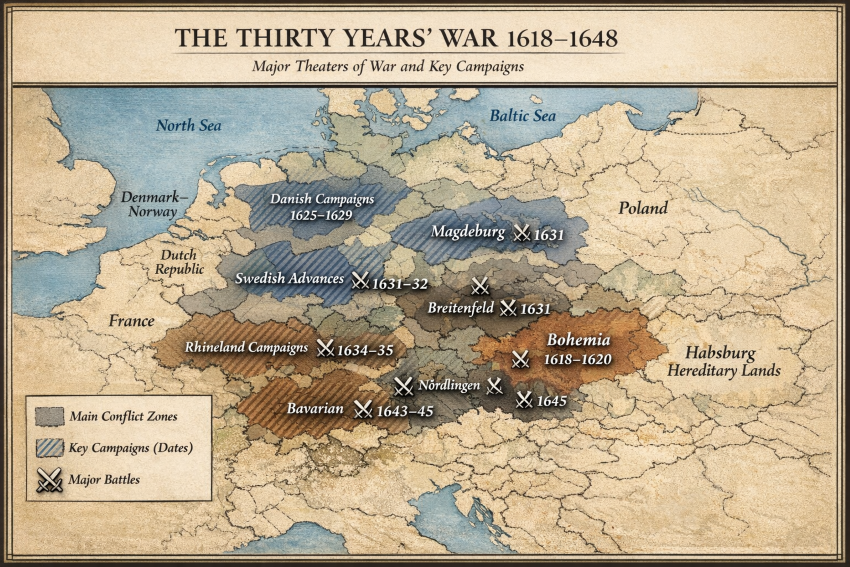
1) What “war conduct” looked like in practice
Across 1618–1648, the Thirty Years’ War was conducted less as a single continuous front and more as overlapping campaigns in which armies sought to control corridors, river crossings, and fortified towns, while managing coalition politics and fragile supply. A recurrent pattern in scholarly and reference treatments is that sieges and positional warfare absorbed much of the operational effort, even though a small number of major battles became decisive turning points.
A second defining feature was that armies frequently relied on extraction from occupied territories (requisitions, billeting, and “contributions”), which shaped where forces moved, how long they stayed, and how civilians experienced the conflict.
2) Phases and operational rhythm
Most syntheses break the war into four broad operational phases—useful here because each phase tends to correlate with a distinct coalition structure and style of campaigning:
- Bohemian–Palatinate phase (1618–1623): revolt and suppression in Bohemia; fighting spreads into the Empire and adjacent theaters.
- Danish phase (1625–1629): an externally backed intervention is defeated; imperial forces expand their reach.
- Swedish phase (1630–1635): Sweden’s intervention transforms operational tempo; major battles reshape alignments.
- Franco–Swedish phase (1635–1648): France becomes an active belligerent; campaigns widen and increasingly connect German theaters to the Franco-Spanish struggle.
This phase structure is a descriptive convenience, not a claim that contemporaries experienced the conflict as neatly segmented.
3) Strategy and operations by phase (without assuming motives)
3.1 Bohemian–Palatinate phase (1618–1623): rapid political collapse, then territorial campaigning
Facts. The Bohemian revolt’s military culmination is commonly identified as the defeat at White Mountain (8 November 1620), after which Ferdinand II reasserted authority in Bohemia.
Conduct pattern. After the decisive battle, campaigning emphasis shifted toward controlling and pacifying territory, including the movement of forces across regions that mattered for communications and alliance support. Scholarly discussions of “warfare in the age of the Thirty Years’ War” stress that control of towns and supply zones was often more consequential than the pursuit of battlefield annihilation.
3.2 Danish phase (1625–1629): mobilization scale and the problem of sustaining armies
Facts. Britannica’s conflict timeline highlights engagements such as the Battle of Dessau (25 April 1626) as part of this period’s operational arc.
Conduct pattern. The Danish phase is often used to illustrate how quickly army sizes and costs could expand—and how the attempt to maintain forces “in being” drove systematic resource extraction from occupied zones. Redlich’s classic Economic History Review article treats “contributions” as a principal financial mechanism during the war years, associating it with the ability to keep armies functioning for extended periods.
Interpretation (attributed; confidence: Medium). One defensible reading is that war aims (however framed in proclamations) were operationalized through resource control: fortresses and river lines mattered because they anchored taxation/requisition and constrained enemy movement. This is consistent with siege-centered analyses, but specific prioritization differed by commander and theater.
3.3 Swedish phase (1630–1635): mobility, coalition-building on campaign, and decisive battles
Facts. Sweden’s intervention is conventionally dated to 1630, and the period is marked by the sack of Magdeburg and major battles including Breitenfeld (17 September 1631) and Lützen (16 November 1632), followed by Nördlingen (5–6 September 1634).
Magdeburg as a civilian-impact hinge. Britannica’s dedicated entry describes the Sack of Magdeburg as involving widespread fires, looting, and mass killing of inhabitants; it gives a figure of about 20,000 killed and calls it the single greatest tragedy of the war. (The scale and mechanisms of killing are discussed by many historians; the exact numbers and causal sequence—combat, fire, massacre—remain debated in the scholarship, addressed below.)
Breitenfeld as a battlefield hinge. Britannica’s Breitenfeld entry provides a detailed loss summary (e.g., “Catholic, 7,000 dead, 6,000 surrendered… Swedish, 2,100… Saxon, 3,000”), illustrating that contemporaries and later historians treated the battle as more than a tactical episode: it materially altered the operational balance in central Germany.
Lützen and the limits of “decisive victory.” Britannica’s Lützen entry emphasizes fog, timing, and near-reversal; it captures a recurrent feature of early modern battle: outcomes could be strategically significant even when tactically ambiguous, especially when senior leaders were lost or coalitions destabilized.
Nördlingen’s coalition effect. Britannica describes Nördlingen (1634) as a crushing Habsburg victory, ending Swedish domination in southern Germany and contributing to France’s decision to become an active participant.
3.4 Franco–Swedish phase (1635–1648): multi-theater attrition and the war’s “Europeanization”
Facts. In this phase, the war’s conduct linked German theaters to major Franco-Spanish fighting. Britannica’s Rocroi entry frames Rocroi (19 May 1643) as a major French victory over a Spanish army and ties it to a broader shift in European military ascendancy (again, a strategic interpretation attached to a factual battle outcome).
In the German-Bohemian theater, Britannica’s Europe narrative notes Swedish success at Jankov/Jankau (6 March 1645), after which Swedish forces threatened Vienna.
Conduct pattern. Scholarship emphasizing siege warfare and fortified networks is especially relevant here: by the 1640s, sustaining coalition armies and holding key nodes often mattered more than chasing a single “final battle,” especially given that multiple diplomatic tracks were already developing (covered in Part 4).
4) Technology and tactics that mattered (and what is contested)
4.1 Pike-and-shot, artillery, and formations
Well-supported baseline. The war was fought largely with pike-and-shot infantry, cavalry, and artillery, with tactical systems varying by army and evolving across decades. Analyses of warfare in 1598–1648 and the broader “military revolution” debate agree that firearms and drill mattered, but they disagree on the scale and novelty of change.
Gustavus Adolphus and “innovation” as an interpretation. Many accounts attribute to Swedish forces increased emphasis on drill, coordinated fire, and more mobile artillery employment; however, scholars differ on whether these were decisive innovations, refinements of Dutch practice, or contingent advantages tied to organization and leadership. The existence of the debate is well documented in the Cambridge overview of “revolutions in warfare” and in the Helsinki University Press study of institutional change during the war.
4.2 Fortifications and the centrality of sieges
A large share of operational effort in early modern European war went into reducing fortified places and holding them against counter-siege. The “world of the siege” literature stresses how urban defenses and the limits of storming shaped campaign pace; Asch’s treatment similarly emphasizes the strategic significance of fortress systems in this period.
Interpretation (attributed; confidence: Medium). A widely used explanatory frame is that fortress networks constrained maneuver and encouraged prolonged campaigns; however, the extent to which fortifications alone drove army-size growth is debated in the “military revolution” literature.
5) Logistics and finance: how armies stayed in the field
5.1 Contributions, requisition, billeting
Redlich’s article “Contributions in the Thirty Years’ War” is frequently cited in later work as a foundational discussion of how occupying armies demanded payments in money or kind—a practice that could substitute for reliable central fiscal support and enabled sustained campaigning.
The practical implication is operational: armies gravitated toward areas where they could extract resources, and commanders faced incentives to disperse troops into quarters—spreading the war’s footprint across civilian communities. This mechanism is one reason many historians connect war conduct to famine, disease, and displacement rather than primarily to battlefield death.
5.2 From “entrepreneurial” war to more regular forces
A parallel institutional story is the gradual push—uneven and contested—toward more regularized military establishments. Mears’ Central European History article ties the Thirty Years’ War to pressures that encouraged the Habsburg monarchy toward a standing professional army, in part to reduce reliance on ad hoc levies and private military entrepreneurship. Bäckström’s 2023 peer-reviewed study likewise frames the war as accelerating institutional change (while also emphasizing limits and decline).
Interpretation (attributed; confidence: Medium). It is reasonable to treat “regularization” as a response to the war’s logistical demands, but the scholarship does not support a simple linear transition; different states and commanders combined older and newer practices throughout the conflict.
6) Civilian impacts: mortality mechanisms and emblematic episodes
6.1 Why civilians died: disease and famine more than direct combat
Recent quantitative work on early modern civilian mortality emphasizes that war-related deaths typically stemmed from interacting mechanisms: displacement, harvest disruption, price spikes, epidemic disease, and local breakdown in provisioning and sanitation. A 2022 economic-history study on early modern civilian mortality discusses the Thirty Years’ War in precisely these terms and treats mortality as driven largely by indirect effects rather than battle alone.
The ICRC’s historical-policy piece likewise highlights famine and the vulnerability of civilians in protracted conflict, using the Thirty Years’ War as an illustrative case (a humanitarian interpretation rather than a specialized demographic dataset).
6.2 High-visibility violence and its evidentiary status
Magdeburg is the best-known example because it is both heavily narrated and treated as emblematic. Britannica’s framing (“massacre… loot… fires… about 20,000 killed”) provides a strong baseline for what is widely accepted in reference literature.
At the same time, scholarly caution remains appropriate: early modern casualty figures for specific atrocities are often derived from partisan reports, later compilations, or city records damaged by the event itself. The most defensible approach is to treat the existence of large-scale killing and destruction as well established, while treating precise tallies and sequences (e.g., how many died by fire versus direct killing) as less certain unless triangulated across archival work.
What is well-established vs what is disputed (for Part 3)
Well-established (high confidence)
- The war’s conduct is commonly described in phases, with widely agreed dating for key turning points such as Breitenfeld (1631), Lützen (1632), Nördlingen (1634), Rocroi (1643), and Jankov/Jankau (1645).
- Sieges and control of fortified nodes were central to operations in many theaters, influencing campaign tempo and logistics.
- “Contributions” and related extraction practices were important components of war finance and sustainment.
- Civilian harm and mortality were often driven by indirect effects (displacement, famine, disease), not only by battle.
Disputed / interpretation-dependent (medium to low confidence)
- Whether Swedish tactical/organizational practices constitute a decisive “military revolution,” versus incremental change within broader European trends.
- The degree to which fortification systems (and siege warfare) versus other factors (state capacity, credit, coalition politics) best explain operational outcomes and army growth.
- Precise civilian death tolls for specific episodes (e.g., Magdeburg) and the relative contribution of fire, disease, and killing within single events.
Key Sources Used
- Encyclopaedia Britannica: Thirty Years’ War (overview and dated milestones).
- Encyclopaedia Britannica: Sack of Magdeburg (1630–31).
- Encyclopaedia Britannica: Battle of Breitenfeld (1631).
- Encyclopaedia Britannica: Battle of Lützen (1632); Battle of Nördlingen (1634); Battle of Rocroi (1643); Battle of Jankov/Jankau (1645).
- Fritz Redlich, “Contributions in the Thirty Years’ War,” Economic History Review (1959) (via JSTOR listings).
- John A. Mears, “Origins of a standing professional army in the Habsburg Monarchy,” Central European History (1988).
- Olli Bäckström, Military Revolution and the Thirty Years War 1618–1648 (Helsinki University Press / OAPEN).
- Ronald G. Asch, Warfare in the Age of the Thirty Years War, 1598–1648 (scholarly treatment used for siege/fortress/logistics framing).
- van Besouw et al. (2022), Estimating warfare-related civilian mortality in the early modern period (ScienceDirect).
- ICRC Humanitarian Law & Policy blog (2017), Thirty Years’ War: the first modern war? (humanitarian framing; not a demographic dataset).
Open Questions / Uncertainties
- Battle “decisiveness” versus siege accumulation: In which sub-theaters did a single battle (e.g., Breitenfeld, Nördlingen) change strategic options more than fortress capture did? (Confidence: Medium; theater-specific.)
- Civilian mortality attribution: How much of regional population loss is best attributed to epidemic cycles that would have occurred absent war, versus war-amplified transmission and famine? (Confidence: Medium-Low; method-dependent.)
- Institutional change timing: How quickly (and where) did wartime pressures translate into more regular standing forces rather than short-term entrepreneurial solutions? (Confidence: Medium; evidence varies by polity.)
- Magdeburg quantification: Can modern archival reconstructions substantially narrow casualty ranges beyond the prominent reference figures? (Confidence: Low without deeper archival synthesis.)