Part 2 — Road to War (Trigger Sequence, Bargaining Failure, Mobilization, Stated Aims)
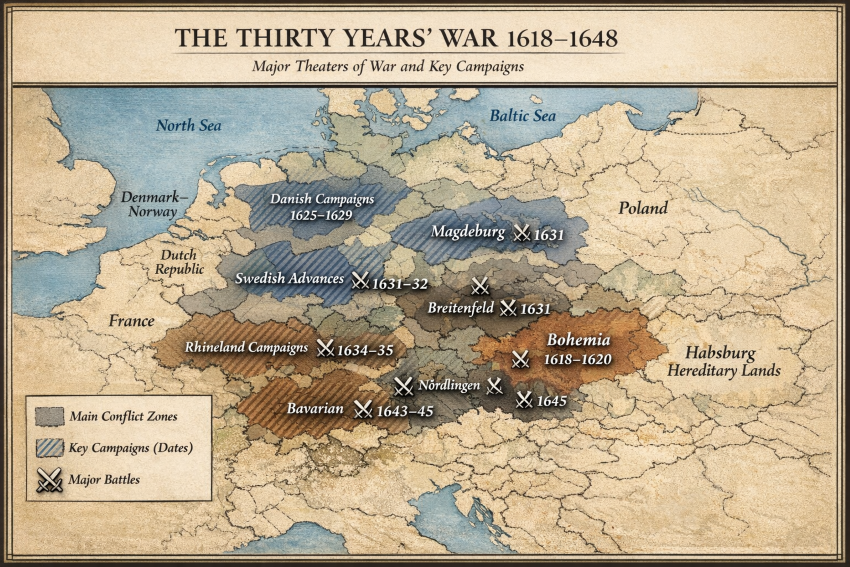
1) The pre-1618 escalation environment: why a local dispute could propagate
Factual baseline. In the decades before 1618, the Empire’s legal-confessional framework stabilized some disputes while leaving others unresolved. The Peace of Augsburg (1555) provided a durable legal basis for coexistence between Lutheranism and Catholicism in the Empire, but it did not provide for other Protestant denominations such as Calvinism, which mattered because confessional alignment did not map cleanly onto formal legal categories.
By the early 1600s, major political actors were also building organized confessional-security alignments. Britannica’s account of “Religion and politics, 1555–1618” describes how the Donauwörth incident (imperial authorization for Bavarian occupation to “protect” a Catholic minority) was read by some rulers as a warning signal, and how this was followed by the formation of the Protestant Union (1608) and the Catholic League (1609). The Protestant Union is described by Britannica as a mutual-protection alliance of Protestant German states (1608–1621). The Catholic League’s formation is similarly presented as a response to the Protestant Union, organized under Bavarian leadership.
A second pre-war stress test was the Jülich-Cleves succession crisis (1609–10). Britannica describes it as a moment when general war nearly broke out: two Protestant claimants occupied territories and were aided by the Protestant Union and foreign powers (France and England), while opposed by Spain and the emperor—an example of how a dynastic succession dispute could become militarized and internationalized.
Interpretation (attributed; confidence: Medium). A common reading consistent with these reference narratives is that, by 1618, the political system contained multiple “escalation pathways”: (i) unresolved legal-religious questions (e.g., who counted as protected under Augsburg), (ii) confessional leagues with armed capacity, and (iii) foreign patrons already linked to internal imperial disputes. This is an analytic framing of structural vulnerability rather than a claim of inevitability.
2) Bohemia’s legal baseline and the immediate credibility problem (1609–1617)
Factual baseline. In Bohemia, the pivotal legal reference point was the Letter of Majesty (1609), issued by Emperor Rudolf II for the Kingdom of Bohemia. GHDI’s editorial introduction emphasizes that the edict confirmed to recognized confessions the right to practice without coercion and situates it as a product of political struggle rather than abstract toleration. The same introduction highlights that the edict’s political context included intra-dynastic conflict (“Brothers’ Quarrel”), which shaped both its issuance and its fragility.
By 1617, Ferdinand of Styria (the future Ferdinand II) had been recognized as king of Bohemia by the Bohemian Diet, and in 1618 he was elected king of Hungary; Britannica notes these as steps in a succession sequence in the Habsburg dynastic lands.
A focal dispute then emerged over religious rights on the ground. Britannica’s Defenestration entry reports that in 1617, Roman Catholic officials in Bohemia closed Protestant chapels being constructed in Broumov and Hrob, presenting this as a violation of the religious-liberty guarantees of the Letter of Majesty.
Interpretation (attributed; confidence: Medium). In bargaining terms, this kind of dispute can function as a “credibility shock”: if one side believes written guarantees are being violated (and the other side disputes the interpretation or jurisdiction), expectations about future enforcement degrade quickly. The sources above support the existence of the legal guarantees and the triggering dispute; the bargaining-language is an analytic lens rather than a direct contemporary quote.
3) The trigger sequence: May 1618 and the Defenestration of Prague
Factual sequence. GHDI’s “War Begins” introduction states that in May 1618, Protestant and Hussite estates met in Prague to discuss what they perceived as interference by Ferdinand of Styria in Bohemian affairs, particularly confessional coexistence. In the confrontation that followed, armed retainers acting on behalf of Count Heinrich Matthias of Thurn seized two Catholic regents (Jaroslav von Martinicz and Wilhelm Slawata), accused them of plotting to subvert Bohemian religious liberty, and threw them—along with a secretary—out a window of Prague Castle.
Britannica’s Defenestration article provides complementary specifics: it notes the role of defensors appointed under the Letter of Majesty, describes the Prague assembly, and records that the regents and secretary were tried and found guilty of violating the Letter before being thrown from the castle window on 23 May 1618; it frames the incident as a signal for the beginning of a Bohemian revolt and an opening phase of the wider war.
Stated justification (primary-facing, via contemporary print culture). A key “stated aims” source is the published Apologia (1618) described by the Museum of Literature (Czech Republic). Its exhibit note reports that the Estates framed the defenestration not as rebellion against the monarch, but as punishment of officials alleged to have violated Rudolf’s “majesty” (i.e., the Letter of Majesty), particularly through the closure/demolition of the Protestant churches at Broumov and Hrob. The exhibit also states the apologia’s purpose was to gain support abroad for the Estates’ resistance and that it circulated in multiple languages.
4) From incident to insurrection: breakdown of settlement pathways (1618–1619)
Factual sequence. After the defenestration, GHDI’s introduction describes the rebellion expanding as Bohemian estates formed a provisional government, began canvassing Protestant Europe for allies, and initiated repression against Catholicism. It then marks May 1619—after the death of Emperor Matthias and Ferdinand’s succession—as deepening the crisis toward war.
Britannica’s Ferdinand II biography adds two high-impact facts for mobilization and coalition expectations:
- Ferdinand secured approval from Spanish Habsburg rulers to succeed the childless Matthias, and in a secret treaty (1617) promised to cede Alsace and imperial fiefs in Italy in return.
- After events in Bohemia, Ferdinand was elected Holy Roman emperor (28 Aug 1619), but Britannica notes he maintained himself only with support from Spain, Poland, and various German princes.
In the same Britannica biography, a critical escalation step is recorded: in 1619, the largely Protestant diet of Bohemia deposed Ferdinand as king and elected Frederick V (elector Palatine) as their king. GHDI likewise states that Ferdinand was deposed in favor of Frederick V, who accepted and was crowned King of Bohemia.
Interpretation (attributed; confidence: Medium). Reference accounts often treat the selection of Frederick V as a threshold-crossing move because it linked a Bohemian revolt to the wider imperial-electoral and confessional alliance system. This inference is supported indirectly by (i) Frederick V’s position within Protestant coalition politics and (ii) the already-militarized league environment. Britannica explicitly identifies Frederick V as director of the Protestant Union and notes his brief reign as king of Bohemia (1619–20).
5) Mobilization and coalition formation: why the conflict widened quickly
Factual baseline on coalition infrastructure. The pre-existing leagues mattered because they enabled faster alignment and resource mobilization. Britannica’s Germany narrative notes that each side organized armies and allied with foreign powers—Protestants with France and Bohemia, Catholics with Spain—describing this as the militarization and internationalization of the German struggle before 1618.
On the Bohemian side, the sources above show active outreach: GHDI reports the estates canvassed Protestant Europe for allies. On the Habsburg side, Britannica reports Ferdinand’s dependence on external and internal supporters and points to earlier preparatory diplomacy (the 1617 secret treaty with Spain).
Stated aims (carefully bounded).
- Bohemian estates (as presented in cited sources): defense of the Letter of Majesty’s guarantees; punishment of officials alleged to have violated those guarantees; seeking foreign support for resistance.
- Ferdinand / imperial authorities (what can be stated from these sources without motive inference): readiness to use force to reassert authority is stated in Britannica’s Germany narrative (“Ferdinand now prepared military action”), and his broader confessional policy orientation is described in Britannica’s Ferdinand II biography (suppression of Protestantism in his hereditary lands).
Note: These sources support policy direction and action, but they do not, by themselves, settle debates about whether the primary driver was confessional uniformity, dynastic authority, constitutional order, or strategic calculation.
6) The early war outcome that locked in escalation: White Mountain (1620) as a hinge
Factual sequence. Both Britannica and GHDI treat White Mountain (8 Nov 1620) as the decisive turning point of the Bohemian revolt’s initial phase. Britannica’s Battle of White Mountain entry describes it as the first major victory of Catholic Habsburg forces over the Protestant Union-aligned side in the war’s early stage. GHDI’s Defenestration introduction likewise states that after indecisive operations, the Imperial and Catholic League armies crushed rebel forces at White Mountain on 8 November 1620, presenting it as the first battle of what came to be known as the Thirty Years’ War.
Britannica’s Bohemia/Czechoslovak-history related entries summarize the immediate result as Ferdinand II’s reassertion of control over Bohemia following the defeat and the flight of Frederick and leading advisers.
Interpretation (attributed; confidence: Medium). In many syntheses, White Mountain is treated less as “termination” of the conflict than as a “lock-in” event: a failed revolt followed by punitive and constitutional reordering measures can broaden the conflict by creating new grievances, refugee flows, and claims to restitution—though the full development of those dynamics belongs primarily to Parts 3–4. The cited sources support the battle’s decisiveness and the collapse of the revolt; downstream consequences will be handled with tighter evidence in later parts.
What is well-established vs what is disputed (for Part 2)
Well-established (high confidence)
- The Letter of Majesty (1609) was a major legal reference point for Bohemian religious rights in pre-war politics.
- The immediate trigger sequence includes chapel closures (1617) cited as violating the Letter and the Defenestration of Prague (23 May 1618), followed by estate mobilization.
- The escalation path includes Matthias’s death, Ferdinand’s imperial election (Aug 1619), the Bohemian deposition of Ferdinand, and the election of Frederick V as king of Bohemia (1619–20).
- The Bohemian phase culminates in the defeat at White Mountain (8 Nov 1620) and Ferdinand’s reassertion of authority in Bohemia.
Disputed / method-dependent (medium to low confidence)
- The relative weight of confessional security versus constitutional/estate privilege versus dynastic-geopolitical bargaining as the dominant “reason” actors escalated. (Most credible accounts treat these as interacting drivers, but weighting varies by author.)
- How representative the estates’ published Apologia was of the full coalition (versus a strategic international messaging document).
- The extent to which pre-1618 league formation should be seen as deterrence, preparation, or signaling (this is an interpretive dispute more than a factual one).
Key Sources Used
- GHDI — The Bohemian Religious Peace / Letter of Majesty (1609) (editorial intro and document context).
- GHDI — The War Begins: Defenestration of Prague (May 1618) (editorial narrative of sequence and early escalation).
- Encyclopaedia Britannica — Defenestration of Prague (1618) (chapel closures; defensors; event framing).
- Encyclopaedia Britannica — Ferdinand II (succession sequence; secret treaty with Spain; imperial election; deposition; early consolidation).
- Encyclopaedia Britannica — Germany: Religion and politics, 1555–1618 (Donauwörth; leagues; Jülich-Cleves; internationalization).
- Encyclopaedia Britannica — Protestant Union; Catholic League; Peace of Augsburg (league characterization; Augsburg’s scope limits).
- Museum of Literature (Czech Republic) — Apologia (1618) (stated justification; international messaging purpose).
- Encyclopaedia Britannica — Battle of White Mountain; Frederick V (hinge event; Frederick’s roles).
Open Questions / Uncertainties
- Scope of “rights” contested in 1617–18: To what extent did actors dispute the interpretation of the Letter of Majesty versus the jurisdiction to enforce it? (Confidence: Medium; requires closer reading of primary legal arguments.)
- Coalition decision-making inside the Bohemian estates: How unified were the estates’ goals, and how did internal bargaining shape the move from protest to deposition? (Confidence: Medium-Low; coalition heterogeneity likely.)
- Role of external patrons as commitment devices: How decisive was Ferdinand’s prior arrangement with Spain (1617) for his willingness to escalate, versus being one factor among many? (Confidence: Medium; strong fact basis for the treaty, weaker for behavioral inference.)
- Meaning of “internationalization” before 1618: Were the leagues primarily defensive or preparatory for coercion? (Confidence: Low; interpretive dispute.)
- Messaging vs intent in the Apologia: To what degree should the Estates’ published framing be treated as a sincere constitutional claim versus strategic external communication? (Confidence: Low–Medium.)