Vietnam War — Part 1: Pre-War System (Actors, Institutions, Stakes, Constraints)
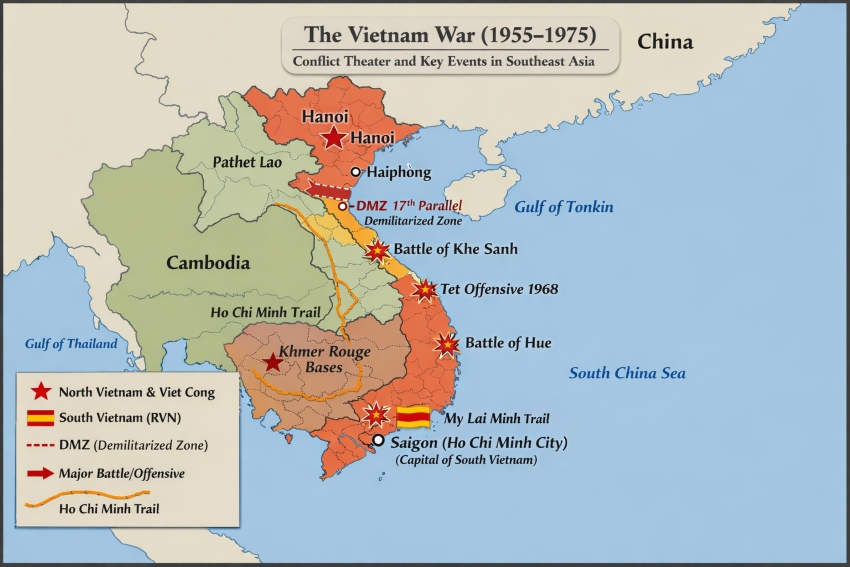
Conflict Snapshot
- Dates (common framing): 1955–1975 (some datasets and studies begin earlier; see “Disputed / Uncertain”).
- Type: Intrastate conflict with major external interventions (“internationalized intrastate” in common conflict-data typologies).
- Primary actors (Vietnam):
- North: Democratic Republic of Vietnam (DRV) and its armed forces (People’s Army of Vietnam).
- South: State of Vietnam (to 1955) / Republic of Vietnam (RVN, from 1955) and armed forces (ARVN).
- Southern communist insurgency: National Liberation Front (NLF, formed 1960) and related forces (“Viet Cong” in common U.S. usage).
- Major external actors (non-exhaustive): United States (large-scale military role from mid-1960s), plus broader Cold War alignments and regional involvement across Indochina.
- Theater: Vietnam; significant spillover and related operations in Laos and Cambodia; maritime/air dimensions in the region.
- Outcome label (1975): RVN collapsed after a North Vietnamese offensive; Saigon fell on April 30, 1975.
Casualty ranges (why they differ):
- U.S. military deaths: 58,220 (official U.S. fatality statistic commonly cited by the U.S. National Archives).
- Vietnamese and other deaths (illustrative ranges):
- A widely cited set of “official estimates (1995)” summarized by Britannica gives roughly 2,000,000 civilian deaths, ~1,100,000 North Vietnamese/Viet Cong combatant deaths, and ~200,000–250,000 South Vietnamese military deaths.
- A very different methodological approach using retrospective survey data (World Health Survey sibling histories) estimated ~3.8 million “violent war deaths” in Vietnam over 1955–2002 (not limited to 1955–1975).
- Why estimates diverge (range logic): definitions vary (battle deaths vs broader “war deaths”); coverage varies (Vietnam only vs Indochina spillover); and time windows differ (e.g., 1955–1975 vs 1955–2002).
Displacement / population movements (selected, well-documented episodes):
- 1954–1955 partition-related movement: a U.S. Navy historical account summarizes ~600,000 to 1,000,000 people moving from North to South, and ~14,000 to 45,000 civilians moving South to North, plus ~100,000 Viet Minh fighters regrouping to the North; it also notes a 300-day movement window tied to the Geneva settlement and U.S. Navy transport of ~310,000 people.
- Post-1975 regional refugee crisis: later scholarship and historical reporting often describes millions of Indochinese refugees resettled over subsequent decades; one university-based account summarizes “almost 3 million Indochinese” resettled through international cooperation.
Last updated: January 17, 2026 (Europe/Stockholm)
Timeline (milestones for orientation; 12 items)
- May 7, 1954 — French defeat at Dien Bien Phu accelerates end of the First Indochina War.
- July 20–22, 1954 — Geneva settlement / armistice framework: ceasefire schedules, regroupment, and international supervision are established; provisions reference national elections as a path to unification.
- 1954–1955 — Large partition-linked population movements (“Operation Passage to Freedom” in U.S. Navy usage).
- September 1954 — SEATO is formed; Geneva terms are commonly described as limiting Vietnam/Laos/Cambodia from joining military alliances, while SEATO defines a “protected area.”
- October 23–26, 1955 — Diem–Bao Dai referendum (Oct 23) and proclamation of a Republic (Oct 26) in the South (per FRUS diplomatic reporting).
- 1959 — U.S. State Department historical summary describes a “large scale insurgency” in the South beginning in this period.
- December 20, 1960 — Formation of the National Liberation Front (NLF).
- August 7, 1964 — U.S. Congress passes the Gulf of Tonkin Resolution.
- February 13, 1965 — Operation Rolling Thunder begins (per U.S. State Department historical summary), alongside deployments of regular U.S. ground combat troops.
- Late January 1968 — Tet Offensive begins (initial phase Jan 30–31 noted in U.S. State Department summary).
- January 27, 1973 — Paris Peace Agreement is signed; U.S. State Department summary describes the signature on this date after January negotiations.
- April 30, 1975 — Fall of Saigon (noted in U.S. State Department summary).
Pre-War System (the “starting conditions”)
1) The inherited structure: decolonization war → partitioned authority
FACTS: The Vietnam War’s core political geometry emerged from the end of the First Indochina War and the Geneva settlement of 1954. A U.S. State Department historical overview describes the Geneva Conference as producing a division of Vietnam into separate northern and southern zones and scheduling elections intended to reunify the country.
The 1954 ceasefire agreement (as reproduced in the U.S. government’s Foreign Relations of the United States series) set out a provisional military demarcation line and a demilitarized zone, specified regroupment zones, and created a Joint Commission plus an International Commission to supervise implementation. The International Commission’s membership is listed as Canada, India, and Poland, with India presiding.
The same reproduced agreement explicitly links the interim military arrangement to a political endpoint by referencing general elections to bring about “unification of Viet-Nam,” and it includes provisions aimed at limiting escalation (e.g., prohibitions on introducing reinforcements and restrictions on foreign bases and alliance adherence in the regrouping zones).
Interpretation (attributed): Many historical summaries treat this as an “armistice-plus-elections” design that created two rival state projects inside a single internationally contested national framework. That framing is implicit in how U.S. State Department summaries present the sequencing (division + planned reunification elections) and in how later U.S. explanations connected regional security institutions (e.g., SEATO) to Vietnam.
2) Two state projects, each claiming national legitimacy
FACTS: By the mid-1950s, the system consisted of two governing centers: the DRV in the North and the State of Vietnam / Republic of Vietnam in the South. A U.S. diplomatic report in FRUS details the October 23, 1955 referendum (Diem vs Bao Dai) and notes that Diem proclaimed “the state of Vietnam to be a republic” on October 26, 1955.
The Geneva-era demarcation was explicitly provisional and operational: it delineated controlled zones and administrative transfers (including Hanoi and Haiphong to DRV authority on specified schedules) rather than establishing a permanent international border.
SYSTEM CONSEQUENCE: This produced a durable structural condition: competing claims to represent “Vietnam” as a whole, while the security environment incentivized each side to treat the other’s consolidation as a threat. This is a system constraint rather than a motive claim: when sovereignty is contested and elections/border legitimacy are unresolved, internal opposition and external support channels tend to become strategically salient.
3) Institutions meant to “freeze” the conflict—and why they struggled
FACTS: The Geneva framework created monitoring bodies (Joint Commission and International Commission) with inspection teams at specified locations and mandates to supervise ceasefire implementation, movements, and restrictions on forces and matériel.
At the same time, the regional security architecture changed quickly. In September 1954, the United States and seven other states formed SEATO. A U.S. State Department summary notes that the Geneva terms prevented Vietnam, Laos, and Cambodia from joining alliances, yet these territories were included within the area SEATO claimed to protect.
Interpretation (attributed, limited): U.S. government historical summaries portray SEATO as part of the U.S. Cold War “containment” rationale, and they explicitly connect SEATO’s charter to later U.S. arguments for involvement in Vietnam. These are descriptions of U.S. rationale as presented by U.S. sources, not an independent judgment of legality or necessity.
4) Early mass politics and demographic shocks as “war-shaping” constraints
FACTS: The 1954–1955 transition triggered major population movements. A U.S. Navy historical account states that 600,000 to one million northerners moved south, while 14,000–45,000 civilians and ~100,000 Viet Minh fighters moved north; it also links these movements to a 300-day window for relocation (ending May 18, 1955 in that account) and reports U.S. Navy transport of ~310,000 people.
SYSTEM CONSEQUENCE: Large refugee flows can reshape local political coalitions, labor markets, land disputes, and recruitment pools. This is not a claim about intent; it is a general, well-established mechanism in civil-war scholarship. In Vietnam’s case, the documented scale of movement alone indicates that both states began with meaningful demographic and administrative shocks to manage.
5) The insurgency problem as a structural feature, not an “event”
FACTS: Even before the war’s high-intensity U.S. phase, U.S. State Department summaries describe a growing communist guerrilla challenge in the South and label 1959 as the start of “a large scale insurgency.”
By December 1960, the NLF existed as an organized front.
Interpretation (carefully bounded): Competing narratives persist regarding (a) how autonomous southern insurgent politics were from Hanoi and (b) how decisive external direction vs local grievances were in early mobilization. Those debates are handled explicitly in the “Disputed / Uncertain” list below; for Part 1, the system-level point is simpler: the South faced a persistent internal security and legitimacy challenge, while the North faced the problem of building a state under the constraints of an armistice and international monitoring regime.
6) Stated aims (later articulated) and the pledge/commitment problem
FACTS (stated aims, with attribution): In April 1965, President Lyndon B. Johnson publicly stated, “Our objective is the independence of South Viet-Nam, and its freedom from attack… only that the people of South Viet-Nam be allowed to guide their own country in their own way.”
Other summaries (e.g., Britannica) present the North’s objective in terms of reunifying Vietnam under its political system. This is presented here as Britannica’s characterization rather than as an inferred motive.
SYSTEM CONSEQUENCE: Once external commitments were made and publicly reiterated, they created a “pledge” dynamic: leaders faced reputational and alliance-credibility arguments about staying vs leaving, regardless of battlefield conditions. This is not unique to Vietnam; it is a general feature of alliance politics and crisis bargaining. In Vietnam, the existence of SEATO and repeated U.S. statements of support (as referenced in U.S. sources) formed part of that structural environment.
What is well-established vs what is disputed
Well-established (high confidence)
- The 1954 Geneva framework created a provisional demarcation and international supervision, and referenced elections as a route to unification.
- The International Commission for supervision in Vietnam was composed of Canada, India, and Poland, chaired by India’s representative.
- Major 1954–1955 population movements occurred at very large scale.
- The NLF was formed in 1960.
- The Gulf of Tonkin Resolution passed on August 7, 1964, and was used as a U.S. legal basis for escalation.
Disputed / debated (handled with care in Parts 2–3)
- Whether the conflict should be dated 1954/1955/1959 depending on criteria (armistice collapse vs insurgency onset vs major externalization).
- The degree of NLF autonomy vs direction by Hanoi (varies by historian and by phase).
- Counterfactual claims about 1956 elections (likelihood of outcomes; feasibility; whether they could have been credibly administered).
- Legal and political interpretations of SEATO’s relevance to intervention (U.S. sources emphasize it; others contest scope).
- Total death tolls and attribution (definitions, methods, and time windows produce wide ranges).
Key Sources Used (Part 1)
- FRUS (U.S. State Department), “Agreement on the Cessation of Hostilities in Viet-Nam” (1954 text reproduction): demarcation, supervision mechanisms, restrictions, and timing.
- FRUS, “The Diem–Bao Dai Referendum” (1955 diplomatic dispatch): dates and contemporaneous U.S. diplomatic observations about the referendum and republic proclamation.
- U.S. State Department, Office of the Historian (Milestones pages): structured summaries for Geneva/Dien Bien Phu context, SEATO, Tonkin Resolution, Tet, and war termination timeline. (Note: “Milestones” is marked as retired/not maintained, but remains a citable U.S. government summary.)
- U.S. National Archives: U.S. fatal casualty statistic (58,220).
- Miller Center / American Presidency Project (Johnson speech transcript, April 7, 1965): stated U.S. objective (as declared publicly).
- Encyclopaedia Britannica: consolidated overview and commonly cited Vietnamese casualty ranges.
- BMJ / PubMed (Obermeyer, Murray, Gakidou, 2008): alternative survey-based estimate of “violent war deaths” and methodological contrast with passive reporting.
- U.S. DoD (.mil) historical article on Operation Passage to Freedom: quantified 1954–1955 migration.
- UCDP Armed Conflict Dataset Codebook: definition framework for classifying conflict type and externalization.
Open Questions / Uncertainties (carried forward to Part 2)
- What is the most defensible start date for the “Vietnam War” for this series (1954 vs 1955 vs 1959), depending on whether we prioritize political settlement breakdown, insurgency scale, or external intervention thresholds?
- How should we partition responsibility for violence in early years without collapsing distinct dynamics (local political conflict, state repression, insurgent campaigns, and external supply)? (Evidence exists, but attribution is contested.)
- How to present 1956 election claims neutrally: what is documented about intended procedures, and what remains speculative about feasibility and outcome?
- What casualty framework should anchor the series: a Vietnam-only 1955–1975 accounting, or a broader Indochina-wide and/or 1955–2002 lens (and how to keep those analytically distinct)?
- How to quantify and date displacement consistently (1954–55 internal migration vs wartime internal displacement vs post-1975 refugee outflows), given uneven open-access UN documentation in this workspace.