Part 4 — Termination (Negotiations, Settlement Terms, Enforcement, Victory Criteria vs Results)
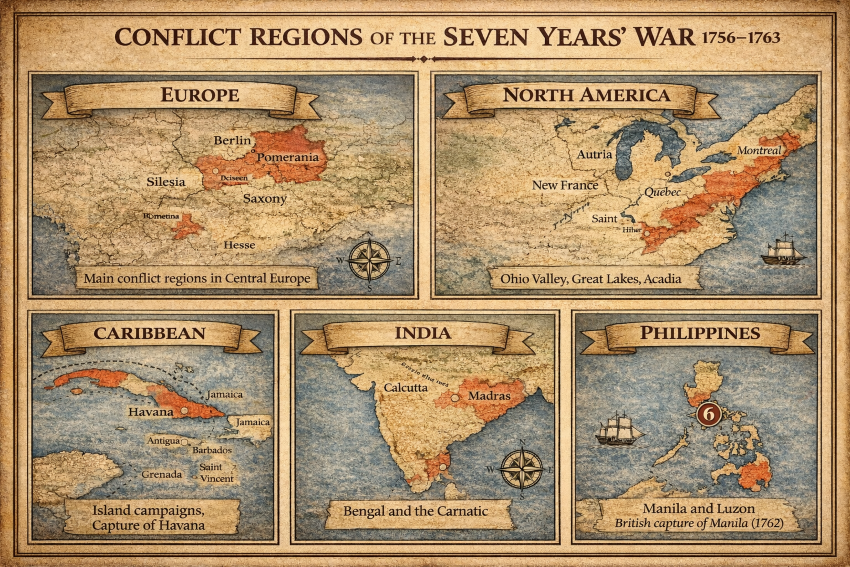
Framing the endgame: why “termination” looked like two peace processes
FACT: The Seven Years’ War ended through two definitive peace treaties signed five days apart in February 1763: (1) the Treaty of Paris (10 Feb 1763) among Great Britain, France, Spain (with Portugal expressly understood to be included), and (2) the Treaty of Hubertusburg (15 Feb 1763) among Austria, Prussia, and Saxony.
FACT: The war’s termination sequence accelerated after a set of strategic discontinuities in 1762, notably Russia’s policy reversal toward Prussia following the death of Empress Elizabeth (5 Jan 1762), Prussia–Russia peace (5 May 1762), Prussia–Sweden peace (Treaty of Hamburg, 22 May 1762), and the Austro–Prussian armistice (24 Nov 1762).
INTERPRETATION (attributed): Encyclopaedia Britannica frames these changes as reducing Austria’s expected gains from continuing the war, while also reducing Britain’s incentives to keep subsidizing Prussia once a global settlement with France and Spain became attainable. This is an interpretive causal chain rather than a single “motive.”
Milestone timeline for termination (1762–1764)
- 5 Jan 1762 — Empress Elizabeth of Russia dies; Peter III succeeds.
- 5 May 1762 — Russia makes peace with Prussia (Treaty of St. Petersburg).
- 22 May 1762 — Prussia and Sweden conclude the Treaty of Hamburg (via Russian mediation).
- 13 Aug 1762 — Britain captures Havana.
- 5 Oct 1762 — Britain captures Manila.
- 3 Nov 1762 — Britain and France sign preliminaries of peace at Fontainebleau.
- 24 Nov 1762 — Austria and Prussia sign an armistice.
- 31 Dec 1762 — Negotiations begin at Hubertusburg.
- 10 Feb 1763 — Treaty of Paris is concluded.
- 15 Feb 1763 — Treaty of Hubertusburg is signed.
- Spring–Summer 1763 — Treaty schedules require phased evacuations, prisoner releases, and archive transfers after ratification and exchange of ratifications.
- April 1764 — British occupation of Manila ends months after the treaty dates, reflecting communication delays and implementation frictions in distant theaters.
1) Negotiation tracks and bargaining structure
A. The Paris track (Britain–France–Spain–Portugal): “imperial exchange”
FACT: The Treaty of Paris explicitly builds on preliminaries signed at Fontainebleau in early November 1762, formalizing a global bargain covering North America, the Caribbean, West Africa, India, and European possessions.
FACT: The treaty’s architecture is largely “exchange-based”: some territories are ceded “in full right,” others are restored, and a general restitution clause covers conquests not otherwise specified.
INTERPRETATION (attributed): A Cambridge University Press chapter by Fred Anderson emphasizes that contemporaries viewed the Peace of Paris as diplomatically major because it moved unprecedented amounts of territory among empires, even if later diplomatic historiography treated it as less system-transforming than Westphalia or Vienna.
B. The Hubertusburg track (Prussia–Austria–Saxony): “continental status quo”
FACT: Negotiations opened at Hubertusburg on 31 Dec 1762, and the treaty was signed 15 Feb 1763.
FACT: Britannica summarizes the settlement as restoring the status quo of 1748, with Silesia and Glatz reverting to Prussia and Saxony to its elector; Austria obtained essentially no territorial revision in its favor.
2) Settlement terms: what each treaty actually did
A. Treaty of Paris (10 Feb 1763): key provisions (selected)
North America (France–Britain; Spain–Britain):
- FACT: France renounced to Britain its mainland North American holdings east of the Mississippi, with the treaty defining the boundary along the river’s midline and explicitly addressing navigation.
- FACT: The treaty text states that New Orleans and the island on which it sits would “remain to France,” while Britain received French possessions on the left (eastern) side of the Mississippi (with detailed boundary language).
- FACT: Spain ceded Florida (including St. Augustine and Pensacola) to Britain.
Caribbean and Atlantic islands:
- FACT: The treaty ceded Grenada and the Grenadines to Britain and fixed the partition of certain “neutral” islands so that St. Vincent, Dominica, and Tobago remained British while St. Lucia was delivered to France.
- FACT: Britain restored to France several Caribbean islands (including Guadeloupe and Martinique) and returned St. Pierre and Miquelon under restrictions (not to be fortified; limited guard).
West Africa:
- FACT: Britain restored Gorée to France; France ceded the Senegal River with specified forts/factories to Britain.
India / East Indies:
- FACT: Britain restored French factories as held at the beginning of 1749, and France renounced post-1749 acquisitions on specified Indian coasts; the treaty also includes restraints connected to Bengal (not to fortify or keep troops in certain contexts).
Europe (selected):
- FACT: Minorca was restored to Britain.
- FACT: France agreed to restore several German territories (Hanover, Hesse, Brunswick, etc.) held during the war.
Prisoners, archives, and “oblivion” clauses:
- FACT: The treaty mandated release/return of prisoners and hostages without ransom on a defined schedule after exchange of ratifications, and required transfer of archives and official papers tied to restored/ceded territories within set deadlines.
General restitution:
- FACT: Conquests “not included” under cessions or restitutions were to be restored without compensation—an important clause for remote theaters where news traveled slowly.
B. Treaty of Hubertusburg (15 Feb 1763): core effect (as summarized in reference works)
FACT: Britannica’s account emphasizes that Hubertusburg did not redraw the map: it restored the prewar territorial situation (status quo of 1748), leaving Prussia in possession of Silesia and Glatz and restoring Saxony to its elector, while also noting Prussia’s consent to Joseph’s election as Holy Roman Emperor as a concession.
3) Enforcement and implementation: how peace became real (and where it did not)
A. Built-in implementation mechanisms
FACT: The Treaty of Paris provides a procedural backbone: exchange of ratifications, set time windows for prisoner releases, and deadlines for evacuation of conquests, as well as archive transfers tied to administrative continuity.
FACT: In the Havana/Florida exchange, the treaty granted 18 months for British subjects in Cuba to liquidate property and depart (with explicit anti-smuggling safeguards), and similarly granted Spanish inhabitants in ceded Florida a period to emigrate and sell property.
B. “Distance” as an enforcement variable: Manila as a case study
FACT: Britain captured Manila in October 1762, but the British presence lasted into April 1764 (per a modern scholarly article hosted by CSIC’s journal platform), illustrating how command-and-control and communications lag could delay implementation even after formal treaty signatures.
FACT: The Treaty of Paris’s general restitution clause (“conquests not included”) created a legal basis to return places not specifically itemized, a category that mattered when negotiators were not always working with synchronized information about late-war captures.
C. Administrative enforcement after the treaty: the British North American settlement line
FACT: In October 1763, Britain issued the Royal Proclamation of 1763, an instrument often treated as part of the postwar governance package for newly acquired or reorganized territories in North America.
INTERPRETATION (contextual): While the Proclamation belongs analytically to “aftermath,” it also functions as an enforcement/administrative layer translating treaty transfers into colonial governance, boundary administration, and regulation.
D. Louisiana’s transfer problem: treaty text vs subsequent arrangements
FACT (treaty text): The Treaty of Paris language provides for New Orleans to “remain to France” while Britain acquires French holdings on the left bank of the Mississippi.
FACT (secondary reference): Britannica states that Spain “received Louisiana, including New Orleans, in compensation from the French.”
FACT (institutional history): The U.S. Library of Congress’s historical essay describes a secret Treaty of Fontainebleau (Nov 1762) by which France handed Louisiana to Spain.
INTERPRETATION: Taken together, these sources indicate that “termination” operated through multiple legal instruments and staged disclosures, rather than a single, fully transparent public settlement. The degree to which various governments and colonial stakeholders understood the full package at each step remains a recurring topic in the historiography.
4) Victory criteria vs results (as outcomes, not moral judgments)
Below, “criteria” are framed as stated or widely recognized strategic objectives discussed in Parts 1–3 (and in contemporary diplomacy), while “results” are the treaty outcomes and enforceable transfers.
Great Britain
- Criteria (broadly evidenced in diplomacy): secure maritime/colonial gains and weaken French imperial position.
- Results (FACT): Britain acquired major North American claims east of the Mississippi from France (with defined boundary language), gained Florida from Spain, retained/received several Caribbean and Atlantic positions, recovered Minorca, and obtained Senegal’s river system while returning some sugar islands to France.
- Constraint (FACT): Britain also undertook restorations and restitutions, including returning Guadeloupe and Martinique and other holdings to France.
France
- Criteria (general): preserve a viable imperial-commercial posture despite military setbacks.
- Results (FACT): France lost extensive mainland North American claims east of the Mississippi but regained several Caribbean islands and retained structured fishing access and a shelter base (St. Pierre and Miquelon) under restrictions; it also regained certain factories in India under specified constraints.
Spain
- Criteria (general): recover key losses and obtain compensation for territorial concessions.
- Results (FACT): Spain recovered Havana and Manila per reference summaries, ceded Florida to Britain, and received Louisiana (including New Orleans) as compensation in the broader settlement architecture as described by Britannica and LOC.
Prussia
- Criteria (general, survival + core territorial retention): keep Silesia and preserve great-power status.
- Results (FACT): Hubertusburg restored the status quo of 1748, leaving Prussia with Silesia and Glatz and returning Saxony to its elector.
Austria (and Saxony)
- Criteria (general): reverse Prussia’s Silesian gains (Austria) and secure reparations/security (Saxony).
- Results (FACT): Austria did not recover Silesia; Saxony was restored, with negotiations reportedly including disputes over reparations and evacuation sequencing (as summarized by Britannica).
What is well-established vs what is disputed (Termination focus)
Well-established (high confidence)
- Two definitive treaties ended the war in February 1763: Paris (10 Feb) and Hubertusburg (15 Feb).
- Paris transferred/confirmed major colonial possessions (e.g., Florida to Britain; multiple Caribbean/Atlantic/West African provisions; India factory arrangements; Minorca restored).
- Hubertusburg restored the 1748 territorial status quo, leaving Prussia with Silesia/Glatz.
- Implementation was proceduralized via prisoner/hostage schedules, archive transfers, and general restitution rules.
Disputed / debated (medium-to-low confidence; evidence uneven)
- The extent to which specific leaders pursued “mild” versus “maximal” settlements for long-run strategic reasons (e.g., claims about intent) varies by historian; encyclopedic summaries exist, but motives are not uniformly documentable.
- How fully contemporaries understood late-war captures and the implications of the general restitution clause in remote theaters (Manila is frequently cited as illustrative).
- The precise sequencing and disclosure politics around Louisiana’s transfer (public treaty text vs secret arrangements and later implementation) remains a technical-historiographical issue.
Key Sources Used (Part 4)
- Treaty text: Treaty of Paris (1763), Avalon Project (Yale Law School).
- Reference synthesis: Encyclopaedia Britannica, “The treaties of peace” (Seven Years’ War).
- Reference synthesis with termination chronology: Encyclopaedia Britannica, “The course of the Seven Years’ War” (incl. 1762 events and preliminaries).
- Historiographical framing (peace significance): Cambridge University Press, The Making of Peace, ch. “The Peace of Paris, 1763” (Fred Anderson) — summary page.
- Louisiana transfer context: U.S. Library of Congress essay on Louisiana as a Spanish colony (Treaty of Fontainebleau as secret transfer).
- Manila implementation lag: CSIC/Gladius article excerpt indicating occupation through April 1764.
- Administrative follow-on: Royal Proclamation of 1763 (Avalon Project).
Open Questions / Uncertainties (for Part 5 follow-through)
- Implementation granularity: For specific territories, what were the exact local handover dates, and where did implementation deviate from treaty schedules? (Evidence is dispersed across administrative archives.)
- Louisiana’s legal mechanics: How did French, Spanish, and British authorities operationalize the overlap between public treaty language and secret/parallel instruments, and when did different colonial stakeholders learn of it?
- Manila’s withdrawal dynamics: Beyond the endpoint date, how did local resistance, EIC governance, and logistics shape British compliance and timing?
- Reparations and fiscal closure: What debts and claims persisted after formal peace (e.g., prisoner subsistence accounting, commercial claims), and how effectively were they settled under treaty mechanisms?
- “Mild vs maximal” peace debate: How do different historians weigh domestic politics, alliance management, and long-run strategy in explaining why certain territories were returned vs retained? (This is interpretive and contested.)