Part 3 — War Conduct (phases, strategy, technology, logistics/finance, civilian impacts)
Orientation: what “war conduct” meant in a multi-theater war
FACTS
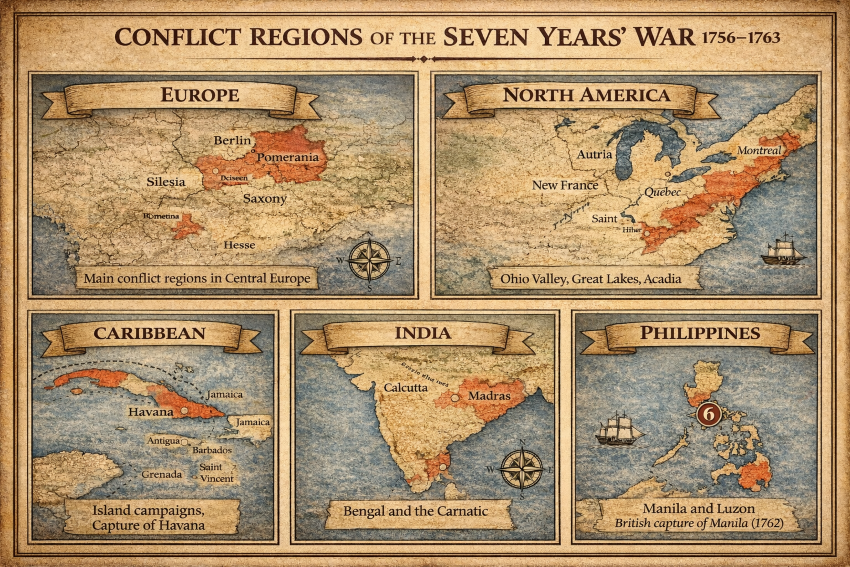
The Seven Years’ War operated as an interconnected but often operationally separate set of conflicts across (at minimum) continental Europe, North America, the Caribbean, West Africa, South Asia, and—late in the war—the Philippines. A useful scholarly framing (Oxford Handbook) treats it as three major conflicts: (1) Britain–France in North America (notably the Ohio Valley and wider Atlantic world), (2) Britain–France in South Asia (notably southern India, with wider Asian links), and (3) the European war in which Prussia fought a coalition led by Austria and Russia, alongside additional “side conflicts.”
INTERPRETATIONS (attributed)
This dispersion matters because belligerents could “win” in one theater while absorbing losses or stalemates elsewhere; historians commonly treat the conflict as an early case where naval mobility, finance, and coalition management could be as decisive as battlefield performance. (This is a synthesis of the Oxford Handbook’s global framing rather than a single “theory of victory.”)
1) Operational phases (high-level) with theater linkages
Phase I — 1756–1757: rapid escalation and early decision-seeking in Europe; colonial struggle intensifies
FACTS
In Europe, 1757 featured decisive Prussian victories at Rossbach (5 November 1757) and Leuthen (5 December 1757).
In South Asia, the Battle of Plassey (23 June 1757) was fought in Bengal and is treated by major reference works and military museums as a key pivot in the East India Company’s shift from primarily commercial to political-military power.
INTERPRETATIONS (attributed)
The National Army Museum explicitly presents Plassey as initiating a process that “eventually” produced British predominance in India; that is a retrospective impact claim (and thus interpretation), even when widely accepted.
Phase II — 1758: consolidation, heavy campaigning, and resource mobilization
FACTS
In North America, the Battle of Carillon (8 July 1758) was a major British defeat in the French and Indian theater.
In Europe, the Battle of Zorndorf (25 August 1758) is described by Britannica as the “bloodiest battle of the war,” and it occurred amid Prussian–Russian operations in the Oder region.
On the alliance/finance side, Britannica notes a treaty of 11 April 1758 in which Britain promised Prussia an annual subsidy of 4,000,000 talers (£670,000) and both pledged not to make a separate peace.
INTERPRETATIONS (attributed)
Oxford Handbook scholarship on “resources” argues that Britain and Prussia’s relative effectiveness in mobilizing and employing war-making resources materially contributed to their outcomes. This is a causal interpretation (not a simple fact of expenditure).
Phase III — 1759: watershed year in maritime and North American operations; severe crisis for Prussia
FACTS
In western Germany, the Battle of Minden (1 August 1759) ended in a major French defeat.
In North America, Quebec fell on 13 September 1759 (Plains of Abraham), which Britannica treats as a decisive defeat for the French force defending the city.
At sea, Quiberon Bay (20–21 November 1759) ended with a decisive French defeat; Britannica and Royal Museums Greenwich both emphasize its strategic effects and the subsequent durability of British naval superiority.
In the east, Kunersdorf (12 August 1759) was a major Prussian defeat against Austro-Russian forces; Britannica provides a narrative of the defeat’s scale and immediate operational consequences.
INTERPRETATIONS (attributed)
Britannica explicitly labels 1759 an “annus mirabilis” for Britain because multiple theaters (Minden, Lagos/Quiberon Bay, and North America—Niagara and Quebec) aligned in Britain’s favor. That label is interpretive shorthand for a cluster of outcomes.
Phase IV — 1760–1761: attrition, sieges, and the narrowing of options
FACTS
Britannica’s campaign narrative states that Russia and Austria chose Silesia as the main field of operations for the 1760 campaign, indicating sustained continental pressure on Prussia after 1759.
In South Asia, a key dated engagement is Wandiwash (22 January 1760) (Third Carnatic War), and a detailed map entry (Royal Collection Trust) identifies the battle, commanders, and outcome as a British victory.
Britannica also states that Pondicherry (capital of French India) was captured in 1761 following French defeats during the Seven Years’ War.
In North America, Britannica notes that Amherst closed in on Montreal in 1760 and New France capitulated, and a Britannica Quebec entry specifies Montreal’s surrender date as 8 September 1760.
INTERPRETATIONS (attributed)
From a strategic perspective, these years are often characterized as a “war of exhaustion”: fewer clean, decisive set-piece decisions and more pressure through supply disruption, siege, and the cumulative effects of manpower and fiscal constraints. That framing aligns with the Oxford “resources” emphasis but remains an interpretive lens rather than a single measurable fact.
Phase V — 1762–1763: late widening (Spain) and high-impact amphibious captures
FACTS
Britannica’s war narrative records that Britain declared war on Spain on 2 January 1762, and it dates the British capture of Havana to 13 August 1762 and Manila to 5 October 1762.
Britannica’s Havana history adds that Havana fell after a three-month siege and identifies the senior British commanders (Admiral Sir George Pocock and the Earl of Albemarle); it also notes Britain held the city for roughly six months until the peace settlement restored it.
Britannica’s Manila history confirms British capture and occupation in 1762 and restoration to Spain by the 1763 Treaty of Paris.
INTERPRETATIONS (attributed)
From an operational standpoint, late-war amphibious offensives against high-value ports demonstrate how maritime superiority could be converted into bargaining leverage—even when the principal European land war remained unresolved until the final settlements. That interpretation is consistent with Britannica’s emphasis on naval superiority and late-war overseas captures, but it is still a synthesis.
2) Strategy and operational methods by theater
A) Central Europe: coalition pressure versus Prussian operational agility
FACTS
Britannica’s account stresses the multi-front nature of the continental war (Austrian, Russian, French, and other pressures). It highlights:
- major Prussian victories at Rossbach and Leuthen (1757),
- the extremely costly Zorndorf battle against Russia (1758),
- and a major Prussian defeat at Kunersdorf (1759), after which Britannica notes the victors did not immediately exploit their advantage and that supply constraints later forced Russian withdrawal.
INTERPRETATIONS (attributed)
A standard interpretation (reflected in reference narratives like Britannica’s) is that battlefield outcomes did not automatically translate into strategic decision because coalition partners had different priorities and because armies’ endurance depended heavily on supply. This is less a claim about “will” than about operational friction and constraints.
B) Maritime war: blockade, fleet actions, and “closing” the invasion option
FACTS
Royal Museums Greenwich calls Quiberon Bay (20 November 1759) the “most decisive naval encounter” of the war, describing it as occurring when France broke out of a five-month blockade of Brest; it also states the action stopped French invasion plans during the conflict.
Britannica similarly links Quiberon Bay to the collapse of French invasion planning and to sustained British naval superiority thereafter.
INTERPRETATIONS (attributed)
Operationally, blockade and fleet battle outcomes constrained what France could reinforce overseas and how credibly it could threaten Britain directly. This is an inference from the described blockade/invasion context rather than a claim about “intent” beyond documented planning.
C) North America: forts, rivers, and sieges rather than purely open-field battle
FACTS
Britannica emphasizes a sequence of fortress and city captures: Louisbourg (1758), Quebec (1759), Montreal (1760), culminating in the collapse of French rule in Canada.
However, this progression was not linear: Carillon (8 July 1758) was a significant British setback.
INTERPRETATIONS (attributed)
The conduct of war in North America is often interpreted as a hybrid of European siege/fort warfare with irregular frontier violence involving colonial forces and Indigenous allies. This interpretive frame is widely used but requires careful theater-by-theater substantiation (and will be treated explicitly in Part 5 when discussing aftermath and contested narratives).
D) South Asia: company armies, local alliances, and the collapse of French “state” capacity in India
FACTS
Britannica and the National Army Museum treat Plassey (23 June 1757) as a major turning point in Bengal.
In the southern theater, Wandiwash (22 January 1760) is documented (including in Royal Collection Trust mapping) as a British victory, and Britannica’s Seven Years’ War timeline lists it as a major event.
Britannica states that Pondicherry was captured in 1761 after French defeats in the war.
INTERPRETATIONS (attributed)
NAM’s presentation that Plassey led to British predominance is a long-run interpretation; alternative scholarly emphases often stress the importance of post-1757 revenue and political arrangements, not only battlefield performance. (This is noted here as an interpretive caution; detailed adjudication belongs in Part 5.)
E) West Africa and the Philippines: “minor sideshows” with strategic and economic linkages
FACTS
An Oxford Handbook chapter explicitly characterizes West Africa as a minor sideshow, with armed conflict largely confined to Saint-Louis (Senegal River) and Gorée, both occupied by the British in 1758–1759.
In the Philippines, Britannica confirms British capture and occupation of Manila in 1762 and restoration by the 1763 settlement.
INTERPRETATIONS (attributed)
Even “minor” theaters could matter disproportionately when they affected trade flows, prestige, or bargaining leverage. The Oxford chapter’s focus on impacts in Senegambia signals that local consequences did not scale neatly with the theater’s size.
3) Technology and “what mattered” in combat effectiveness
FACTS (bounded to sources)
Two cross-cutting constraints recur in authoritative syntheses:
- Seapower and access: The blockade context and the Quiberon Bay outcome underscore that controlling sea lanes could prevent reinforcement, disrupt plans, and enable amphibious attacks.
- Disease and the limits of campaigning: The University of Chicago Press summary of Erica Charters’ research states that diseases (e.g., scurvy, smallpox, yellow fever) killed far more than combat in multiple theaters, stretching state resources.
INTERPRETATIONS (attributed)
Charters’ argument implies that “technology that mattered” included not only weapons and ships but also medical logistics and institutional capacity to keep forces effective. That is an interpretive shift from battle-centric accounts toward sustainment-centric explanations.
4) Logistics and finance: sustaining global operations and a continental ally
FACTS
Britannica provides a concrete indicator of financial sustainment: Britain’s annual subsidy of 4,000,000 talers (£670,000) to Prussia (treaty dated 11 April 1758), paired with a pledge against separate peace.
Oxford Handbook “resources” scholarship argues (as a causal assessment) that Britain and Prussia’s relative capacity to mobilize/procure/employ resources contributed significantly to outcomes.
INTERPRETATIONS (attributed)
A defensible interpretation—consistent with these sources—is that Britain’s war conduct blended (a) maritime projection and (b) fiscal underwriting of continental resistance, while Prussia’s conduct centered on repeated operational responses to multi-front threats. This does not require assuming motives beyond documented commitments and observed behavior.
5) Civilian impacts (non-exhaustive, bounded to evidence)
FACTS
The Oxford Handbook introduction (summarizing Peter H. Wilson) reports an estimate that the Prussian population declined by about 400,000 as a result of the war, and it notes Britain “lost relatively few men in battle though more to disease,” referencing Charters’ contention.
Britannica’s Canada narrative indicates that by 1760 the military situation forced capitulation in New France, implying large-scale political and social dislocation even where precise displacement counts are not provided in the cited synopsis.
INTERPRETATIONS (attributed)
Civilian harm in this conflict is often interpreted as stemming from (1) requisition/contribution systems and troop movements in central Europe, and (2) frontier violence and forced movement in colonial theaters. The Wilson estimate underscores that demographic effects could be large even without a single “civilian casualty figure” that meets modern accounting standards.
What is well-established vs. what is disputed (Part 3 focus)
Well-established (high confidence)
- The war’s multi-theater character and the three-core-conflicts framing in modern scholarship.
- Key dated milestones: Rossbach and Leuthen (1757), Zorndorf (1758), Minden/Quebec/Quiberon Bay/Kunersdorf (1759), Montreal’s surrender (8 Sep 1760), Havana (Aug 1762) and Manila (Oct 1762) captures as dated by Britannica.
- Britain’s 1758 annual subsidy commitment to Prussia (as stated by Britannica).
Disputed / harder to pin down (often medium confidence unless narrowed to a specific archive study)
- Comparative casualty totals by theater (combat vs disease) in standardized numbers across all belligerents; Charters supports the “disease > combat” claim in multiple theaters, but precise ratios vary by place/time.
- The magnitude and distribution of civilian mortality in central Europe (Wilson provides an estimate for Prussia; wider region totals differ by methodology).
- The extent to which 1759 outcomes were “decisive” versus “advantage-shifting” (labels such as annus mirabilis summarize outcomes but compress complex causality).
- In India, the balance between battlefield decisions (Plassey/Wandiwash) and subsequent fiscal-political restructuring as the driver of long-run dominance (NAM emphasizes a long-run arc; scholars debate weights).
Key Sources Used (Part 3)
- Oxford Academic (OUP), The Oxford Handbook of the Seven Years’ War, Introduction (global framing; demographic/disease synthesis note).
- Oxford Academic (OUP), “Resources” chapter description (resource mobilization argument).
- Encyclopaedia Britannica: battle/event entries and campaign narrative (Rossbach; Leuthen; Minden; Carillon; campaign-year narratives; Montreal/Canada summaries; Havana/Manila; Treaty context).
- Royal Museums Greenwich (National Maritime Museum): Quiberon Bay object record (blockade/invasion-plan context; assessment of decisiveness).
- University of Chicago Press (Charters book description): disease impact framing.
- National Army Museum (UK): Plassey interpretive summary (clearly labeled as a museum interpretation).
- Royal Collection Trust: Wandiwash battle map metadata (date/command/outcome).
- Oxford Academic chapter snippet: West Africa theater scope (Saint-Louis and Gorée).
Open Questions / Uncertainties (to resolve before Part 4–5)
- Casualty accounting by theater and belligerent: Which modern datasets or archival syntheses provide the most comparable (method-consistent) estimates across Europe, North America, Caribbean, India, West Africa? (Confidence: Medium—methodologically difficult.)
- Civilian demographic effects in central Europe beyond Prussia: can we cite parallel estimates for Saxony, Silesia, or neighboring regions using comparable demographic methods? (Confidence: Medium.)
- India causality weighting: relative explanatory power of Plassey vs post-1757 revenue/administrative changes vs later Carnatic operations (Wandiwash/Pondicherry). (Confidence: Medium.)
- West Africa local impacts: the Oxford chapter signals African/Eurafrican community consequences—what are the best primary/archival references to describe them without overgeneralization? (Confidence: Medium.)
- Link from Quiberon Bay to peace leverage: how directly can we evidence the operational-to-diplomatic chain (e.g., cabinet correspondence, war aims, negotiation instructions) rather than inferring it from outcomes? (Confidence: Medium.)