Part 3 — War Conduct (capabilities, strategy, phases, logistics/finance, civilian harm)
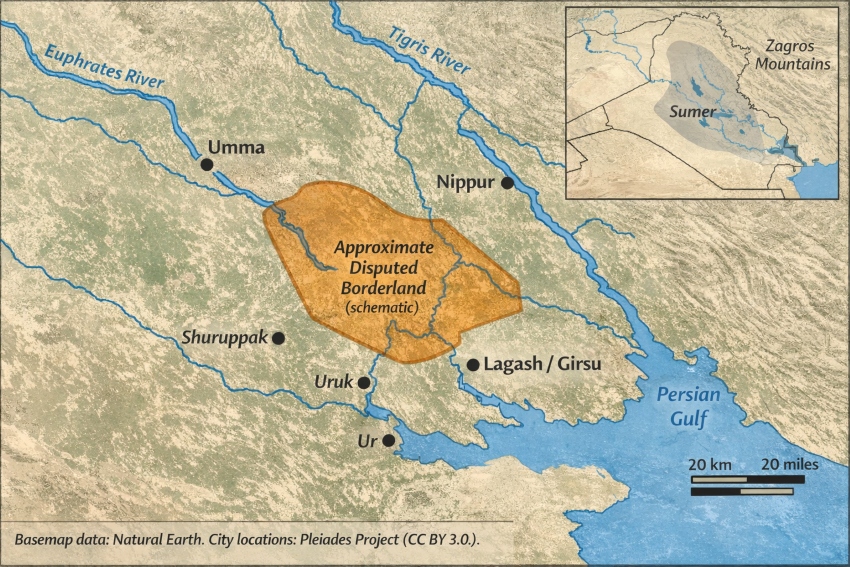
Timeline (8–15 dated milestones)
- Undated: Boundary violation and first armed clash framing (Lagash text tradition: Ningirsu “did battle” with Umma/Gisha).
- c. 2450–2425 BCE (approx.): Monumental commemoration of a Lagash victory tradition in the Stele of the Vultures (fragmentary survival).
- Undated: Redemarcation and canal-leading actions associated with E’annatum and an Umma ruler (Enakale).
- Undated: Establishment of burial tumuli “in the Eden district” after a battle (as described in translation).
- Undated: Urlumma’s actions: diversion of water; destruction of monuments and chapels; hiring of foreign mercenaries; crossing the boundary dike “from above.”
- Undated: Battle at the Ugiga-field; Urlumma’s retreat and death in Umma; abandonment of draft animals and casualties described.
- Undated: Il assumes rulership; renewed diversion claims and hostile boundary assertions.
- Undated: Enmetena reconstructs the boundary dike “from the Tigris to the Nun-canal.”
Capabilities: what “military power” likely consisted of (interpretation bounded by sources)
Armed forces and organization (confidence: medium).
The Stele of the Vultures is widely treated as evidence for organized infantry formations and elite leadership display in Early Dynastic warfare, but the Louvre object entry available here primarily offers object-level documentation and bibliography rather than a full tactical analysis. A cautious reconstruction is:
- forces centered on infantry with standardized equipment (inferred from the stele’s famous visual program, though detailed reading belongs to specialized studies),
- leadership linked to rulers and temple institutions (consistent with the political economy described for the period).
Use of auxiliaries/mercenaries (confidence: low-to-medium).
One translated text explicitly states that Urlumma “hired the (people) of the foreign lands (as mercenaries).” Without independent corroboration, we should treat this as a claim embedded in a hostile narrative. It nonetheless indicates that the concept of paid external fighters was legible within the discourse of the time.
Strategy and operational logic: canals, fields, and boundary infrastructure
Canals as objectives and weapons.
The text attributes to Umma rulers actions that are operationally meaningful in an irrigation landscape: diverting water from boundary dikes/levees and asserting control over the hydraulic system. In practical terms, such actions could:
- reduce agricultural yields downstream,
- undermine legitimacy if a ruler is seen as failing to protect temple lands,
- force bargaining by imposing seasonal pressure.
Fields as battle sites.
Engagements are located at named places (e.g., the Ugiga-field), suggesting that clashes were linked to control of specific productive zones rather than deep territorial conquest. This is consistent with a border conflict in which the prize is a tract of cultivable land and the infrastructure enabling it.
Phases of combat (as described in the surviving narrative tradition)
Because the record is not a continuous campaign diary, “phases” here are analytic groupings:
- Initial demarcation and violation phase (low dating precision).
Boundary-making (measurement, stele) is followed by alleged boundary violation and the claim of a Lagash response framed as justified enforcement. - Re-demarcation and institutionalization phase (buffer + cultic marking).
The narrative describes leading a boundary channel, leaving a measured strip, setting up monuments, and constructing multiple chapels on the boundary levee. - Renewed escalation phase (hydraulic sabotage + coercive labor/force).
Urlumma is described as diverting water, destroying monuments/chapels, hiring foreign fighters, and crossing the boundary. - Battle and punitive phase (battlefield victory + pursuit).
A battle is described at Ugiga-field, with Urlumma fleeing and being killed in Umma; additional losses and abandonment of draft animals are claimed. - Post-battle bargaining under threat.
Il’s succession and partial repayment of barley is described, followed by renewed hostile claims and then reconstruction by Enmetena.
Logistics and finance: grain, labor, and the temple economy
Grain as the key logistical currency.
The text’s barley “loan/interest” structure—whatever its precise accounting meaning—signals that grain obligations were central to how the border settlement was operationalized. Grain mattered because it provisioned labor, supported officials, and underwrote the institutional economy (temple and palace).
Infrastructure maintenance as a form of mobilization.
Canal and levee construction/repair requires coordinated labor and administrative capacity. Hritz emphasizes that written documents recounting border tensions place emphasis on canal maintenance, consistent with the hydrological scale of the joint channel system in the region. Thus, “mobilization” likely meant not only assembling fighters, but also compelling labor for hydraulic works—particularly when a boundary canal is itself a disputed object.
Civilian harm: what can be said without overclaiming
Direct evidence is limited.
The available translated narrative includes violent outcomes (deaths, “bones strewn,” burial tumuli), but it does not provide civilian/combatant distinctions or population-level impacts.
Most defensible inference (confidence: medium): localized harm and economic disruption.
Given the borderland setting and the focus on canals and fields, the most defensible inference is that harm likely concentrated in:
- border communities (labor demands, insecurity),
- agricultural production (water diversion effects),
rather than mass displacement across the whole polity. This is an inference from the conflict’s object (productive land and water control) and the nature of the institutional landscape, not a quantified finding.
What is well-established vs what is disputed
Well-established
- The texts describe military engagements tied to specific places and hydraulic actions (diversion, reconstruction) as central modes of conflict.
- Post-conflict boundary sacralization (chapels, monuments, curses) appears as an enforcement strategy.
Disputed / uncertain
- Force size, duration of engagements, and tactical details cannot be derived quantitatively from the preserved texts here.
- Whether “mercenary hiring” reflects real recruitment patterns or rhetorical escalation language is uncertain.
- Civilian harm magnitude is not measurable from the extant corpus; any attempt to quantify would be speculative.
Endnotes (Part 3)
- Detailed episode sequence in the Enmetena-related translation: water diversion, destruction of monuments/chapels, mercenaries, battle at Ugiga-field, Urlumma’s death, barley repayment, and dike reconstruction.
- Environmental and institutional context for canal maintenance and the riverine landscape enabling such conflict modalities.
- Stele of the Vultures object record and bibliography establishing it as a central commemorative artifact for the Lagash victory tradition.
Key Sources Used (Part 3)
- CDLI Tablet translation page.
- Carrie Hritz chapter (hydrology, settlement, canal context).
- Louvre collections entry for the Stele of the Vultures.
- CDLI Wiki overview.
Open Questions / Uncertainties (Part 3)
- Are there archaeological correlates (burn layers, canal breaks, emergency works) that can be securely tied to specific named episodes?
- How should we interpret “burial tumuli” references: commemorative mounds, mass graves, or stylized language?
- What proportion of conflict effort went into hydraulic works versus battlefield action?
- How did seasonal cycles (planting/harvest) shape escalation timing, given canals as both infrastructure and target?