Part 4 — Termination (negotiations, settlement, enforcement, how “victory” was defined)
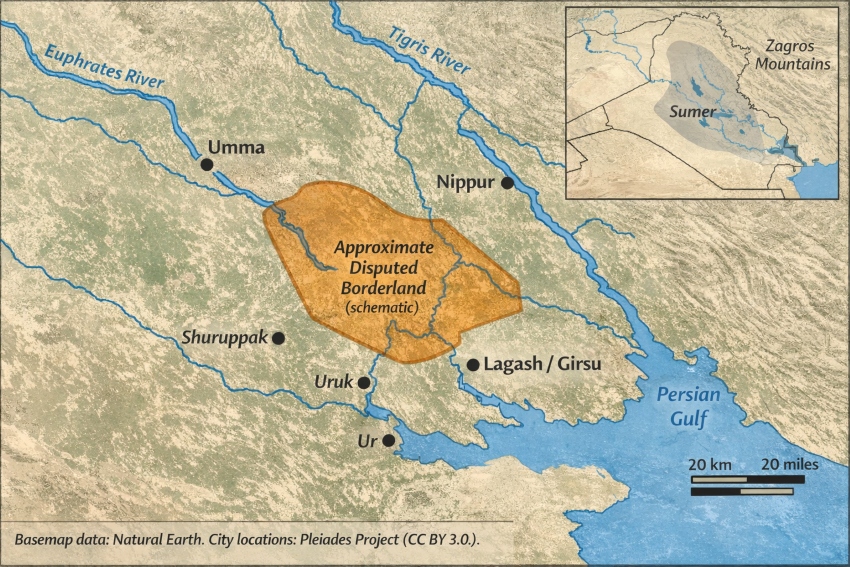
Timeline (8–15 dated milestones)
- Undated: Mesilim demarcation tradition provides early settlement template.
- Undated: E’annatum and Enakale described as demarcating the border; boundary channel led; buffer zone established.
- Undated: Monuments restored and erected; chapels built on boundary levee.
- Undated: Barley “loan/interest” arrangement stated, implying an ongoing settlement mechanism.
- Undated: Urlumma’s alleged violation and renewed war; after defeat, a new Umma ruler (Il) emerges.
- Undated: Il repays “only” 3,600 guru of Lagash’s barley; hostile boundary claims are quoted.
- Undated: Enmetena reconstructs boundary dike from the Tigris to the Nun-canal; foundations built “out of stone.”
- c. 2350 BCE (period boundary): Early Dynastic political landscape transitions; dispute as a discrete bilateral rivalry becomes harder to trace cleanly in the surviving narrative corpus used here.
Termination as a pattern: settlements that “ended an episode,” not necessarily the conflict
For this case, “termination” is best treated as episodic: specific settlements conclude particular rounds of fighting and reset the boundary—without guaranteeing durable peace for the full c. 2500–2350 BCE window.
Negotiation and settlement instruments
1) Physical demarcation + buffers.
The settlement toolkit includes:
- re-measuring and demarcating the border,
- leading/marking a boundary canal,
- creating a defined strip and a “no-man’s land” buffer (as translated).
These are classic devices for reducing day-to-day uncertainty over where cultivation and maintenance rights begin and end.
2) Monumentation and sacralization.
The text describes:
- restoring Mesilim’s monument,
- erecting additional monuments,
- building chapels for major deities at the boundary levee.
From an enforcement perspective, this does two things:
- creates high-visibility markers (harder to plausibly deny),
- raises the “cost” of violation by embedding the boundary in divine-legal discourse.
3) Transfers / compensation via grain obligations.
The barley “loan/interest” framework functions like a transfer mechanism: Umma’s use of resources is paired with a growing obligation and the possibility of default triggering enforcement. Modern readers should not assume the numbers are literal; however, the structure is consistent with a settlement that mixes territory and tribute-like terms.
Enforcement: curses, reconstruction, and punitive narratives
Curses as deterrence.
The text ends with a conditional: if Umma crosses the boundary dikes to seize fields, then Enlil should destroy the violator and Ningirsu should cast the “great battle-net” upon him; even the people of the violator’s own city are invoked as executioners. This is a deterrence formula embedded in religious authority. Its real deterrent value depends on shared belief and reputational costs, which cannot be directly measured.
Reconstruction as enforcement.
Enmetena’s described reconstruction of the boundary dike “from the Tigris River to the Nun-canal,” and stone foundations, reads as an attempt to make the border legible and resilient after sabotage. In hydraulic terms, rebuilding is also a form of asserting control: whoever rebuilds can shape flow and access.
How “victory” was defined (in the sources)
Victory as boundary legitimacy + capacity to impose terms.
In the Lagash narrative tradition, “victory” is not framed as annihilation of Umma; it is framed as:
- defeating a violating ruler (Urlumma),
- restoring boundary markers,
- compelling repayment (even partial),
- reasserting a divinely authorized boundary order.
This aligns with the conflict’s object: a specific tract and its water regime.
Umma’s “victory condition” is less fully recoverable here.
We can document that Umma’s rulership and cultic identity (Shara) appear in an Umma-associated object record, but the accessible record excerpt does not provide a full counter-interpretation of what Umma framed as legitimate victory (e.g., restoring older markers, alternate measurements, claims of theft). The asymmetry is a source-base limitation.
What is well-established vs what is disputed
Well-established
- The settlement repertoire includes boundary markers, canals/levees, cultic installations, and curse formulas.
- The narrative describes post-war rebuilding and partial repayment, implying bargaining and enforcement after fighting.
- The dispute is embedded in a broader Early Dynastic system of multiple polities and shifting landscapes.
Disputed / uncertain
- Durability of each settlement (how long it held, what monitoring existed) cannot be reconstructed with precision.
- Whether barley obligations were ever enforced materially at stated scales is unclear; the figures may be accounting rhetoric or textual convention.
- Umma’s settlement terms and enforcement logic are underdocumented in the accessible excerpts used here.
Endnotes (Part 4)
- Boundary-making, buffer strip, chapels, barley obligation, violations, partial repayment, and reconstruction; curse enforcement language.
- Early Dynastic period framing and system context.
- Overview framing of dispute continuity and evidentiary basis.
- Umma-associated artifact record establishing an independent material “Umma voice” even where the excerpted text is limited.
Key Sources Used (Part 4)
- CDLI Tablet translation page.
- Carrie Hritz chapter.
- CDLI Wiki overview.
- British Museum object record (Gishakidu mace).
Open Questions / Uncertainties (Part 4)
- Were boundary chapels primarily deterrent symbolism, administrative checkpoints, or both?
- Did third parties (other polities) play recurring arbitration roles beyond Mesilim’s remembered intervention?
- How should “partial repayment” be interpreted: real settlement compliance, rhetorical diminishment of Umma, or accounting convention?
- What enforcement mechanisms existed beyond religious sanction—e.g., hostages, rotating access, or shared maintenance regimes? (not recoverable from cited excerpts).