Part 1 — The Pre-War System (background and stakes)
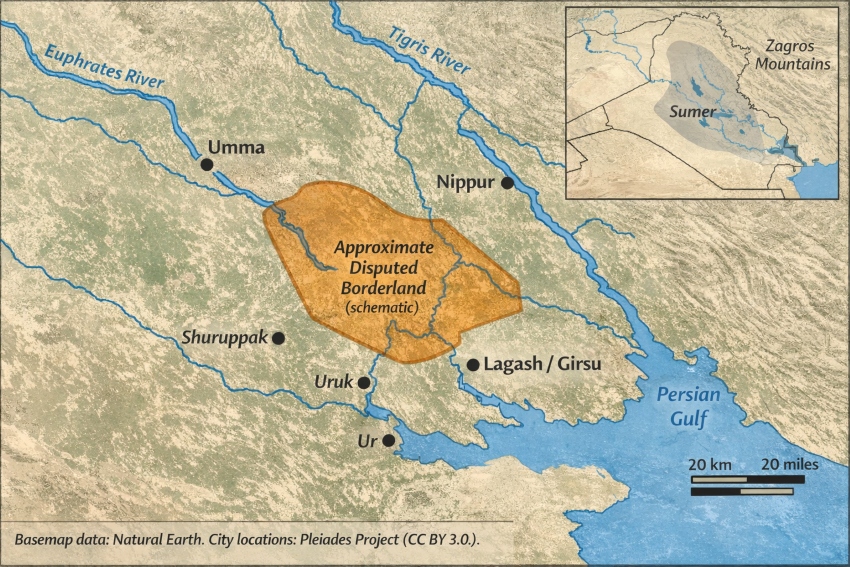
Part 1 — The Pre-War System (background and stakes)
Conflict Snapshot (reference box)
- Dates: c. 2500–2350 BCE (key episode often placed c. 2450–2425 BCE)
- Type: inter-polity border conflict among Early Dynastic Sumerian city-based territorial polities (sometimes framed as “internal” to a shared Sumerian cultural zone)
- Main actors: Lagash (notably Girsu/Nina within the Lagash polity) vs Umma; third-party arbiter role in tradition attributed to Kish under King Mesilim
- Theater: the agricultural and canal landscape in southern Mesopotamia (Sumer), especially the border zone and fields associated with the Gu’edena / “Eden” district and a boundary canal/levee system
- Outcome label: repeated negotiated boundary settlements with intermittent fighting; the surviving corpus does not preserve a single, universally accepted “final settlement” text for the entire c. 2500–2350 BCE span
- Casualty estimates (ranges) & why sources differ: No credible quantitative estimates survive. Royal inscriptions and monument texts describe battles, burial mounds, and routs, but they do not provide consistent, audit-like tallies; archaeological attribution of deaths to specific engagements is not currently possible at high confidence. Any numeric “range” would be conjectural rather than source-derived.
- Displacement estimates: Unknown / not recoverable from extant evidence; the record is primarily elite commemorative and administrative-legal in focus rather than demographic reporting.
- Last updated: 2026-01-14
Timeline (8–15 dated milestones)
- c. 2900–2350 BCE: Early Dynastic period in southern Mesopotamia; multiple semiautonomous city-based polities.
- c. 2500–2350 BCE: The Umma–Lagash border dispute is attested as a long-running intercity conflict in texts and later reconstructions.
- Undated (Early Dynastic): Tradition of an arbitration/demarcation attributed to Mesilim of Kish, including a boundary stele and measurement of a field.
- Undated (Early Dynastic): A ruler of Umma (rendered “Ush, ruler of Gisha” in one translation) is described as removing the stele and advancing into the contested district.
- c. mid-25th century BCE: Lagash under rulers remembered in the Lagash tradition (e.g., E’annatum / Enmetena’s lineage) frames the dispute as boundary violation and canal/levee conflict.
- Undated: Construction of shrines/chapels at a boundary levee is described as part of demarcation and sacralization of the border.
- Undated: A “loan/interest” framing appears (barley obligations tied to the contested land), implying an economic mechanism attached to boundary control.
- Undated: Renewed fighting episodes are described, including battle at a named field and pursuit/kill of an Umma ruler in Umma itself.
The pre-war system: what “states,” borders, and resources meant in Early Dynastic Sumer
Political units and sovereignty.
In the Early Dynastic period, southern Mesopotamia (Sumer) is described in modern scholarship as a network of semiautonomous, city-based territorial polities—often called “city-states,” though scholars note important differences from the Greek polis model (e.g., multi-center polities such as Lagash and Umma). The dispute is therefore best understood as a conflict between neighboring territorial administrations embedded in a shared cultural-linguistic zone, not as a “civil war” within a single centralized state.
Where authority was located.
Lagash and Umma were not simply urban nodes; they were territorial systems. Lagash in particular operated with multiple major centers (Lagash, Girsu, Nina are prominent in modern reconstructions), with temples and palaces as major institutional actors in production and administration. In this setting, “border” issues were simultaneously:
- administrative (who collects rents/dues; who assigns labor),
- hydraulic (who maintains canals/levees; who controls feeder channels),
- ideological-legal (which gods and which precedents authorize a boundary).
The landscape and why it mattered.
The theater was a riverine landscape shaped by branching channels, levees, and irrigation agriculture. A key contextual point in landscape-focused scholarship is that the region east of the modern Shatt al-Gharraf reflects complex interactions of Tigris and Euphrates channel systems, with canal maintenance appearing as a recurring emphasis in written accounts of the border tensions. The contested zone is repeatedly associated (in translation traditions) with the Gu’edena / “Eden” district—agricultural land whose value derived from access to water and the ability to stabilize production against local fluvial variability.
Stakes: land, water, and fiscal rights.
The sources tie boundary control to economic obligations—most explicitly, a barley “loan/interest” framework attached to the border arrangement in one key text. Even if the precise institutional meaning is debated (see below), the structural point is clear: control of the borderland could be converted into recurring grain flows, and grain was a central medium for provisioning labor and institutions in these polities.
A note on evidence quality: why “propaganda risk” is high.
The best-known narratives come from royal/elite inscriptions, often preserved in fragments or later copies, and they are not neutral reports. They aim to:
- memorialize boundary claims,
- justify coercive action,
- place enforcement under divine sanction and curses.
Modern historians therefore treat them as evidence for claims made and institutions invoked, while remaining cautious about literal readings of intent and scale.
What is well-established vs what is disputed
Well-established
- A sustained boundary dispute existed between the neighboring polities of Umma and Lagash in the Early Dynastic period and is among the earliest well-attested intercity conflicts in the written record.
- The dispute was articulated through boundary-making practices: measuring land, erecting stelae/monuments, naming canals/levees, and building cultic installations at the border.
- Economic and hydraulic dimensions were central: the texts connect border control with canal/levee management and grain obligations.
Disputed / uncertain
- Geography of specific features (exact course of the “boundary canal” and associated levees) remains debated because textual toponymy and shifting river systems are difficult to reconcile.
- Institutional meaning of the “barley loan/interest” passage (literal debt? legal fiction? ideological framing?) is contested, as is the real-world feasibility of the very large figures appearing in one translation tradition.
- Chronological placement of individual episodes (exact year-by-year sequence) is not recoverable from the surviving narrative sources alone; many dates are approximate reconstructions.
Endnotes (Part 1)
- Early Dynastic period framing; city-based polities; environmental/hydrological context; dispute dates c. 2500–2350 BCE.
- Overview framing of the conflict as a historically discussed “Umma–Lagash border conflict” and its evidentiary basis.
- Translation excerpt capturing Mesilim demarcation tradition, boundary violations, and the border’s sacral/legal framing.
- Monument context and scholarly apparatus for the Stele of the Vultures as a key Lagashite commemorative artifact (object entry and bibliography).
Key Sources Used (Part 1)
- Carrie Hritz, “The Umma-Lagash Border Conflict: A View from Above” (chapter PDF copy).
- CDLI Wiki, “Umma–Lagash border conflict” overview page.
- CDLI Tablet page (YBC highlight / translation of Enmetena-related text tradition).
- Louvre Collections entry: “Stèle des vautours” (Stele of the Vultures) object record and bibliography.
Open Questions / Uncertainties (Part 1)
- Where precisely did the “boundary canal” run in modern coordinates, and how often did its course shift over the dispute’s duration?
- How should scholars interpret the very large barley-accumulation figures: accounting notation, rhetorical intensification, or later textual accretion?
- Which elements of the Mesilim arbitration are historical memory vs later legitimation strategy?
- To what extent did non-elite communities in the borderland experience recurring disruptions (labor demands, crop loss), given the elite-centered source base?