Iran–Iraq War (1980–1988) — Part 2: Road to War (c. 1978–September 1980)
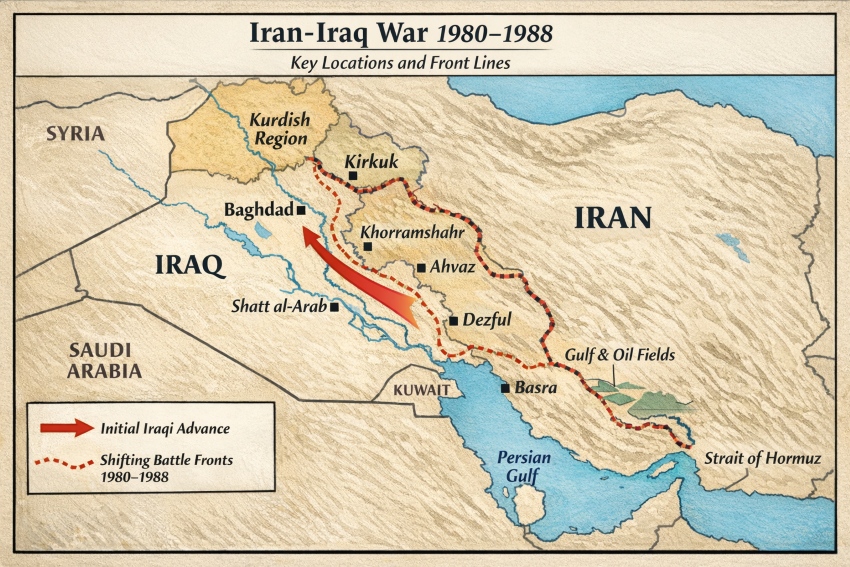
1) Baseline framing (classification and scope)
In standard quantitative conflict coding, the 1980–1988 Iran–Iraq War is generally treated as an inter-state war (a war between two sovereign states), even though it was entangled with internal opposition movements, cross-border broadcasting, and proxy dynamics.
This episode focuses on the trigger sequence, bargaining failure, and mobilization leading to Iraq’s invasion of Iran on 22 September 1980.
2) Trigger sequence: deterioration after 1978–1979 (facts, then contested meanings)
2.1 What is well-attested as happening (FACTS)
Key inflection points before open war (selected):
- 4 Oct 1978: Ayatollah Ruhollah Khomeini—who had lived in exile in Iraq—was expelled from Iraq (Iranica dates the expulsion and situates it within the Shah’s request amid unrest in Iran).
- 1979: After the Iranian Revolution, Iran–Iraq relations deteriorated steadily (Iranica explicitly frames post-1979 deterioration as the immediate pre-war condition).
- June–July 1979: Iranica reports Iraqi attacks on Iranian border towns, including Kurdish towns in north-western Iran and Ṣāleḥābād in the south, with reported fatalities.
- First half of 1980: Iranica describes additional border clashes during this period.
- 1 Apr 1980: Britannica notes an attempted assassination of Iraqi official Tariq Aziz, which Iraqi leaders blamed on Iran (as part of the escalation narrative).
These items establish a pattern of escalating friction: propaganda and accusations, localized violence at the border, and rising political hostility following Iran’s revolution.
2.2 What each side claimed about the other (FACTS about claims; not endorsements)
Iranica records that Iraq frequently accused Iran of “aggression” and of interfering in Iraq’s internal affairs, including alleged support to the banned al-Daʿwa Party; it also notes Iranian Arabic-language broadcasts vilifying Iraq’s Baʿth regime.
Conversely, Iranica reports accusations against Iraq of supporting separatist insurgents in Khuzestan, including claims (attributed to Iranian provincial leadership) that Iraq supplied arms to rebels and encouraged the “Arabestan” framing.
Interpretation boundary: These are documented allegations and information operations recorded by historians; they are not, by themselves, proof of responsibility for specific incidents.
3) Bargaining and bargaining failure: from treaty dispute to “null and void”
3.1 The treaty focal point (FACTS)
A central bargaining object was the 1975 Algiers Protocol, which (among other provisions) accepted the thalweg principle for the Shatt al-Arab / Arvand Rud boundary. Iranica presents this as a decisive settlement of the boundary question—later reopened.
On 17 September 1980, Iranica reports that Saddam Hussein abrogated the Algiers Protocol. In a speech to Iraq’s National Assembly, he asserted Iran had refused to abide by the Protocol and therefore Iraq considered it “null and void,” while also claiming historical Iraqi authority over the Shatt al-Arab.
Five days later (22 September 1980), Iraq attacked.
3.2 Third-party diplomacy (FACTS)
After the invasion, the UN Security Council adopted Resolution 479 (28 September 1980) calling on both states to refrain from further force and pursue peaceful settlement. Iranica reports it had little effect, in part because Iraq conditioned acceptance on Iranian concessions, while Iranian leaders would only negotiate after Iraqi evacuation of Iranian territory.
This is a classic bargaining failure pattern: incompatible preconditions (Iraq demanding recognition/territorial-waterway claims; Iran demanding withdrawal first), leaving little “zone of possible agreement” once large-scale fighting began.
4) Mobilization and the opening move (FACTS)
Iranica describes the war’s opening on 22 September 1980 as:
- simultaneous Iraqi air raids on ten Iranian civilian and military airports; and
- a ground invasion along the entire Iran–Iraq border.
Britannica likewise frames the onset as a broad-front Iraqi attack in September 1980.
Analytical note (attribution): A major modern operational history (Murray & Woods) emphasizes that, based on captured Iraqi records, there was a “lack of planning” in the invasion and that Iraqi decision-making can be examined through internal Iraqi regime documentation. This is a methodological point about sources rather than a claim about motives.
5) Stated aims: what leaders said they were fighting for (with attribution)
5.1 Iraq’s stated aims and bargaining demands (FACTS about stated positions)
Iranica records Iraq’s public framing of its action as self-defense and recovery of claimed territory, including the argument that Iran had “barred the way” to legally recognized methods of dispute settlement.
A short excerpt capturing the public justification: Iraq invoked a “legitimate right to self-defense” (quoted in Iranica from legal scholarship).
Iranica also lists Iraqi demands (as relayed by Tariq Aziz) including:
- mutual non-intervention guarantees;
- an Iranian undertaking to cease alleged “aggression”; and
- Iranian recognition of Iraqi sovereignty over claimed territories and waterways, including the Shatt al-Arab / Arvand Rud.
Britannica summarizes Iraq’s aims at the onset as seeking control over the Shatt al-Arab and oil-rich Khuzestan, and notes that Iraqi leadership portrayed Iran’s post-revolution stance as destabilizing.
5.2 Iran’s stated position on negotiations (FACTS)
Iranica reports Iranian leaders were prepared to negotiate a truce only after Iraqi forces evacuated Iranian territory, and that Iran presented Iraq’s attack as unprovoked aggression in international fora.
At the UN, Iran and Iraq both defended their conduct as self-defense (a fact about diplomatic posture, not a finding on legality).
6) Competing explanations for the decision to go to war (INTERPRETATIONS, attributed + confidence)
Because leaders rarely publish candid decision memos in real time—and because much evidence is retrospective—causal claims need attribution and confidence grading.
Explanation A: “Window of vulnerability” after Iran’s revolution (Confidence: Medium)
Claim (attributed): Britannica argues that Iraqi leadership viewed Iran’s revolution as creating an opportune moment because Iran’s regular forces were disrupted and Iran faced internal disorder.
Why medium: This is a common interpretation in reputable reference works, but it compresses complex military readiness questions into a short assessment; detailed archival work is required to move from “Iran looked weak” to “therefore Iraq chose invasion.”
Explanation B: Territorial revisionism: Shatt al-Arab and border settlement rollback (Confidence: High)
Claim (attributed): Iranica details the centrality of the Shatt al-Arab boundary and records Saddam’s 17 Sep 1980 abrogation speech explicitly focused on restoring Iraqi authority, followed by invasion days later.
Why high: The treaty issue is documented with clear dates and public statements tightly coupled to subsequent military action.
Explanation C: Regime security and fear of revolutionary “export” / sectarian agitation (Confidence: Medium)
Claim (attributed): Iranica records Iraqi accusations that Iran sought to export revolution by inciting sectarian strife, including a specific UN statement by Iraqi foreign secretary Saʿdun Hammadi (15 Oct 1980), and it notes Iraqi allegations of Iranian support for al-Daʿwa.
Why medium: The evidence for the perception is strong (documented accusations and rhetoric). The evidentiary leap is whether such fears were decisive (rather than complementary) in Iraq’s war decision.
Explanation D: Leadership rivalry and ideological contest (Confidence: Low–Medium)
Claim (attributed): Iranica notes “personal hostility” between Saddam Hussein and Ayatollah Khomeini as one component among broader political ambitions and disputes.
Why low–medium: Personal hostility is plausible but difficult to weight causally relative to treaty/border and security drivers, absent direct internal documentation demonstrating primacy.
7) Road-to-war milestone timeline (10 items, dated)
- 4 Oct 1978 — Khomeini expelled from Iraq.
- 1979 (Feb) — Iranian Revolution consolidates; Iran–Iraq relations deteriorate in its aftermath.
- Jun 1979 — Iranica reports Iraqi attacks on Iranian border towns in the northwest.
- Jul 1979 — Iranica reports attack on Ṣāleḥābād in the south with fatalities.
- First half 1980 — Additional border clashes reported.
- 1 Apr 1980 — Attempted assassination of Tariq Aziz (Iraq blamed Iran, per Britannica).
- 17 Sep 1980 — Saddam abrogates the 1975 Algiers Protocol, declaring it “null and void” (Iranica).
- 22 Sep 1980 — Iraqi air raids on ten Iranian airports and invasion along the border (Iranica).
- 28 Sep 1980 — UNSC Resolution 479 calls for restraint; Iranica notes conditional Iraqi acceptance and limited effect.
- 15 Oct 1980 — Iraqi UN statement accusing Iran of trying to export revolution (Iranica).
8) What is well-established vs what is disputed (focused on the road to war)
Well-established (high confidence)
- The war began 22 Sep 1980 with Iraqi air strikes and a ground invasion.
- Saddam abrogated the Algiers Protocol on 17 Sep 1980 and publicly linked this to sovereignty over the Shatt al-Arab.
- The UN Security Council called for restraint (Res. 479), and early diplomacy failed due to incompatible preconditions (as summarized by Iranica).
- Border incidents and clashes occurred in 1979–1980, as recorded by Iranica.
Disputed or hard to prove to a single standard (medium/low confidence)
- Relative contribution of ideology vs territorial revisionism vs perceived opportunity in Iraq’s decision calculus (depends on weighting and archival interpretation).
- Scale and directionality of covert support to insurgents (e.g., Khuzestan, al-Daʿwa) compared with rhetorical and propaganda activity (evidence exists for accusations; proving operational magnitude is harder).
- Whether the invasion reflected a planned limited war for bargaining leverage or a broader political project that escalated beyond control (requires deeper internal documentation; scholars disagree).
Key Sources Used (Part 2)
- Encyclopaedia Iranica, “IRAQ vii. IRAN-IRAQ WAR” (S. M. Gieling) — detailed chronology, stated aims, border/treaty background, and early UN diplomacy.
- Encyclopaedia Britannica, “Iran–Iraq War” — concise narrative of the escalation and Iraqi objectives as commonly summarized in reference literature.
- Correlates of War (COW), Inter-State Wars list — conflict classification as an inter-state war.
- Murray & Woods (Cambridge University Press) frontmatter — methodological note on use of captured Iraqi records and the study of Iraqi decision-making (not used for numeric claims here).
Open Questions / Uncertainties (for Part 3 follow-through)
- Decision mechanics in Baghdad: What do internal Iraqi records show about the invasion’s intended scope (limited bargaining war vs broader aims)? (Confidence now: Medium; depends on archival synthesis.)
- Pre-war violence accounting: Can border incidents (1979–1980) be reconstructed into a verifiable incident dataset (who fired first, where, casualty counts), or are they irreducibly contested? (Confidence: Medium–Low.)
- Covert action vs rhetoric: What is the best-evidenced floor/ceiling for Iranian support to Iraqi opposition (and Iraqi support to unrest in Iran), beyond public accusations? (Confidence: Low–Medium.)
- Bargaining alternatives: Were there credible third-party mediation proposals pre-invasion (not just post-invasion), and what archival evidence exists for acceptance/rejection? (Confidence: Low.)