Part 1 — Pre-War System (Iran–Iraq War, 1980–1988)
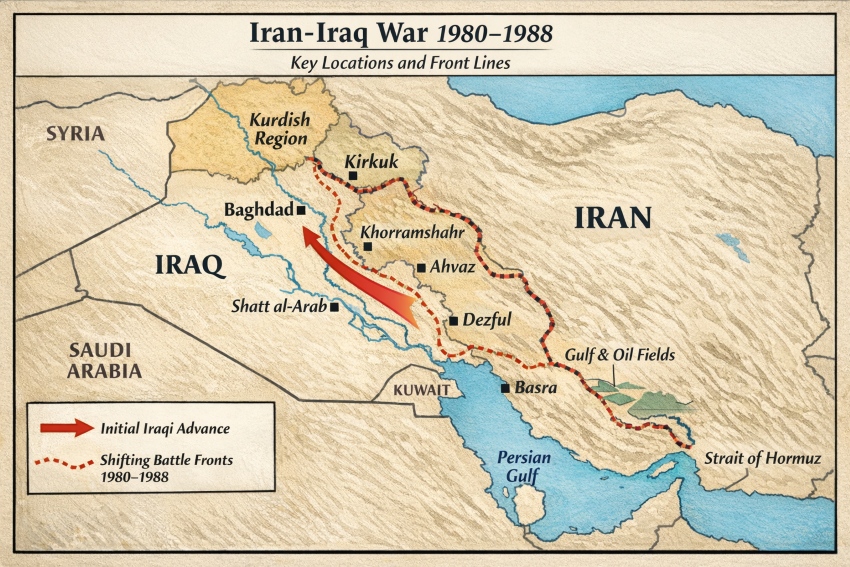
Conflict Snapshot
- Dates: 22 Sep 1980 – 20 Aug 1988
- Type: Interstate war (with substantial external financing/arms support and international diplomacy).
- Primary actors: Republic of Iraq (Baʿathist state under Saddam Hussein) vs Islamic Republic of Iran (post-1979 revolutionary state).
- Theater: Iran–Iraq land border (notably Khuzestan and the Shatt al-Arab/Arvand Rud waterway), plus later maritime and air dimensions.
- Outcome label: UN-brokered ceasefire implemented; territorial status quo ante largely restored; no decisive victory acknowledged by both sides. (Ceasefire under UNSC framework; war ends in 1988.)
- Casualties (ranges) and why they differ:
- Total casualties (killed + wounded): commonly cited around ~1 million (some summaries use broader totals).
- Killed: Britannica summarizes “perhaps 500,000” killed and 1,000,000–2,000,000 total casualties.
- Missing: ICRC notes “tens of thousands” disappeared/missing in connection with the war, a category sometimes counted separately from “killed.”
- Why estimates diverge (high confidence): definitional differences (killed vs total casualties; civilian vs military; missing), incomplete or non-transparent wartime recordkeeping, and whether related campaigns (e.g., chemical attacks and internal security operations) are included in war totals.
- Displacement (ranges) and why they differ:
- A declassified CIA assessment estimated the initial invasion created at least ~1.5 million refugees and reported an estimate of ~1.5 million made homeless (definitions vary between refugees and internally displaced).
- Why estimates diverge (high confidence): time-window differences (early-war vs cumulative), mixing refugees/IDPs/homeless, and uneven reporting during active combat.
- Last updated: 16 Jan 2026.
Timeline of 12 milestones (system-shaping and war-defining)
- 1975 (Algiers Protocol): Iran ends support to Iraqi Kurdish rebels in exchange for Iraqi acceptance of thalweg (deep-channel) boundary in the Shatt al-Arab.
- 22 Jun 1976: Boundary treaty enters into force (UNTS record).
- 1978–1979: Iranian Revolution culminates in collapse of the monarchy and creation of a new revolutionary political order.
- Apr 1979: Formation of the Islamic Revolutionary Guard Corps (IRGC) as a parallel security institution.
- 16 Jul 1979: Saddam Hussein becomes president of Iraq, consolidating control over key state organs.
- 4 Nov 1979: Start of the U.S. embassy hostage crisis—an event that shaped Iran–U.S. relations and the external environment surrounding Iran.
- 17 Sep 1980: Saddam declares the 1975 Algiers arrangements “null and void,” reasserting claims over the Shatt al-Arab; five days later Iraqi forces cross the border.
- 22 Sep 1980: Iraqi air raids and a full-scale invasion begin the war.
- 28 Sep 1980: UNSC Resolution 479 calls on both states to refrain from further force and accept mediation.
- 24–25 May 1982: Iranian forces enter Khorramshahr; Iranica treats this as a major turning point.
- 20 Jul 1987: UNSC Resolution 598 calls for ceasefire and withdrawal to internationally recognized boundaries (core framework later used to terminate the war).
- 20 Jul 1988 – 20 Aug 1988: Iranica records bilateral acceptance of 598 on 20 Jul 1988; Britannica dates the war’s end to 20 Aug 1988; UN then deploys UNIIMOG to verify the ceasefire arrangements.
The pre-war system: what structured the conflict risk
1) The border order and the Shatt al-Arab problem (high-confidence background)
Facts (well-established):
- The Shatt al-Arab/Arvand Rud is economically and strategically significant for both states (ports, oil installations, access to the Gulf).
- The 1975 Algiers arrangements recognized the thalweg principle along the waterway; Iranica describes this as a major settlement after earlier treaties favored an Iraqi position along the eastern bank except limited zones.
- Iranica reports that, in Iraq’s narrative, alleged Iranian non-compliance was used to justify Iraq’s 1980 abrogation; Saddam’s 17 Sep 1980 speech explicitly asserted historical Iraqi authority over the entire waterway.
Interpretations (attributed):
- Iranica frames the boundary dispute as the most contentious territorial issue and a central structural driver of crisis recurrence. (Confidence: High, because the dispute is documented across treaties and official statements.)
2) Regime structures and security institutions (how each state “worked”)
Iraq (Baʿathist state under Saddam): facts
- Saddam consolidated executive power in 1979 and relied on a strong internal security apparatus.
- The ruling Baʿath party’s ideology was Pan-Arabist, advocating Arab political unity and (in its historic doctrine) an Arab nationalist project.
- Iranica links Baʿathist pan-Arab ideological claims to Iraq’s asserted entitlement to Khuzestan (“Arabestan” in Iraqi regime discourse), while also emphasizing the Shatt al-Arab as the most important bone of contention.
Iran (post-revolutionary state): facts
- The revolution produced a new political system and created security institutions intended to defend the revolutionary order; Britannica describes the IRGC as created in 1979.
- Iranica describes the deterioration of bilateral relations after 1979 and records mutual accusations of interference and support for insurgent or opposition actors.
Interpretations (attributed):
- Iranica explicitly describes Iraqi leadership concerns that Iran’s revolutionary ideology and messaging could destabilize Iraq—particularly by mobilizing oppositional networks—while also noting Iraq’s parallel fear of domestic unrest. (Confidence: Medium–High for “concern,” because it is documented as a stated or reported security preoccupation; lower for precise causal weight.)
3) Internal heterogeneity and cross-border insurgency dynamics
Facts (well-established):
- Iranica reports that Iran’s pressure on Iraq in earlier decades included support to Kurdish rebels, and that the 1975 settlement involved Iran ending that support.
- In the immediate pre-war years, Iranica documents cross-accusations: Iraq alleging Iranian interference (including support for banned opposition groups), and Iran alleging Iraqi support for separatist insurgents in Khuzestan; it also records specific border attacks and clashes in 1979–1980.
Interpretations (attributed):
- One common scholarly framing (reflected in encyclopedic synthesis) is that insurgency support and border incidents created a security spiral in which each side interpreted the other’s actions as evidence that bargaining was failing. (Confidence: Medium; the incidents are documented, but “spiral” is an analytical model.)
4) Regional and great-power environment (constraints and enablers)
Facts (well-established):
- Britannica notes Iraq received financial backing from Saudi Arabia and Kuwait and that the United States and the Soviet Union each provided some support to Iraq (forms and timing varied).
- UNSC Resolution 479 (1980) demonstrates early international engagement urging restraint and mediation, though it did not stop the war’s escalation.
Interpretations (attributed):
- Murray & Woods (Cambridge) emphasize access to Iraqi records and decision-making processes “through the lens of the Iraqi regime,” implying the importance of internal Iraqi threat perception and strategy formation as a system-level factor. (Confidence: Medium—strong on Iraqi-side documentation; less direct on Iranian internal records.)
5) Economic structure and strategic geography (why the stakes were high)
Facts (high-confidence, but often under-quantified):
- Iranica explicitly links the Shatt al-Arab corridor to Basra and to major oil installations near the waterway, making it disproportionately valuable relative to its geographic size.
- The waterway’s legal status (sovereignty, navigation, and boundary line) therefore had direct implications for revenue flows and strategic access.
Interpretations (attributed):
- Iranica lists among Iraqi objectives and motives: control of the Shatt al-Arab, capturing claimed territories, and ambitions for regional political-economic influence. (Confidence: Medium—this is an attributed synthesis; specific internal Iraqi deliberations are debated.)
What is well-established vs what is disputed
Well-established (high confidence)
- The Shatt al-Arab boundary dispute and the 1975/1976 settlement architecture (thalweg) were central elements of the bilateral relationship.
- The 1979 Iranian Revolution altered Iran’s internal institutions (including creation of IRGC) and the region’s political context.
- Iraq initiated a large-scale invasion on 22 Sep 1980; UNSC called for restraint on 28 Sep 1980.
- Khorramshahr’s recapture in May 1982 was a major turning point in the war’s trajectory.
- The war terminated through the UNSC 598 framework and a verified ceasefire in 1988 (UNIIMOG mission).
Disputed or analytically contested (flagged for later Parts 2–3)
- Relative weight of territorial aims vs regime-security fears vs opportunism in Iraq’s decision for war.
- The magnitude and categorization of civilian deaths and displacement, and whether some violence episodes are counted “within” war totals.
Key Sources Used (Part 1)
- Encyclopaedia Iranica (Iran–Iraq War entry; Shatt al-Arab/boundary history within the entry).
- Encyclopaedia Britannica (Iran–Iraq War summary; dates/casualty ranges; external support note).
- UN Digital Library / UN Documents (UNSC Res. 479; UNSC Res. 598 records and summaries).
- UN Peacekeeping (UNIIMOG mission overview).
- UN Treaty Series record for the Iran–Iraq boundary treaty framework (entry into force).
- ICRC (missing/disappeared “tens of thousands”).
- Britannica biographies/background: Saddam Hussein; Baʿath Party ideology.
- U.S. Department of State historical summary (Iran hostage crisis date as external-context marker).
- Murray & Woods (Cambridge) description emphasizing captured Iraqi records and Iraqi decision-making lens.
- Declassified CIA assessments (refugee/homelessness estimates; civilian-death estimate as one benchmark).
Open Questions / Uncertainties (to resolve in Parts 2–3)
- Decision calculus in Baghdad (1980): What internal Iraqi documents most directly show prioritized aims (Shatt al-Arab control, Khuzestan, regime security), and how consistently were these aims held across Iraqi leadership? (Confidence: Medium, evidence exists but access/selection matters.)
- Role of insurgency support: How decisive were cross-border insurgency dynamics versus formal territorial disputes in producing war expectations? (Confidence: Medium.)
- External support sequencing: How did the timing and form of external financing and arms transfers affect pre-war bargaining and early-war escalation? (Confidence: Medium—requires granular sourcing.)
- Displacement accounting: What is the best-supported cumulative displacement estimate over 1980–1988 when separating refugees, IDPs, and “homeless,” and how do definitions shift across sources? (Confidence: Low–Medium.)
- Casualty reconciliation: How much of the divergence in “killed” totals is definitional (missing, indirect deaths, inclusion of related campaigns) versus genuine uncertainty? (Confidence: Medium.)