Egypt–Hittite War — Part 5: Aftermath (Who Benefited, What Endured, What Remains Uncertain)
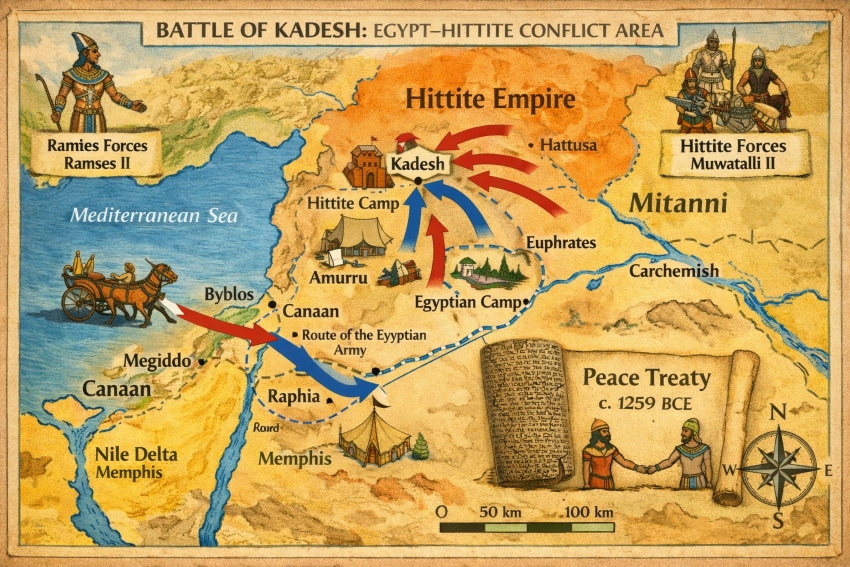
Framing note on evidence
For the “aftermath,” the evidentiary picture shifts. For battle conduct we relied heavily on Egyptian commemorative narratives; for termination we relied on treaty text traditions. For aftermath, the strongest anchors are:
- Continuing diplomatic correspondence preserved (largely) from Hittite archives and catalogued as Egyptian–Hittite correspondence in modern text inventories.
- Material attestations of dynastic linkage (notably the Hittite princess’s Egyptian name on an object).
- Macro-historical endpoints for Hatti’s collapse and the post-empire landscape (primarily later historical synthesis, not local event logs).
This part therefore emphasizes what can be said securely about post-treaty relations and what becomes speculative when we move into the wider Late Bronze Age collapse.
5.1 Short-run aftermath: from adversaries to managed partnership
Continued correspondence as a fact of the relationship
FACT: Modern cataloguing of Hittite texts explicitly includes a category for Egyptian–Hittite correspondence and lists multiple items under Ramesses II, including (a) letters “about Urḫi-Teššup,” (b) marriage letters to Ḫattušili III and to Queen Puduḫepa, and (c) letters from Egyptian royal women to the Hittite court.
FACT (contextualized): Trevor Bryce’s synthesis notes that an extensive corpus of correspondence between the Egyptian and Hittite courts survives in the archives of Hattusa and that these exchanges include both routine diplomatic matters and sharper disputes, including acrimonious exchanges over the fate of Ḫattušili’s displaced predecessor Urhi-Teššup.
INTERPRETATION (Medium confidence): Taken together, the cataloguing evidence and Bryce’s treatment support a conservative conclusion that the treaty did not merely “end fighting” in the abstract—it opened (or normalized) a working diplomatic channel that had to manage ongoing disputes and practical coordination problems.
Dynastic linkage as a reinforcement (and its evidentiary footing)
FACT: A British Museum plaque (EA20821) bears the Egyptian name Maathorneferura and is described as belonging to “the Hittite princess married to Ramses II by the year 34 treaty.”
INTERPRETATION (Medium confidence): Dynastic marriage is plausibly a stabilizing device: it increases reputational and political costs of renewed war and provides an elite-level relationship that can be mobilized during disputes. However, the marriage is not, by itself, proof that the relationship was harmonious or that no military incidents occurred at lower levels; it is best treated as evidence of high-level intent to sustain the diplomatic settlement.
What “peace” likely looked like on the ground
FACT (macro-level): The surviving correspondence categories strongly imply continuing attention to politically sensitive issues—succession disputes (Urhi-Teššup), returns of persons, and marriage arrangements.
INTERPRETATION (Medium confidence): A plausible “peace in practice” model is: the great-power frontier became less a battlefield and more a managed system of vassal discipline, extradition/returns, and status negotiation. This is consistent with the treaty’s known focus on mutual obligations (as discussed in Part 4) and with the post-treaty correspondence themes.
5.2 Stakeholder outcomes: winners and losers on both sides (without assuming motives)
This section avoids claims about private intentions. It instead frames outcomes in terms of observable constraints and deliverables after the treaty.
Egypt (Ramesses II and the Egyptian state)
Likely gains (evidence-based, Medium confidence):
- Strategic stabilization: the existence of sustained diplomatic exchange and dynastic marriage indicates that Egypt gained a more predictable northern relationship than the pre-treaty rivalry implied.
- Prestige management: Egyptian commemorative culture could continue to present Kadesh in favorable terms while the state operated under a negotiated settlement; the very coexistence of triumph narrative and treaty practice is part of the Ramesside “outcome.” (This is an inference about political messaging, not a claim about sincerity.)
Likely costs/limits (evidence-based, Medium confidence):
- No clear restoration of maximal northern aims: if Ramesses’s stated objective is summarized as “recapturing Kadesh” (as modern syntheses commonly phrase it), the fact that a later treaty was needed implies that battlefield action did not resolve the territorial contest decisively.
- Ongoing dispute management: the persistence of contentious correspondence (e.g., Urhi-Teššup) suggests that “peace” required continuous diplomatic labor rather than being self-enforcing.
Hatti (Ḫattušili III’s regime and the Hittite imperial system)
Likely gains (evidence-based, Medium confidence):
- Recognition as an equal great-power counterpart: the scale of correspondence and the eventual dynastic marriage implies an Egypt–Hatti relationship framed as peer-to-peer, not as a simple submission dynamic.
- Regime-security utility: correspondence categories about Urhi-Teššup and related disputes are consistent with a post-treaty environment in which Hatti sought to manage legitimacy and internal security with Egyptian cooperation or at least Egyptian non-interference.
Likely costs/limits (evidence-based, Medium confidence):
- Constraints on coercion in the south: a treaty-plus-correspondence regime constrains opportunistic raiding and makes support for rebels or defectors riskier (because disputes can be litigated diplomatically, and extradition expectations exist in the treaty logic). The fact that such issues remain active in correspondence implies continuing friction and bargaining costs.
Bottom line (Interpretation, Medium confidence): The most defensible stakeholder assessment is mutual: both courts gained strategic predictability and a workable partnership, while both accepted limits on unilateral action in the contested zone and incurred ongoing diplomatic transaction costs.
5.3 Long-run aftermath: the treaty in the shadow of the Late Bronze Age collapse
The collapse of Hittite imperial power
FACT (macro-historical synthesis): Britannica dates the fall of the Hittite empire to around c. 1193 BCE, describing it as sudden and associating it with large-scale migrations including the Sea Peoples; it also notes that some Syrian dominions retained “Hittite identity” for centuries as smaller polities later absorbed by Assyria.
FACT (post-collapse landscape): Britannica’s Anatolia overview emphasizes that written records are relatively few for the period between roughly 1200 and 1000 BCE, and it describes the emergence of multiple neo-Hittite states extending into northern Syria after the empire’s breakup.
INTERPRETATION (Medium–Low confidence): The treaty’s long-run “effectiveness” is difficult to measure with precision because the best macro endpoint—Hatti’s collapse—reflects systemic regional disruptions for which causal mechanisms are debated and documentation is uneven. It is methodologically safer to say: the treaty created a documented framework for great-power cooperation during the late 13th century BCE, but it did not “immunize” either state from the broader structural shocks of the early 12th century BCE.
What likely endured (and what we cannot responsibly claim)
More defensible (Medium confidence):
- The Egyptian–Hittite relationship after the treaty appears to have remained diplomatically active and included marriage linkage—at least into the later regnal decades of Ramesses II.
Less defensible without additional sources (Low confidence):
- Claims that the treaty “remained in force” uninterrupted until the Hittite collapse are common in modern retellings, but establishing continuous compliance would require specific evidence of border incidents (or lack thereof) across decades—evidence that is not fully recoverable from the high-level sources used in this series so far.
5.4 Modern afterlife: why this treaty is remembered (and how that shapes interpretation)
“Oldest surviving peace treaty” as a modern label
FACT (modern institutional memory): UN media captions describe a replica of the “Kadesh Peace Treaty” as “the earliest peace treaty whose text is known to have survived,” reflecting its modern diplomatic symbolism.
FACT (display claim): A Turkish Ministry of Foreign Affairs note states that a replica was presented by Turkey and is displayed at UN Headquarters “at the entrance to the Security Council chamber.”
Caution (FACT about disagreement): That Turkish MFA note also gives a date (“1279 BC”) for the treaty, which conflicts with the widely used conventional dating (~1259 BCE) employed in scholarly catalogues and in earlier parts of this series. The display context is therefore best used for the modern commemoration claim (replica at the UN), not as the primary anchor for ancient chronology.
INTERPRETATION (Medium confidence): Modern commemoration can subtly pull interpretation toward “peace treaty as closure,” whereas the ancient record (including post-treaty correspondence themes) suggests a more realistic model: a peace-and-alliance instrument that required ongoing management.
Timeline: Aftermath milestones (11 items)
- c. 1259 BCE — Treaty concluded (conventional dating; chronology varies by scheme).
- Post-1259 BCE — Sustained diplomatic correspondence between Egypt and Hatti continues, preserved in Hittite archives and catalogued in modern inventories.
- Post-treaty decades — Letters and disputes include matters relating to Urḫi-Teššup (a displaced predecessor), indicating continued political sensitivity.
- Year 34 of Ramesses II (relative date) — Hittite princess Maathorneferura is attested as married to Ramesses II (British Museum plaque description).
- Late 13th century BCE — Ongoing marriage-related correspondence and logistical negotiation occur (as characterized in Bryce’s synthesis).
- 1213 BCE — End of Ramesses II’s reign (absolute dating depends on chronology; used here as a common anchor for “end of his reign”).
- c. 1200 BCE — Documentary scarcity increases for Anatolia and parts of the Near East; written records become fewer for 1200–1000 BCE.
- c. 1193 BCE — Britannica’s date for the sudden fall of the Hittite empire, associated with large-scale migrations including Sea Peoples.
- c. 1180 BCE onward — Emergence of neo-Hittite states in Anatolia/northern Syria after imperial breakup.
- Modern era — Replica of the treaty is used as a diplomatic symbol at the UN; UN media captions describe it as the earliest surviving peace treaty text.
- 2005 — Turkish MFA note reiterates the UN display location claim for the replica (useful for modern commemoration context).
What is well-established vs what is disputed (Aftermath)
Well-established (High confidence)
- A post-treaty diplomatic relationship existed, evidenced by catalogued Egyptian–Hittite correspondence items (including marriage letters and Urhi-Teššup-related letters).
- A dynastic marriage link in Ramesses II’s later reign is materially attested (Maathorneferura).
- The Hittite empire collapsed around the late 13th/early 12th century BCE; Britannica dates this c. 1193 BCE and links it to broader upheavals.
Disputed / uncertain (Medium–Low confidence)
- How continuous and incident-free the treaty relationship was across decades (we have correspondence themes, but not a complete “border incident ledger”).
- The degree to which the treaty encoded a precise territorial settlement versus a broader non-aggression/alliance framework (requires deeper vassal-level evidence than used here).
- The relative causal importance of the treaty in shaping the late 13th century balance compared with other drivers (regional threats, internal Hittite dynamics, economic and demographic pressures). (Interpretive; confidence varies by scholar.)
- Modern public labels (e.g., “Kadesh Treaty” dating on exhibits) sometimes conflict with scholarly chronologies; display sources should not be treated as chronology authorities.
Key Sources Used (Part 5)
- Hethport CTH index — catalog evidence for the existence and themes of Egyptian–Hittite correspondence (Urhi-Teššup letters; marriage letters; royal women’s letters).
- Trevor Bryce (2003), Letters of the Great Kings of the Ancient Near East — synthesis on the corpus’ survival in Hattusa archives and on marriage negotiation and dispute themes.
- British Museum object EA20821 — material attestation of Maathorneferura as Hittite princess married to Ramesses II (Year 34 framing).
- Britannica: “Hittite” — macro-historical endpoint and post-collapse persistence of neo-Hittite identities in Syria.
- Britannica: “Anatolia from the end of the Hittite Empire…” — post-collapse documentary scarcity and emergence of neo-Hittite states.
- UN media captions — modern institutional framing of the treaty replica as the earliest surviving peace treaty text.
- Turkish MFA note (2005) — claim about the replica’s display location at the UN (used for modern commemoration context only).
Open Questions / Uncertainties (highest value next steps)
- Compliance record: Which specific episodes (returns of persons, dispute settlements, border incidents) can be dated and connected to the treaty regime, and with what evidentiary strength?
- Local Levantine perspective: What can be established about vassal polities’ experience of the settlement (especially in the Kadesh/Amurru orbit) from non-royal archives?
- Chronology harmonization: How should the series present absolute dating ranges (battle, treaty, marriage) across competing chronologies in a consistent, reader-friendly way?
- Propaganda vs practice: How did Egyptian monumental memory of Kadesh interact with decades of pragmatic partnership—did it shape later domestic legitimacy narratives in measurable ways?
- Systemic collapse linkage: To what extent can we connect Egypt–Hatti détente to broader Late Bronze Age systemic stress (trade disruption, migrations, internal fragmentation) without overstating causality?