Egypt–Hittite War — Part 4: Termination (Negotiation, Settlement, and Enforcement)
Termination context: what “ending the war” meant in practice
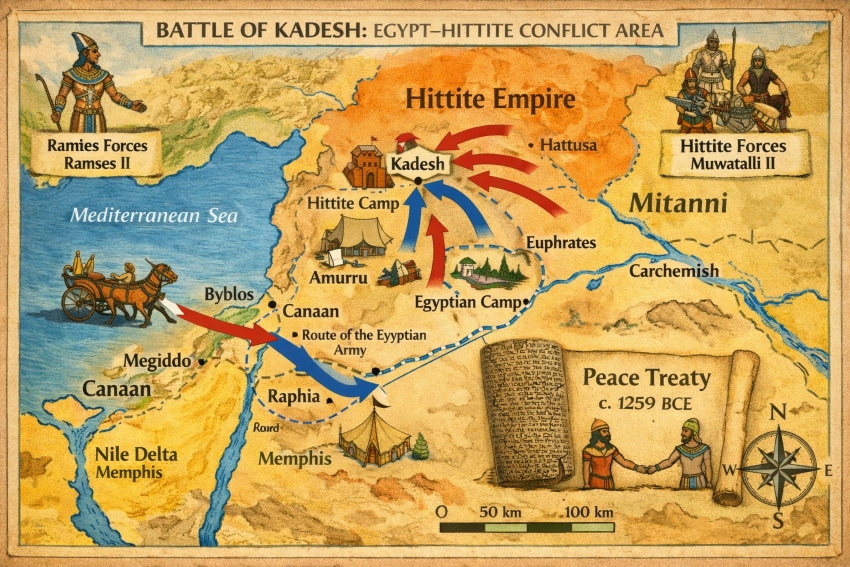
For Egypt under Ramesses II and Hatti under Hattusili III, “termination” did not mean a single battlefield decision at Kadesh. Egyptian monumental texts present Kadesh as a triumph narrative, while other evidence supports a more mixed or inconclusive operational outcome. The British Museum notes that Egyptian texts (the “Bulletin” and the “Poem”) attribute victory to Ramesses II with divine aid, and that both sides could claim success.
In that setting, the practical problem of ending the conflict was to stabilize a contested frontier in the Levant and prevent renewed campaigning. The principal mechanism that survives in high-resolution detail is the written peace-and-alliance treaty (often called the “Egyptian–Hittite peace treaty” or, by later convention, the “Treaty of Kadesh,” though it was concluded elsewhere). The treaty is conventionally dated to 1259 BCE (with the usual caveat that absolute BCE years depend on the chronology used), and it was concluded after the two kingdoms “had previously been at odds over territory in the Levant.”
The negotiation channel: envoys and the “silver tablet”
Fact pattern (from the Egyptian treaty’s introductory protocol): The Egyptian version dates the agreement to Year 21, first month of winter, day 21, and places Ramesses II at Pi-Ramesses when envoys arrived carrying “the tablet of silver” that Hattusili had “caused to be brought” to Pharaoh “in order to beg peace.”
A few points are analytically important:
- Diplomacy ran through formal messengers. The narrative frame is not a summit between kings but a credentialed exchange via envoys, consistent with Late Bronze Age “great king” diplomacy.
- The treaty was conceived as a durable written instrument. The text repeatedly frames itself as an enduring commitment and—crucially—ties compliance to divine witnessing and oaths (discussed below).
- The “silver tablet” matters as a status object. Even if the Egyptian introduction uses formulaic language, it signals that the agreement was presented as a high-prestige diplomatic document.
Interpretation (Medium confidence): The Egyptian introductory claim that Hattusili “beg[ged] peace” can be read as rhetorical positioning (i.e., a presentational choice that flatters Egyptian prestige rather than a neutral description of bargaining leverage). This is consistent with the general pattern of Egyptian monumental self-presentation around the Kadesh cycle.
Settlement terms: what the treaty actually committed each side to do
A key advantage of the Egypt–Hatti settlement is that we can describe its content from the treaty text itself (while noting that versions differ and parts are damaged).
1) Core commitment: peace and non-aggression
The treaty repeatedly frames the relationship as “peace” and “brotherhood,” and it contains explicit non-aggression language (no plundering/raiding into the other’s land).
2) Mutual defense against external enemies
A central clause is a defensive alliance: if an “enemy” comes against Hatti and Hattusili requests help, Ramesses is to send troops and chariots; and the parallel commitment applies in the opposite direction.
This matters because it is not merely a ceasefire; it is a formal reclassification of the other party from adversary to (conditional) partner against third parties.
3) Cooperation against internal rebellion
The treaty also addresses internal threats: if one king is “incensed” at servants who “sin” against him (i.e., rebellion/insubordination), the other side is obligated to assist in suppressing opposition.
Interpretation (High confidence): Clauses of this type reduce incentives for proxy warfare and frontier destabilization by denying rebels a safe external patron—at least on paper.
4) Succession / legitimacy clause (fragmentary)
The text appears to have included a clause relating to succession or recognition of an heir, but both versions are fragmentary and scholars treat the content as partly conjectural.
Interpretation (Low–Medium confidence): Where such clauses exist in related Hittite diplomatic practice, they can function as regime-security devices. For this specific treaty, the fragmentary state prevents strong claims beyond “some succession/recognition issue was likely addressed.”
5) Extradition: “important fugitives” and “unknown” persons
The treaty contains unusually explicit extradition provisions:
- High-status (“great man”) fugitives (and possibly seceding towns/districts): If a “great man” flees from Egypt to Hatti, Hatti “shall not receive” him but must cause him to be brought back to Ramesses.
- Lower-status (“unknown”) fugitives: If “one man or two men who are unknown” flee to Hatti “to be servants of another,” they are not to be left there; they are to be brought back to Egypt.
- Reciprocal clauses: The treaty mirrors these obligations in the other direction—Egypt must not “receive” fugitives from Hatti and must return them.
Interpretation (High confidence): Extradition clauses reduce the risk that the frontier becomes a recruitment pool for defectors, dissidents, or opportunistic local elites—an issue that plausibly mattered in contested Levantine polities.
6) Witnessing and sanction: the gods as enforcement infrastructure
The treaty explicitly invokes “a thousand gods” of both lands as witnesses to the words written “upon this tablet of silver.”
This is not window dressing in the internal logic of Late Bronze Age diplomacy: treaties routinely treat divine witnessing as a compliance mechanism (curse/blessing logic), even if modern analysts would frame enforcement differently.
Enforcement and compliance: how the settlement was meant to “hold”
Because we lack a modern enforcement body, the treaty’s durability depended on overlapping mechanisms:
A) Formal duplication, inscription, and archival survivability
Langdon and Gardiner emphasize that a hieroglyphic treaty text was set up on major stelae in Karnak and the Ramesseum, while a cuneiform version (in Babylonian diplomatic language) was recovered from the Hittite capital’s archives at Boğazköy/Hattusa—evidence of deliberate duplication across polities and scripts.
Interpretation (Medium confidence): Public inscription in Egypt likely served both commemorative and domestic-legitimating functions, whereas archival copies in Hatti served administrative and diplomatic reference needs. The treaty can thus be simultaneously “international law” and “political communication.”
B) Oaths placed before gods: a contemporaneous view of bindingness
A separate text tradition preserves the idea that sworn oaths were physically placed “under the feet” of major gods (Teshub in Hatti; Re in Egypt), explicitly framing the gods as witnesses and guarantors.
C) Dispute-management through correspondence and reaffirmation
In the same corpus (as compiled in Luckenbill), Ramesses is represented denying treaty violation and reaffirming “good brotherhood and good peace” in relation to the “matter of Urhi-Teshub,” while again invoking the oath’s divine witnessing.
Caution on source-use: Luckenbill’s compilation is early 20th-century scholarship and translations have evolved, but it remains useful here as a window into (i) the conceptual vocabulary of oath-bindingness and (ii) the existence of “treaty compliance” discourse in surviving texts.
D) Relationship-deepening via dynastic marriage
Material culture supports a later dynastic linkage: a British Museum object (EA20821) identifies the Egyptian name Maathorneferure as a Hittite princess “married to Ramses II by the year 34 treaty.”
Interpretation (Medium confidence): Dynastic marriage can be read as a reinforcement mechanism—raising the political cost of renewed war and creating elite networks invested in continuity. It is not, by itself, proof of perfect compliance, but it is consistent with an alliance relationship rather than a mere pause in hostilities.
Victory criteria vs. results: what “termination” delivered relative to aims
Because this project avoids motive-inference, the safest approach is to distinguish (i) what the treaty text commits to and (ii) how historians interpret why that bargain became acceptable.
What the settlement clearly delivered (high confidence)
- A durable non-aggression framework.
- A mutual defense pact and cooperation against internal challengers.
- A structured regime for returning fugitives, limiting sanctuary and defection across the frontier.
- A legitimacy- and religion-infused enforcement model (divine witnesses, oaths, written tablets).
How historians commonly interpret the bargain (attributed)
One recent academic framing (Guo, 2022) describes the treaty as an “implicit recognition…of a territorial status quo,” arguing that its conclusion was “probably enhanced” by external pressures and internal concerns about rule and succession.
Interpretation (Medium confidence, attributed): A “status quo recognition” reading is consistent with the treaty’s structure (peace + alliance + extradition) and with the fact that it is concluded long after Kadesh rather than immediately after it.
Interpretation (Low–Medium confidence, attributed): Specific causal weight placed on particular external threats or internal legitimacy concerns depends on broader reconstructions beyond the treaty text itself and varies by scholar; this should be treated as a hypothesis rather than a directly observed fact.
Timeline: termination and settlement milestones (8–12 items)
- c. 1275 BCE — Battle of Kadesh fought; Egyptian textual tradition later frames it as a Ramesside success; modern summaries often describe no outright victor.
- After Kadesh (mid–late 13th c. BCE) — Continued rivalry over Levantine territories is the background condition for later diplomacy (general context).
- 1259 BCE (conventional dating) — Peace treaty concluded between Egypt and Hatti.
- Ramesses II, Year 21, I Peret 21 (Egyptian dating formula) — Treaty protocol places the event at Pi-Ramesses, with envoys delivering a “tablet of silver” associated with peace-making.
- Treaty clauses (same occasion) — Mutual defense obligations articulated (“troops and chariots” assistance).
- Treaty clauses (same occasion) — Extradition of “great man” fugitives and of “unknown” persons formalized, with reciprocal obligations.
- Treaty clauses (same occasion) — “A thousand gods” of both lands invoked as witnesses to the words written on the “tablet of silver.”
- Public commemoration in Egypt (date uncertain; Ramesside period) — Hieroglyphic treaty set on stelae at Karnak and the Ramesseum.
- Ramesses II, Year 34 — Dynastic marriage: Maathorneferure identified as a Hittite princess married to Ramesses II (material attestation in a British Museum object description).
- 1906 CE — Discovery of Hittite palace archives at Boğazköy/Hattusa (context for recovering cuneiform treaty copies).
- 1916–1920 CE — Publication and comparative treatment of cuneiform and Egyptian versions (philological milestone that shapes modern reconstructions).
What is well-established vs. what is disputed
Well-established (High confidence)
- A formal treaty of peace/alliance exists and is preserved in Egyptian and Hittite textual traditions.
- The Egyptian treaty protocol dates the agreement to Year 21, specifies Pi-Ramesses, and describes envoys carrying a “silver tablet.”
- Core obligations include mutual defense, cooperation against internal challengers, and extradition/return of fugitives (with reciprocal structure).
- Divine witnessing is explicit and central to the treaty’s self-presentation.
- A later dynastic marriage connection is materially attested (Maathorneferure).
Disputed / limited by evidence (Medium–Low confidence, depending item)
- The precise content and force of the succession/recognition clause, due to fragmentary text.
- The best absolute BCE year for the treaty under different chronologies (1259 is conventional; chronologies vary).
- Whether the Egyptian framing (“beg peace”) reflects bargaining reality or primarily Egyptian rhetorical posture (often treated as rhetorical).
- The relative causal weight of external threats vs. internal legitimacy dynamics in driving settlement (interpretive; varies by scholar).
Key Sources Used
- Langdon & Gardiner (1920), The Journal of Egyptian Archaeology: parallel presentation and analysis of treaty clauses; crucial for the Egyptian protocol date/location, extradition clauses, and divine witnesses.
- CDLI Wiki: concise description and conventional treaty date (1259 BCE) with bibliographic pointers.
- Luckenbill (1921), Hittite Treaties and Letters (Attalus): early compilation useful for oath/witness framing and compliance discourse in related correspondence (with the caveat that translations have evolved).
- British Museum collection entries: (i) contextualizes the Egyptian “Bulletin” and “Poem” tradition; (ii) object evidence for Maathorneferure and the Year 34 marriage linkage.
- Britannica (Battle of Kadesh): modern general reference summarizing the battle’s scale and inconclusive outcome and noting post-treaty dynastic ties (used cautiously as a tertiary synthesis).
- Guo (2022) (author-uploaded access): interpretive claim that the treaty recognized a territorial status quo and discussion of possible contributing pressures (used explicitly as interpretation, not as primary evidence).
Open Questions / Uncertainties (for Part 5 follow-through)
- Territorial practice vs. treaty language: How consistently did local Levantine polities experience the “status quo” implied by the settlement (given fragmentary local documentation)?
- Succession clause specifics: What, if anything, can be recovered about recognition of heirs from other related tablets or later references?
- Compliance record: Which concrete incidents best demonstrate treaty enforcement (extraditions, joint responses to threats), and how securely are they dated?
- Domestic politics and propaganda: How did the treaty’s public inscription function inside Egypt relative to the Kadesh victory narrative?
- Long-run durability: Through what mechanisms did the relationship persist across later decades, and where do we see the first signs of strain (if any) before the wider Late Bronze Age disruptions?