Part 2 — Road to War: Why Kadesh Became the Flashpoint (c. late 14th–mid 13th century BCE)
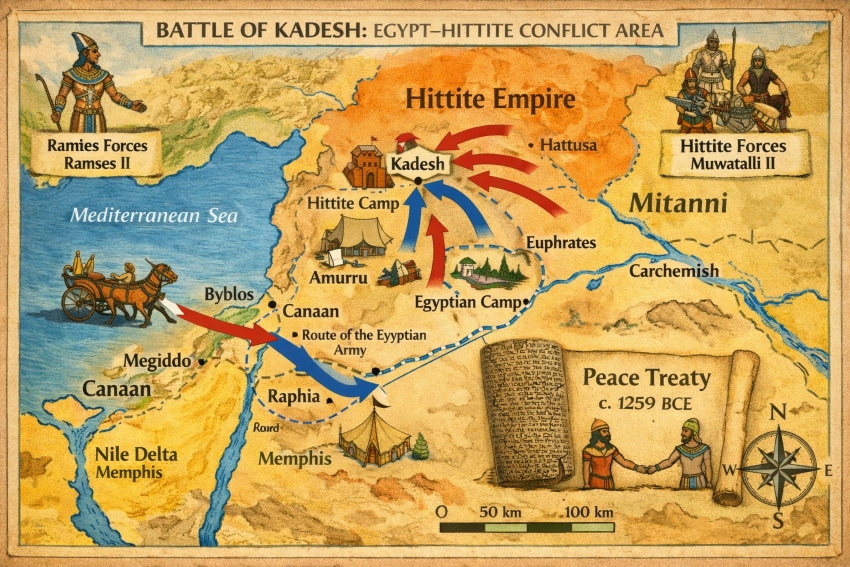
1) The bargaining problem in “international” Late Bronze Age politics
FACT: By the Late Bronze Age, Egypt and Hatti were two of several “Great Kingdoms” whose rulers interacted through diplomacy as well as warfare, including regular messenger traffic, negotiated settlements, and attempts to apportion spheres of influence.
INTERPRETATION (High confidence): This diplomatic system reduced—but did not eliminate—major interstate wars. It worked best when borders and vassal allegiances were stable, and least well when small client polities could shift allegiance (or be coerced into shifting). This framing is common in modern syntheses of the period’s interstate relations.
Why this matters for Kadesh: Kadesh sat in a frontier zone where (a) control carried symbolic weight, (b) it affected access along the Orontes corridor, and (c) it intersected with the status of nearby polities such as Amurru. When the “rules” of who belonged in which sphere were unclear—or changed suddenly—the system tended to escalate toward coercion and force.
2) From Seti I’s northern campaigns to an “uneasy peace”
FACT: Egyptian state inscriptions and later scholarship treat Seti I’s Levantine operations as part of a wider contest over the northern frontier. One modern scholarly work emphasizing the evidentiary limits notes that Seti I’s Karnak war reliefs depict the capture of Kadesh, but the key dating text is lost—meaning the precise campaign date is uncertain even if the episode itself is widely accepted in Egyptological discussion.
INTERPRETATION (Medium–High confidence): Trevor Bryce characterizes Seti I’s clash with Hatti over Amurru and Kadesh as yielding a fairly even division of influence in Syria and an “uneasy peace” that functioned as a pause before Ramesses II’s later showdown with Muwatalli II. Bryce explicitly cautions that Egyptian royal monuments contain rhetoric that must be separated from recoverable fact.
What can be said neutrally: By the end of Seti I’s reign, both powers had credible claims (and local supporters) in the contested zone, and neither appears to have achieved a settlement that prevented renewed confrontation. This is consistent with the pattern Bryce describes and with the broader “Great King” diplomatic environment he outlines.
3) Ramesses II’s early reign: signaling, preparation, and the problem of vassals
FACT: The Egyptian narrative tradition presents Ramesses II as continuing an expansionist northern policy associated with his predecessors, with Kadesh as a principal objective. Britannica summarizes the basic Egyptian framing: Ramesses sought to “wrest Canaan and Syria from the Hittites” and to recapture the Hittite-held city of Kadesh.
FACT (with evidentiary limits): Modern scholarship often refers to an early Levantine campaign prior to Kadesh. A recent academic thesis (2025) states that Ramesses II’s first campaign occurred in his regnal year 4 and associates it with the erection of monuments (stelae) in coastal cities such as Tyre and Byblos; this supports the general proposition of a preparatory phase, though it is not the only possible reconstruction and depends on how one correlates monuments, regnal years, and routes.
INTERPRETATION (Medium confidence): Many reconstructions treat the lead-up as a classic frontier “credibility” contest: if Egypt could not sustain client loyalties in the Levant, its network of tribute, ports, and marching routes would erode; if Hatti could not protect (or reclaim) key vassals, its Syrian system would look vulnerable. This interpretation is compatible with Bryce’s emphasis on spheres of influence and vassal administration in the region.
4) The trigger sequence: why the crisis centered on Kadesh (rather than a negotiated fix)
A neutral reconstruction of “trigger sequence” needs to separate what the Egyptian narrative says happened from what modern historians infer.
4.1 The Egyptian narrative trigger: deception and a forced contact battle
FACT (Egyptian account as preserved/translated): The main Egyptian textual tradition for Kadesh is conventionally called the “Poem” (also “Literary Record”) and the “Bulletin/Record.” The British Museum’s catalog entry for Papyrus Sallier III summarizes that these texts present an Egyptian perspective and attribute victory primarily to Ramesses II (with divine support), while noting scholarly debate about whether the “Poem” is truly verse.
FACT (from a scholarly translation tradition): John A. Wilson’s publication (1927) provides translations of the Poem and Record from multiple copies and stresses that the Poem is rhetorically shaped and must be used cautiously for extracting “historical fact.”
FACT (as summarized by Britannica): Britannica reports that Ramesses’ forces captured two men who claimed the Hittite army was far away near Aleppo, but these were loyal agents; the Hittites were actually near at hand and attacked.
INTERPRETATION (Medium confidence): Whether the deception episode occurred exactly as described cannot be independently verified from Egyptian material alone; however, the episode’s function in the Egyptian narrative is clear: it explains an Egyptian operational surprise while preserving the king’s heroic agency. This is consistent with Wilson’s warning and the British Museum’s description of the text’s self-glorifying structure.
4.2 The strategic trigger in modern reconstructions: a contested frontier network
INTERPRETATION (Medium–High confidence): Modern reconstructions commonly treat Kadesh as the focal node in a wider competition over Syrian overlordship and vassal alignment. Bryce’s synthesis explicitly frames Seti I’s earlier confrontation and the subsequent “respite” as leading toward a renewed clash under Ramesses II and Muwatalli II, implying a structural drive to revisit unresolved territorial and vassal questions.
5) Mobilization and march: what the sources actually show (and what they do not)
FACT (as preserved in the Egyptian textual tradition): The Egyptian account describes an army on campaign with named divisions and positional sequencing. In Wilson’s translated presentation, the army’s divisions appear in the narrative framework (including references to the division of Sutekh/Set and others) as the force approaches the Kadesh area.
FACT (source criticism): The Egyptian record survives in multiple monumental copies, and later collation work indicates complex composition and reworking of the relief-text complex over time. The University of Memphis “Hypostyle Hall Project” field report notes that collation of the palimpsest of Kadesh reliefs and the “Bulletin” has revealed more traces than earlier investigators found, and that portions of the relief program were not completed before being altered.
Implication (High confidence): The Kadesh narrative is unusually well-attested for the Bronze Age, but it is not a stenographic battlefield log. It is a curated complex of text-and-image production with identifiable editorial and monumental aims—an important constraint when reconstructing the precise road-to-war sequence.
Timeline: Road-to-war milestones (8–15 dated anchors, with uncertainty noted)
Dates are approximate and reflect common scholarly chronologies; specific regnal-year conversions remain debated.
- 14th century BCE (Amarna-era baseline): Kadesh and nearby polities appear in the diplomatic landscape in ways that later frame the contested frontier problem (via later syntheses of the “Syrian principalities” environment).
- c. late 14th–early 13th century BCE: Hittite expansion and consolidation in Syria creates a more durable Hittite presence north of Egyptian-held zones (contextualized in modern overviews of the era’s “Great Kingdom” system).
- Reign of Seti I (early 13th century BCE): Seti I’s Karnak war reliefs depict operations in the contested zone, including a claimed capture of Kadesh; the precise dating is uncertain due to missing text.
- Late Seti I reign (interpretive dating): Some modern scholarship places Seti I’s Kadesh-related campaign in the later half of his reign (while stressing evidentiary gaps).
- 1279 BCE (approx.): Accession of Ramesses II (relative anchor for regnal-year references used in Egyptian texts and later scholarship).
- Regnal Year 4 (approx. 1276 BCE in one reconstruction): An academic thesis argues for a Levantine campaign and monument erection (Tyre/Byblos stelae) as evidence of pre-Kadesh activity.
- Regnal Year 5 (often placed 1275 BCE in some references): The Egyptian campaign culminates at/near Kadesh; Britannica dates the battle to 1275 BCE and frames it as a major chariot engagement with no outright victor.
- Approach to Kadesh (Egyptian narrative): The Egyptian account describes misleading intelligence (captured men/nomads) and a near-immediate Hittite attack.
- Immediate aftermath (strategic consequence in Bryce): Bryce describes Egyptian retreat and subsequent territorial consequences inconsistent with a decisive Egyptian victory claim, emphasizing the divergence between Egyptian monumental rhetoric and longer-term outcomes.
- Long-run endpoint (contextual anchor): The later peace treaty is the best-documented formal stabilization mechanism in this rivalry (full termination is addressed in Parts 4–5), with a cuneiform version preserved and cataloged among Hittite texts.
What is well-established vs what is disputed (for the road-to-war phase)
Well-established (High confidence)
- Kadesh was a contested frontier objective in the Egypt–Hatti rivalry, framed in Egyptian tradition as a goal of recapture and northern expansion.
- The Egyptian account is dominated by the Poem/Bulletin tradition, preserved across multiple monumental copies and papyri, and it is rhetorically shaped to elevate Ramesses II.
- Seti I’s reign forms an immediate prehistory for the crisis; scholarship acknowledges a Seti I episode involving Kadesh in royal relief tradition, while emphasizing missing dating evidence.
Disputed / less secure (Medium to Low confidence)
- Exact sequencing and reliability of the “deception” episode (two men/nomads) as an operational cause of surprise: it is clearly present in the Egyptian narrative but hard to corroborate independently.
- Details of pre-Kadesh campaigning in regnal year 4 (route, scope, and political effects): supported by monument-based argument in recent scholarship, but not universally fixed because correlations between monuments and campaign phases vary.
- How stable any “post-Seti” settlement was (formal treaty vs informal accommodation): Bryce uses “uneasy peace” language; the underlying documentation is fragmentary and filtered through royal narratives.
Key Sources Used (Part 2)
- British Museum, Papyrus Sallier III catalog entry — concise, source-critical overview of the Poem/Bulletin tradition and scholarly cautions on genre and bias.
- Encyclopaedia Britannica, “Battle of Kadesh” — high-level synthesis including aims, deception episode summary, and “no outright victor” framing (good for baseline claims, limited for technical detail).
- Trevor Bryce, Letters of the Great Kings of the Ancient Near East — modern synthesis of Late Bronze Age interstate relations; includes interpretation of Seti-to-Ramesses transition and post-battle consequences; contains explicit rhetoric-vs-fact cautions.
- Peter J. Brand, The Monuments of Seti I (text via archive reproduction) — scholarly note that Seti’s reliefs depict capture of Kadesh but the key dating text is lost (critical for evidentiary uncertainty).
- John A. Wilson (1927), “The Texts of the Battle of Kadesh” (accessed via a hosted copy) — early but still foundational translation work; explicitly warns against reading the Poem as straightforward reportage; useful for identifying internal narrative structure.
- University of Memphis, Hypostyle Hall Project field report — evidence that Kadesh relief-text programs were complex, revised, and in parts unfinished, reinforcing source-criticism constraints.
- Recent academic thesis (2025) on Levantine monument context — supports an argument for a pre-Kadesh “year 4” campaign phase via monument evidence; useful but not a consensus anchor on its own.
- CDLI entry for the treaty between Hattusili III and Ramesses II — authoritative catalog anchor for later settlement documentation (used here only as a contextual endpoint marker).
Open Questions / Uncertainties (to carry into Parts 3–4)
- What elements of the Egyptian “deception” narrative reflect field reality vs literary convention? (Confidence: Medium for “something went wrong in intelligence”; Low for exact details.)
- How should Seti I’s Kadesh episode be dated and contextualized given the loss of the main dating text? (Confidence: High that reliefs depict the claim; Medium on dating within the reign.)
- How robust was the “uneasy peace” framework prior to Ramesses II’s march? Was it an informal accommodation, a temporary balance, or a sequence of local contests without a clear great-power settlement? (Confidence: Medium.)
- How decisive was any “year 4” campaign in shifting vassal alignments before the Kadesh showdown? (Confidence: Medium that pre-Kadesh campaigning occurred; Low–Medium on its specific political effects.)
- What can be reconstructed from Hittite-side materials about pre-battle diplomacy and mobilization relative to the very rich Egyptian monumental account? (Confidence: Medium that Hittite archives help “balance” assessments; Low on specifics without fuller corpus review.)