Part 4 — Termination (negotiations, settlement terms, enforcement, victory criteria vs results)
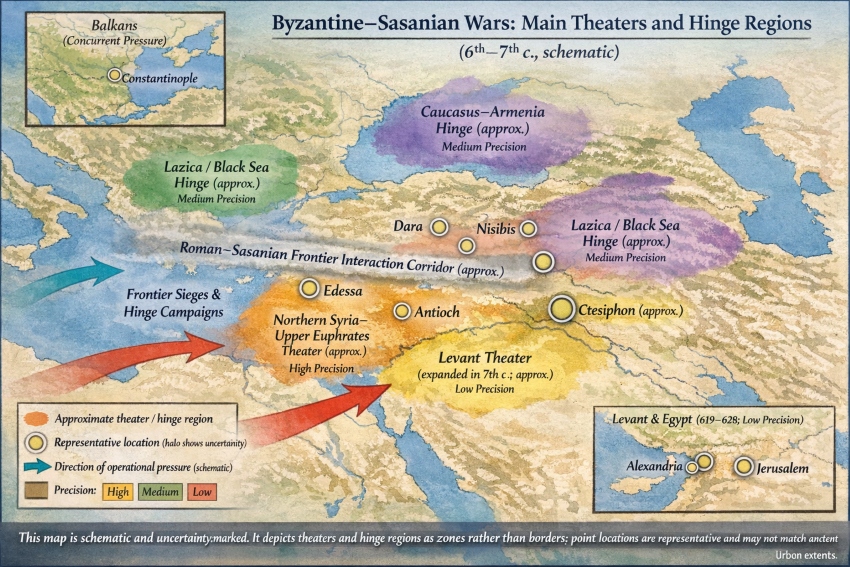
Why “termination” is not one event in this series
Fact: Across the Byzantine–Sasanian wars, fighting typically ended through truce-and-treaty cycles, not through total conquest. Settlements were often written, article-based agreements (where they survive) that regulated frontier administration, payments, commerce, and the handling of refugees and religious communities.
Interpretive note (bounded): Because the evidence base is heavily narrative, “why peace was chosen” is usually inferential. A safer approach is to treat treaty terms and diplomatic messaging as the observable surface of what each side could accept at a given moment. Confidence: High (method follows the surviving record’s limits).
Termination milestones (9–12 dated markers)
- c. 506 — Kavād I relinquishes gains “in exchange for a substantial payment” when pressures from the Hephthalites shift strategic conditions (as summarized in Iranica).
- 532 — “Eternal/Perpetual peace”: territorial status quo confirmed for payment of 11,000 pounds of gold; administrative and Caucasus/Lazica/Iberia provisions noted in Procopius and synthesized by Iranica.
- 545–546 — A major truce is concluded (money paid; Lazica excluded), illustrating how “partial truces” could freeze one sector while leaving another active.
- 557 — A new truce “without a time limit” including Lazica is concluded (per Iranica synthesis).
- 561/562 — The truce becomes a general peace with 13 articles preserved via Menander fragments; includes trade restrictions, no-new-fortress clauses, refugee return, and protections for Christians in Persia.
- 572 — The 562 settlement breaks down after Justin II stops annual payments (Iranica summary).
- 590–591 — Maurice supports Khosrow II’s restoration “in return for territorial concessions”; a cordial interlude follows.
- 25–28 Feb 628 — Court coup: Khosrow II is imprisoned (25 Feb) and executed (28 Feb) according to Chronicon Paschale dating as relayed in Iranica’s Kawād II entry.
- 628 — Peace contacts: Byzantine sources emphasize Kawād II’s diplomacy with Heraclius; an (incomplete) letter is preserved in the Chronicon Paschale tradition (via Iranica).
- 628 (preliminary settlement) — Iranica reports a “hasty peace” restoring the True Cross and relinquishing Sasanian wartime gains.
- 630 (final treaty in some reconstructions) — Iranica’s Khosrow II entry states that all wartime gains had to be relinquished before a final peace treaty was signed in 630, after rapid successions and coups.
1) The termination toolkit: how peace was made and stabilized (when it was)
A. Truces as staging points to a treaty
Fact: In the 6th century, we can trace short ceasefires explicitly framed as windows for negotiation. Iranica’s Justinian I entry describes a three-month ceasefire in 531/532 aimed at negotiating peace, preceding the 532 settlement.
Fact: The same entry describes how later agreements separated theaters (e.g., a truce excluding Lazica), indicating that peace could be compartmentalized geographically.
B. Treaties as “systems engineering” for the frontier
Fact: The 561/562 peace is unusually detailed in the surviving diplomatic record (via Menander fragments), allowing reconstruction of treaty “plumbing”:
- Duration clause (50 years; treaty art. 13)
- Payments (staggered; “30,000 gold pieces annually” in the Iranica Justinian I PDF)
- No new frontier fortresses, and limits on fortifying cities near the frontier
- Trade routing restricted to specified cities “to prevent spying”
- Refugee return with impunity
- Separate provisions on Christian worship in Persia (church building and freedom of worship, with limits on proselytizing to magi).
Interpretive note: These clauses suggest that “enforcement” often meant reducing opportunities for surprise mobilization (fortifications), controlling intelligence flows (trade routes), and creating reversible remedies (reparations clauses and revocation threats). Confidence: High as an inference from explicit treaty architecture.
C. Ritualized diplomacy: letters, oaths, gifts
Fact (primary-witness tradition): In the Armenian narrative attributed to Sebeos, Kawād II is depicted ordering peace with Heraclius, “leav[ing] all of his borders alone,” and sealing it with “an oath and salt,” plus gifts delivered by an envoy.
Fact (Byzantine witness tradition): Iranica’s Kawād II entry notes that Byzantine sources concentrate on diplomatic contacts with Heraclius and points to an (unfortunately incomplete) letter preserved in the Chronicon Paschale tradition.
Interpretive note: Even without full treaty texts for 628, the preserved letter fragments and ritual language indicate that termination relied on recognizable diplomatic forms (oaths, kinship language, gifts), not only battlefield outcomes. Confidence: Medium–High (form is visible; exact terms remain partly opaque).
2) Case files: the principal settlements and how they worked
A) c. 506: ending the “Anastasian” opening war
Fact: Iranica’s Byzantine–Iranian relations entry reports that Kavād I relinquished gains “in exchange for a substantial payment” when a new Hephthalite pressure wave descended.
What can and cannot be said:
- Well-supported: termination linked to a combination of frontier exhaustion and changing strategic pressures (as transmitted).
- Not well-supported: precise treaty articles, payment totals, enforcement mechanisms—these are not reliably preserved in the summary we can cite. Confidence: Low on details beyond the “payment-for-withdrawal” structure.
B) 532: the “eternal peace” as an explicit bargain
Facts (terms): Iranica reports that Procopius recorded the agreements and that the territorial status quo was confirmed in exchange for a payment of 11,000 pounds of gold. It also records the administrative clause that the dux Mesopotamiae was no longer to have his official seat at Dara but at Constantina, and that Lazica/Iberia disputes were temporarily settled by affirming Byzantine possession of Lazica while recognizing Sasanian control over Iberia.
Enforcement logic (inferred from terms):
- The payment and the Dara/Constantina clause functioned as a mechanism to reduce frontier friction and limit provocative military posture at a contested fortress.
- The Lazica/Iberia provisions show how treaties tried to “pin” buffer zones into recognized alignments. Confidence: High as term-based inference.
Victory criteria vs results:
- Stated/observable criteria: confirmation of borders + payment + administrative adjustment.
- Result: a pause that later broke down (540), indicating that the settlement stabilized conditions without eliminating underlying contestation.
C) 561/562: the 50-year peace as the most “legible” termination document
Facts (terms and scope): The Iranica Justinian I PDF explicitly lists a broad set of treaty mechanisms: payments linked to Caucasus defense, bans on new frontier fortifications, regulated trade corridors, amnesty and return for refugees, and Christian worship protections via a separate agreement.
Enforcement:
- Enforcement was partly self-enforcing (trade routings; fortification restrictions) and partly punitive (revocation threats for breach noted in the treaty article discussion).
Why it failed (observable trigger):
- Fact: Iranica reports Justin II stopped the annual payment about a decade later, followed by renewed hostilities.
D) 590–591: termination through regime restoration and concession exchange
Fact: Iranica reports that after Bahrām Čōbīn seized the Persian throne, Khosrow II appealed to Maurice; Maurice provided “generous financial and military assistance” in return for territorial concessions, after which Bahrām was overthrown and a cordial relationship developed.
Termination profile:
- This is not merely a battlefield termination; it is a political termination in which war ends through a negotiated alliance centered on legitimacy and compensation (as transmitted).
- Limits: the exact map of concessions varies across reconstructions and is not fully specified in the cited Iranica passage; therefore, precision should be bounded. Confidence: Medium (structure clear; details not fully visible here).
E) 628–630: termination of the last war via coup, preliminary peace, and delayed finalization
This is the most important termination episode because it combines (1) operational reversal (Heraclius’ penetration), (2) Persian elite coup politics, and (3) an extended settlement process.
Facts (coup and immediate diplomacy):
- Iranica’s Kawād II entry gives specific coup dating: Khosrow II imprisoned on 25 Feb 628 and executed on 28 Feb 628 (Chronicon Paschale dating as cited there), with Kawād II taking the throne.
- Iranica’s Byzantine–Iranian relations entry reports that Persian generals and magnates “rose in rebellion and killed Khosrow,” installing Kawād II and concluding a “hasty peace” with Heraclius, under which Sasanian territorial gains were given up and the True Cross restored (as transmitted by Byzantine chroniclers and summarized by Iranica).
Facts (withdrawal/rollback as the core term):
- The consistent high-level term across Iranica summaries is relinquishment of wartime gains (i.e., withdrawal from occupied Roman territories).
- A Cambridge History of Iran passage (via Frye’s chapter text) similarly presents Kawād II as quickly seeking peace and agreeing to recall Sasanian troops from Egypt, consistent with a broad withdrawal framework.
The “two-stage” termination problem (why 628 is not the end of the story):
- Iranica’s Khosrow II entry states that before a final treaty was eventually signed in 630, Persia went through rapid leadership turnover (Kawād II, Ardašir III, Shahrwarāz’s short coup, then Bōrān), indicating that termination required iterated negotiation and practical implementation amid internal instability.
Victory criteria vs results (strictly term-based):
- Roman/Byzantine observable victory criteria: restoration of provinces and symbolic restitution (True Cross in the Byzantine narrative tradition) rather than annexation of Persian territory.
- Sasanian observable criteria: stopping Roman advance and ending the war on terms compatible with political survival of the regime in 628—again inferred from the peace initiative and concession pattern, not asserted as private motive. Confidence: Medium.
- Result: a settlement that (in Iranica’s phrasing) required giving up wartime gains and was finalized only after continuing upheaval—suggesting that “ending war” and “restoring normal administration” were separable processes.
What is well-established vs what is disputed (Part 4 focus)
Well-established (high confidence)
- The 6th-century settlements (especially 532 and 561/562) are reconstructible in meaningful detail, including payment structures, frontier/fortress constraints, regulated trade, and refugee/religion clauses.
- The 628 termination involved a Persian coup, rapid initiation of diplomacy with Heraclius, and a peace framework that required relinquishing wartime gains and returning the True Cross in Byzantine-source tradition (as synthesized by Iranica).
- A final settlement is commonly placed in 630 in Iranica’s Khosrow II entry, after successive short reigns and coups.
Disputed / uncertain (medium to low confidence)
- Exact 628 treaty articles: Unlike 561/562, we do not have a comparably complete, widely cited article-by-article treaty text in the materials used here; we largely have chronicle-derived summaries and letter fragments. Confidence: Low–Medium.
- Implementation timeline: How quickly withdrawals occurred in each province (Egypt, Levant, Anatolia) and how consistently local commanders complied is difficult to reconstruct without deeper documentary triangulation. Confidence: Medium (general withdrawal framework is strong; pacing is harder).
- Territorial concessions in 591: The structure is clear (aid-for-concessions), but the precise concession set varies by reconstruction and is not specified in the cited summary. Confidence: Medium.
Key Sources Used
- Encyclopaedia Iranica, “Justinian I” (532 settlement terms; peace architecture; renewed truces; 561/562 treaty detail via Menander fragments).
- Encyclopaedia Iranica, “Byzantine–Iranian relations” (series-level termination pattern; 590–591 aid-for-concessions; 628 coup and “hasty peace” summary).
- Encyclopaedia Iranica, “Kawād II” (Chronicon Paschale-based dating for 25–28 Feb 628; letter reference; diplomatic framing).
- Encyclopaedia Iranica, “Khosrow II” (final treaty framed as signed in 630; sequencing of post-628 rulers/coups).
- Cambridge History of Iran (Frye chapter text via Archive.org) for the “seek peace and recall troops from Egypt” framing under Kawād II.
- Sebeos (translation excerpt) as a primary narrative witness to the rhetoric of peace (borders, oath, salt, gifts).
Open Questions / Uncertainties
- 628 terms beyond “withdrawal + restitution”: What additional clauses (prisoner exchange, indemnities, border administration) can be recovered securely when Byzantine, Armenian, Syriac, and later Arabic traditions are triangulated?
- Enforcement in a collapsing polity: How did successive Sasanian rulers (628–630) practically compel far-flung commanders (e.g., in Egypt) to comply with peace terms?
- Why treaty engineering worked (sometimes): Under what conditions did “trade-route control + fortress restraints + payments” produce stability, and when did it merely postpone conflict?
- 591 concessions map: What is the narrowest concession set that multiple high-quality reconstructions agree on, and what remains contested?
- Symbolic vs material peace objectives: How should historians weigh the “True Cross” restitution (highly visible in Byzantine narrative) against the more prosaic mechanics of withdrawal and fiscal repair?