Part 3 — War Conduct (phases, strategy, technology, logistics/finance, civilian impacts)
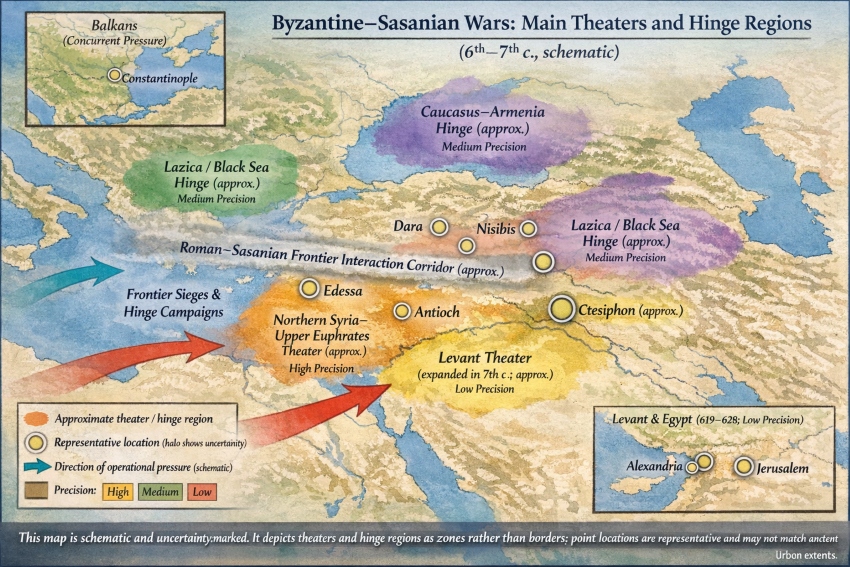
Framing: what “war conduct” looks like in this rivalry
Fact: Across the 6th–7th centuries, fighting between the Eastern Roman (Byzantine) and Sasanian empires recurrently combined (1) frontier siege warfare against fortified nodes, (2) campaigning in “hinge regions” (Armenia/Caucasus; Lazica; northern Mesopotamia), and (3) periodic deep raids or occupations into Syria, Anatolia, and (in the last war) Egypt and Palestine. Modern narrative sourcebooks and synthetic studies emphasize that the form of war was shaped by fortification density, limited campaigning seasons, and the need to secure supply lines in long-distance operations.
Interpretation (attributed): James Howard-Johnston treats the final war (603–628) as a case where operational tempo and territorial reach expanded dramatically, culminating in Persian conquest of multiple Roman provinces and a later Roman counteroffensive into the Sasanian heartland.
A compact operational-phase timeline (for Part 3)
- 502–506: Frontier war characterized by sieges and counter-sieges in northern Mesopotamia/Armenia (series “opening” phase).
- 527–532: Sustained fighting early in Justinian’s reign; culminates in the 532 settlement (conduct includes set-piece battles and fortified-city operations in the frontier zone).
- 540–562: Khosrow I’s major invasion of Syria (540) and a long contest whose conduct shifts between Syria and the Caucasus/Lazica; concludes with the 562 peace.
- 572–591: Renewed war, with heavy fighting in Mesopotamia and Armenia; ends with a settlement linked to Maurice’s support for Khosrow II.
- 603–615/616: Early phase of the last war: Persian operational penetration and Roman political/military crisis.
- 615/616–620: Persian takeover of Palestine and later conquest of Egypt; Persian raids into Asia Minor are also noted in this sequence.
- 624–626: Roman counteroffensives and maneuver warfare outside the “standard” frontier pattern (Heraclius’ campaigns in Kaegi’s framing).
- 626: Avar-led siege of Constantinople, with Persian forces positioned across the Bosporus; siege fails.
- Winter 627/628: Roman invasion of Mesopotamia; battle near Nineveh dated 12 Dec 627 in Kaegi’s reconstruction headings; Persian regime crisis follows in 628.
1) How the wars were fought: fortresses, mobility, and “controlled devastation”
Fortifications and siege warfare as the structural core
Fact: The eastern frontier was unusually fortification-dense. As a result, campaigns frequently aimed at capturing, neutralizing, or bypassing fortified cities that served as logistics hubs, garrison points, and negotiation leverage. This is one reason modern compendia emphasize siege episodes (rather than open battle) as the recurring operational “grammar.”
Evidence type and limitation: Tactical manuals such as the Strategikon (attributed to Maurice, with debated authorship and dating) are often used by historians to illuminate what commanders thought mattered: march discipline, camps, reconnaissance, and combined-arms organization. They are not direct battle transcripts, but they do document the problems an army expected to face.
Mobility: cavalry-centered operations and the contested “battlefield edge”
Fact: Scholarship and reference synthesis on Sasanian warfare stresses the existence of a substantial martial literature and a developed “art of war” tradition, alongside elite cavalry forces central to field operations.
Interpretation (bounded): Most modern military-historical treatments characterize both empires as relying heavily on cavalry for reconnaissance, raiding, and battlefield shock—especially in the open zones of northern Mesopotamia and Armenia—while heavy infantry and siege trains mattered most in fortress warfare. Confidence: Medium (consistent across many studies; specific force ratios vary and are poorly quantifiable).
2) The 6th-century wars (502–591): recurring patterns of conduct
502–506 and 527–532: frontier pressure and negotiated stabilization
Fact: These early phases are typically reconstructed as siege-heavy frontier wars in which each side sought leverage through key fortified places and controlled corridors, rather than annihilation through decisive battle. The Greatrex–Lieu sourcebook is structured to track precisely these repeated movements of siege, relief, and truce-making across multiple wars.
Interpretation (attributed): Modern syntheses often treat this period’s combat as a “contest of endurance”: tactical victories mattered, but bargaining position frequently depended on which empire could sustain garrisons, replace losses, and keep the frontier system intact. Confidence: Medium (the pattern is clear, but the internal decision calculus remains only partially visible).
540–562: Syria, deportations, and a long war with shifting theaters
Fact (episode-level): Encyclopaedia Iranica’s “Deportations” entry explicitly reports that Khosrow I captured Antioch in 540, describing destruction and the carrying away of treasures, and it lists multiple narrative witnesses (John Lydus, John of Ephesus, Michael the Syrian, and Procopius among others).
Fact (conduct mechanism): Deportation and captive resettlement are presented in this reference literature as a state instrument with economic and political implications—moving skilled labor and populations into the Sasanian realm and, in some cases, founding or populating new settlements.
Interpretation (careful): It is plausible to treat deportation as simultaneously (a) an immediate wartime act and (b) a medium-term state policy tool. However, source traditions can compress events and use formulaic language (“destroyed,” “carried away”), so episode reconstructions should be triangulated. Confidence: High that deportations occurred; Medium on the precise scale and local mechanics for any single city.
572–591: protracted fighting and “client and corridor” dynamics
Fact: This phase is commonly treated as prolonged warfare in Mesopotamia and Armenia with shifting fortunes and a diplomatic end linked to Khosrow II’s restoration with Roman help. Operationally, this reinforced the idea that frontier war could end not by annihilation but by political realignment and treaty exchange.
3) The last war (603–628): escalation to occupations and empire-wide strain
From frontier war to multi-theater occupation (615–620)
Fact (Howard-Johnston’s reconstruction, attributed): In an Oxford Academic chapter abstract, Howard-Johnston identifies winter 615–616 as a decisive moment when peace overtures were rejected and then summarizes a sequence: Persians “take over Palestine (616), raid Asia Minor (617), and conquer Egypt (619).” These are presented as key markers of the war’s operational expansion.
Evidence note: Because this is an author’s synthesized timeline (not a primary source), it should be treated as a high-level scholarly reconstruction supported by broader evidence, not as a direct “primary document statement.”
614 Palestine/Jerusalem and the occupation problem (614–628)
Fact (specialist regional study): A Cambridge Core chapter on the Sasanian occupation of Palestine (614–628) frames the conquest of Palestine in 614 and subsequent occupation to 628 as a major rupture for Christian communities, and it explicitly raises contested questions about the extent of destruction in Jerusalem and elsewhere and the roles of various participants (Sasanian troops, Jewish allies in some accounts, and Bedouin).
Interpretation (methodological): This is a useful reminder that “war conduct” includes not only operations but also occupation regimes: garrisoning, local alliances, religious/community politics, and the uneven distribution of violence. Confidence: High that an occupation occurred; Medium on the local profile of violence in specific towns without granular cross-source reconciliation.
Roman adaptation and counteroffensive campaigning (624–628)
Fact (Kaegi’s periodization): Kaegi’s work organizes Heraclius’ wartime conduct into distinct campaign blocks, including “Heraclius’ campaigns against Sasanian armies, 624–628,” and the “winter 627/628” Mesopotamian operation culminating in the Battle of Nineveh (12 Dec 627) as a reconstructed event.
Interpretation (bounded): Many reconstructions emphasize that these counteroffensives relied on maneuver, operational surprise (including winter campaigning), and coalition management (e.g., with steppe forces in some years), rather than simply replaying the siege-centric frontier pattern. Confidence: Medium (broad agreement on the shift; details vary by source tradition).
4) The 626 siege of Constantinople: conduct at the “imperial center”
Fact: Modern scholarship treats the 626 siege as a pivotal event in the war’s European theater and as an example of how the Roman–Sasanian conflict intersected with Avar and Slavic power. Hurbanič’s monograph specifically frames it as a major seventh-century event with wider political and ideological repercussions.
Fact (source criticism focus): A dedicated study of the homily attributed to Theodore Syncellus shows how siege narratives were produced and transmitted and how they relate to contemporary literary responses (including George of Pisidia), underlining that the siege is documented not only as a military episode but as a major textual and commemorative event.
Interpretation (neutral): The conduct lesson is operational: Constantinople’s fortifications and control of maritime spaces constrained besiegers, while the broader war context meant the city’s defenders framed survival as both a military outcome and a legitimating event. Confidence: High that the siege failed; Medium on the degree to which later narrative shaping altered the perceived tactical details.
5) Logistics, finance, and “war’s carrying capacity”
Fact: Both empires depended on mobilizing resources across long distances—tax, requisition, and the maintenance of siege equipment, cavalry remounts, and garrisons. Manuals like the Strategikon devote substantial attention to camp life, marching order, discipline, and supply—evidence of how central logistics was to military effectiveness.
Fact (plague as a complicating factor): Contemporary testimony (Procopius, John of Ephesus) is frequently cited for the Justinianic Plague beginning in 541/542 and recurring through the 540s, which modern scholarship debates in terms of demographic magnitude and systemic impact. The Austrian Academy of Sciences overview points directly to Procopius’ observations and John of Ephesus as key witnesses; modern historiography includes explicit “new approaches” that contest older maximalist readings.
Interpretation (confidence-rated): It is reasonable to treat epidemic shock as a potential amplifier of wartime strain (labor, revenue, manpower), but the magnitude is disputed. Confidence: High that epidemics occurred and were perceived as severe; Low–Medium on any specific macroeconomic or manpower effect on particular campaigns.
6) Civilian impacts: sieges, deportations, and contested destruction claims
Well-attested forms of harm (fact-level):
- Sacks and ransoms of major cities recur (e.g., Antioch 540 in multiple traditions summarized by Iranica).
- Forced movement of populations (captives/deportees) is a documented practice in some Sasanian campaigns and is explicitly discussed as policy in Iranica’s treatment of deportations.
- Occupation dynamics in Palestine after 614 include contested narratives about the extent of destruction and communal conflict; modern scholarship treats this as a question requiring careful source reconciliation.
What should not be overstated:
- Aggregate casualty totals for the series or even for 603–628 remain not reliably quantifiable from surviving evidence; even event-level numbers are often inconsistent across traditions, and modern reconstructions typically avoid presenting a single “total.”
What is well-established vs what is disputed (Part 3 focus)
Well-established
- War conduct relied heavily on sieges and fortified nodes, alongside cavalry mobility in open theaters.
- The 540 capture of Antioch and associated deportation narratives are widely attested and synthesized in high-quality reference literature.
- The last war’s operational arc includes Palestine/Egypt conquests (as summarized in Howard-Johnston’s reconstruction) and a later Roman counteroffensive culminating in the winter 627/628 campaign block and Nineveh (12 Dec 627) in Kaegi’s reconstruction headings.
- The 626 siege of Constantinople occurred and failed; it generated substantial contemporary and near-contemporary narrative production.
Disputed / uncertain
- Extent of destruction and casualty levels in specific conquests (notably Jerusalem/Palestine 614) and attribution of violence among participants—explicitly flagged as a contested analytical problem in specialist scholarship.
- Demographic and fiscal impact of the Justinianic Plague on war-making capacity (major historiographical debate).
- The degree to which surviving siege narratives (626 especially) reflect tactical detail versus later ideological memorialization.
Key Sources Used
- Greatrex & Lieu, The Roman Eastern Frontier and the Persian Wars AD 363–628 (narrative sourcebook for campaign conduct across decades).
- Howard-Johnston, The Last Great War of Antiquity (Oxford Academic chapter abstract for 615–619/620 phase markers and interpretive framing).
- Kaegi, Heraclius: Emperor of Byzantium (campaign periodization; Nineveh dating and operational framing).
- Encyclopaedia Iranica, “Deportations” and related entries (Antioch 540; deportation as practice; source list).
- Encyclopaedia Iranica, “Army i. Pre-Islamic Iran” (Sasanian warfare tradition and evidentiary base).
- Maurice’s Strategikon, trans. George T. Dennis (logistics/tactics concerns; authorship/dating debated).
- Cambridge Core chapter: “The Sasanian Occupation: 614 to 628” (occupation dynamics and contested destruction questions for Palestine).
- Whitby on Theodore Syncellus and the 626 siege tradition (source transmission and genre shaping).
- Sarris (Past & Present) and OEAW overview on the Justinianic Plague (debate landscape and primary witnesses).
Open Questions / Uncertainties
- Occupation practice vs narrative memory: How far can we reconstruct day-to-day Sasanian governance in Palestine/Egypt from the surviving textual and documentary record, and what remains irretrievably opaque?
- Violence attribution in 614: How should we weigh competing traditions on who did what (and at what scale) in Jerusalem and nearby sites?
- Operational causality: Which specific logistical constraints most plausibly explain the shift from frontier sieges to deep operations in the last war, and can any be evidenced directly rather than inferred?
- Plague impact: What claims about manpower, taxation, and campaign timing can be supported without over-reading rhetorical primary testimony?
- 626 siege detail: Which tactical elements can be recovered with high confidence when we separate contemporary reportage, later chronography, and homiletic/poetic elaboration?