The Pre-War System
1) Two imperial states with different institutional logics
Well-attested structural facts (baseline):
- The Eastern Roman state of the 6th–early 7th centuries was a tax-raising, law-producing, bureaucratic monarchy centered on Constantinople, with an administrative apparatus capable of sustaining standing forces and expensive fortifications—though with persistent stresses from multi-front commitments. A concise synthesis for the sixth century is often sought in modern handbooks and companion volumes.
- The Sasanian polity (224–651) is typically described in scholarship as a monarchical empire balancing royal authority with powerful aristocratic and military elites, with major tax and military reforms associated especially with Khosrow I (building on earlier initiatives under Kavād I in some accounts).
Interpretive notes (attributed, not motive inference):
- Many historians emphasize that the Roman and Sasanian systems were mutually intelligible competitors: each developed ideological language of universal kingship while also practicing pragmatic frontier management. A Cambridge History of Iran chapter frames the relationship as sustained rivalry with substantial diplomatic and cultural contact.
- For the Romans, a common interpretive line is that fiscal-administrative capacity enabled periodic offensives and rapid rebuilding, but also created high fixed costs (army pay, logistics, fortifications). For the seventh century, Haldon argues the empire underwent major transformation under the compounded pressures of war and territorial loss after 610.
2) A fortified frontier system—plus “hinge regions” that pulled wars outward
Facts that recur across the source tradition:
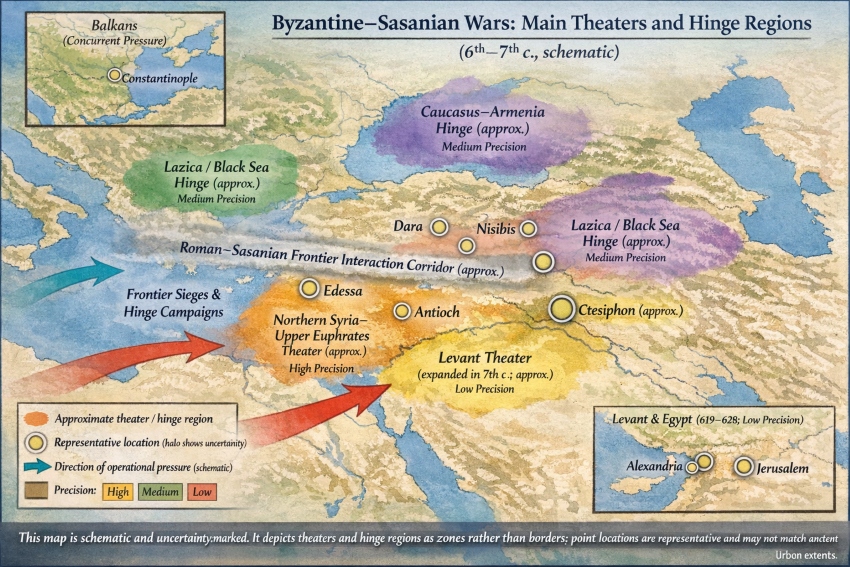
- The Mesopotamian corridor (Upper Mesopotamia and the Euphrates–Tigris approach zones) appears repeatedly as the “default” arena for campaigns, sieges, and treaty clauses regulating forts and border cities. Greatrex & Lieu’s narrative sourcebook is designed precisely to anchor these recurring episodes in translated texts and contextual commentary.
- The Caucasus/Armenia functioned as a strategic hinge. Armenian and Caucasian polities appear in both imperial diplomatic strategies, and Armenian narratives (e.g., the history attributed to Sebeos) are central witnesses for the early 7th century because comparable Greek/Syriac coverage is uneven.
- The Lazica problem (Black Sea littoral) is a recurring case where war aims and peace terms can be tracked through negotiations and their breakdown. Modern reference summaries of Byzantine–Iranian relations highlight these treaty cycles.
Interpretive notes (why “hinge regions” mattered):
- A common scholarly interpretation is that these areas were not mere borderlands but multipliers: once Armenia/Caucasus politics or Levantine cities became active theaters, the war’s logistical and fiscal burden rose sharply for both empires. This claim is typically made by synthesizing campaign narratives and state-capacity arguments rather than by direct contemporary accounting. Confidence: Medium (mechanism plausible; quantification weak).
3) Diplomacy built on parity language, treaty engineering, and controlled violence
Facts:
- The relationship is marked by repeated formal peaces (notably 532 and 562, then 591) that regulated borders, allies, and (in some settlements) money flows and recognized spheres of influence.
- Diplomatic ideology could cast the two powers as peer lights of the civilized world. A chapter in the Cambridge Companion to the Age of Justinian preserves and discusses this rhetorical framing and its context in sixth-century statecraft.
Interpretive notes (attributed):
- Many modern historians treat these treaties less as “endings” than as pauses that reallocated risk—e.g., buying time on one frontier while pressure mounted elsewhere (Balkans for the Romans; steppe/eastern pressures for the Sasanians). Confidence: Medium because the pattern is clear, but motive-ranking is not directly recoverable from administrative records at scale.
4) Federates and clients: Arab border powers as buffers and triggers
Facts:
- On the Roman side, the Ghassanids are widely described in reference works as Arab federates/clients operating as a frontier buffer in the Levant and steppe interface; they appear in both specialist reference entries and general encyclopedic summaries.
- On the Sasanian side, Arab clients (often discussed in tandem with al-Hira/Lakhmid politics in modern syntheses) are part of the broader frontier system in late antique Near Eastern history writing.
Interpretive notes (carefully framed):
- Scholarship commonly treats federate systems as both stabilizers (buffering raids, supplying cavalry, intelligence, and local knowledge) and fragilizers (when patronage collapses or when clients pursue their own rivalries). Confidence: High for the stabilizer/fragilizer duality as a general model; Low–Medium for pinning specific war onsets primarily to federate dynamics in any single episode.
5) War finance, reforms, and coercive population management
Facts:
- Sasanian reforms under Khosrow I are described in modern reference synthesis as including taxation and military organization reforms, with roots possibly in earlier reigns.
- Deportation and captive resettlement are documented as tools of Sasanian state practice in some episodes, including the post-540 Antioch case, with modern reference works aggregating the chain of narrative attestations.
- For the Romans, later military literature associated with the period (e.g., the Strategikon) is commonly used by historians as evidence for doctrines and concerns—even while authorship and exact dating remain debated in the scholarship.
Interpretive notes (limits of inference):
- It is tempting to read deportation, treaty payments, and reforms as direct indicators of “grand strategy.” A more cautious reading is that they demonstrate state capacity and repertoire rather than a single coherent plan, since the surviving evidence is episodic and filtered through hostile or distant chroniclers. Confidence: High (evidentiary constraint is clear).
6) The information environment: why reconstruction is hard even when chronology is strong
Facts:
- For the early 7th century, Sebeos is repeatedly singled out as a crucial non-Greek witness; modern bibliographic framing notes its value because comparable Greek and Syriac narratives can be sparse or discontinuous for certain years and regions.
- Modern syntheses of the 603–628 war often foreground the fragmentary and scattered evidentiary base while still offering a coherent sequence of operations and political turning points (Howard-Johnston’s project statement is explicit on filling the gap).
What is well-established vs what is disputed
Well-established (high confidence)
- The segmented chronology of major wars and treaty intervals (502–506; 527–532; 540–562; 572–591; 603–628) and their anchoring around named rulers (Justinian, Khosrow I, Maurice, Khosrow II, Heraclius).
- The centrality of Upper Mesopotamia and the Armenia/Caucasus hinge as repeated theaters, and the expansion of the final war into the Levant and Egypt.
- The existence of Sasanian administrative/military reforms (especially under Khosrow I) and documented instances of deportation/captive resettlement as a policy instrument in some campaigns.
Disputed or sensitive (medium to low confidence)
- Stated aims vs underlying aims in particular war onsets (e.g., whether a justification like “revenge” in 603–628 should be treated as primary cause or convenient casus belli). The evidence is mostly narrative and partisan.
- Scale of human losses (casualties, captives, displacement) beyond local episodes; numbers vary sharply across traditions and are rarely reconstructible into totals.
- Relative weight of “client politics” (Ghassanids/Lakhmids and other border actors) versus imperial fiscal or court politics in causing particular escalations; plausible in multiple episodes but not cleanly isolatable.
Key Sources Used
- Geoffrey Greatrex & Samuel N. C. Lieu, The Roman Eastern Frontier and the Persian Wars AD 363–628 (narrative sourcebook and commentary).
- James Howard-Johnston, The Last Great War of Antiquity (project framing for the 603–628 war’s reconstruction from scattered evidence).
- John F. Haldon, Byzantium in the Seventh Century (state/society transformation framework after 610).
- Encyclopaedia Iranica entries on the Sasanian dynasty, Kavād I, Khosrow I reforms, deportations, and Khosrow II (reference synthesis with bibliographic orientation).
- Cambridge Companion to the Age of Justinian (administrative/economic synthesis; diplomatic framing language).
- Walter E. Kaegi, Heraclius: Emperor of Byzantium (operational narrative anchor for late-war campaigning; sample includes map references and Nineveh dating).
- Chronicon Paschale (chronographic tradition and a key contemporary witness for some events, used heavily in modern reconstructions).
- The Armenian History attributed to Sebeos (translation + historical commentary; critical for early 7th century).
Open Questions / Uncertainties
- Treaty mechanics: For each major peace (532, 562, 591, 628), what clauses are securely recoverable versus later reconstruction from partial notices?
- Frontier political economy: How far can we quantify the fiscal load of fortification and garrisoning on either side without projecting from later evidence?
- Clients as causal drivers: In which episodes do federate/client dynamics (Ghassanid and Sasanian-aligned Arab polities) appear as primary triggers versus secondary accelerants?
- Population movement totals: Can archaeology and papyrology meaningfully bound displacement for the 603–628 war beyond narrative claims about captives and deportations?
- Comparability across source traditions: Where Greek, Syriac, and Armenian narratives diverge, what criteria should govern confidence (genre, proximity, corroboration, manuscript history)?
- Military doctrine evidence: How directly should manuals like the Strategikon be connected to “what armies actually did” in 6th–7th century operations?
- End-of-war interpretation: To what extent should 628 be read as a “restoration” versus a structural rupture (given subsequent transformations emphasized in seventh-century scholarship)?