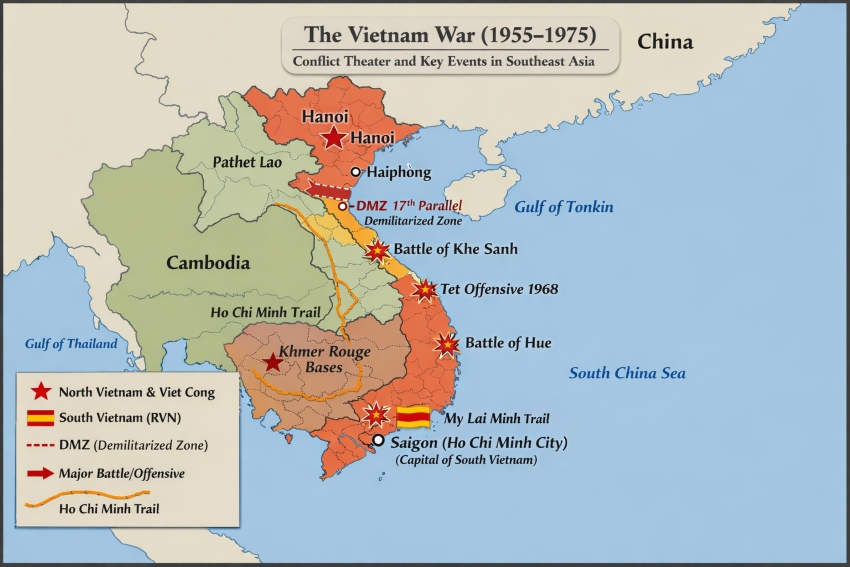
In the mid-1950s, Vietnam entered a new phase of struggle not as a single unified polity, but as a country shaped by the end of one war and the incomplete architecture of its settlement. In May 1954, the French defeat at Dien Bien Phu accelerated the close of the First Indochina War and set the stage for the Geneva negotiations. The resulting agreements in July 1954 created a provisional military demarcation—a temporary line meant to separate forces and reduce immediate violence, not a permanent border. An international supervisory mechanism was established, and the political horizon—at least on paper—pointed toward nationwide elections intended to reunify the country.
In practice, the settlement functioned like a pause with unresolved fundamentals. The demarcation line, the demilitarized zone, the schedules for administrative transfer, and international inspection bodies were tangible. But the political formula depended on cooperation between rivals who did not share a common definition of legitimate authority. The United States did not sign the Geneva accords; its position emphasized legitimacy through genuinely free elections under effective international supervision. At the same time, the broader Cold War security environment was tightening. SEATO formed in September 1954, and U.S. historical summaries describe how Vietnam, Laos, and Cambodia were not meant to join military alliances under Geneva-era terms while also being treated as within a “protected area” under SEATO’s framing. These overlapping structures—armistice commitments, international monitoring, and regional alliance logic—created a system in which diplomacy and force were never fully separated.
The first major human signal of how disruptive the transition would be came through population movement. Between 1954 and 1955, large numbers moved across the provisional division. A U.S. Navy historical account describes hundreds of thousands moving from North to South and smaller numbers moving in the opposite direction, within a defined relocation window tied to the Geneva settlement. Whatever the individual reasons—political affiliation, fear, family ties, economic prospects—the demographic shift itself became part of the new political landscape. It altered local balances, strained governance, and produced communities whose identities and vulnerabilities were shaped by war before the next war fully began.
South Vietnam’s political structure hardened quickly. In October 1955, a referendum pitted Ngo Dinh Diem against Bao Dai, and U.S. diplomatic reporting describes a process marked by strong state direction. Days later, Diem proclaimed a republic in the South. What had been a provisional division with a theoretical reunification pathway became, in daily political reality, two competing state projects—each asserting a claim to national legitimacy.
By the end of the 1950s, the southern state confronted an expanding internal security challenge. A U.S. State Department historical summary describes 1959 as the start of a “large-scale insurgency” in the South. The South Vietnamese government also adopted measures that widened the conflict’s coercive scope: Law 10/59 authorized special tribunals and severe penalties for actions defined as threatening state security. Supporters and critics have long interpreted such measures differently. What is firmly established is that the law existed and functioned as part of the state’s counterinsurgency toolkit, shaping the environment in which opposition—armed and political—operated.
Meanwhile, North Vietnamese-linked organization and logistics adapted and developed. U.S. and military-historical syntheses commonly describe a key party decision point in early 1959, and U.S. reporting identifies the creation of a logistics group (often associated in later literature with the Ho Chi Minh Trail system) as part of a sustained movement of personnel and matériel southward. In December 1960, the National Liberation Front (NLF) formed as a political umbrella claiming to represent southern opposition. Its program framed its objectives in political terms and described staged reunification through negotiation. The enduring dispute here is not whether the NLF existed or issued programmatic statements—those are matters of record—but the degree and timing of Hanoi’s operational control over southern forces, which many historians argue changed over time.
By the early 1960s, the war’s center of gravity moved toward internationalization. U.S. internal documentation tracked adviser numbers and acknowledged sensitivities in relation to Geneva-era expectations. By 1963, U.S. internal accounts referenced personnel levels just over 16,000 in Vietnam—well beyond a small advisory presence. South Vietnam’s internal politics then ruptured. In November 1963, a coup ended in the deaths of Diem and his brother Nhu. Whatever one’s interpretation of why U.S.–South Vietnamese relations took this path, the fact of sudden leadership change and subsequent instability became a major constraint on any strategy aimed at steady state-building.
In August 1964, the Gulf of Tonkin incidents and the Tonkin Gulf Resolution accelerated U.S. authority to use force. Later official review revised the story of the reported August 4 attack, concluding it did not occur as initially represented—an unusually clear case where official reassessment changed a key escalatory narrative. By early 1965, escalation was visible and sustained. Rolling Thunder began—its “start” is dated differently in official sources depending on whether one counts initial strikes or regularized missions—and U.S. Marines arrived at Da Nang on March 8, 1965.
From 1965 through 1967, the war’s conduct reflected a combination of attrition-oriented operations and efforts to expand state presence. U.S. and allied operations leaned heavily on mobility and firepower—helicopters, artillery, and air support—seeking contact with opposing forces and disruption of base areas. At the same time, the war remained deeply political at the village level, where control could not be measured solely in battlefield engagements. The United States and South Vietnam repeatedly reorganized pacification structures; CORDS was formally organized in May 1967 to integrate civil and military support for pacification under the broader command structure.
Technology entered the conflict not only through aircraft and helicopters but also through surveillance and logistics warfare. One emblematic program was Igloo White, operational in late 1967, using air-dropped sensors and analysis infrastructure to cue strikes on infiltration routes. The geographic reality of Laos mattered: supply systems were not confined to Vietnam’s borders, and interdiction became a cross-border problem. UNDP reporting underscores the scale of the air war in Laos, citing more than 2 million tons of ordnance dropped between 1964 and 1973. Another enduring technical and humanitarian legacy came from herbicide use: U.S. records syntheses describe approximately 19–20 million gallons of herbicides used in Vietnam between 1962 and 1971. The long-run health burden is debated, but the program’s broad operational scope and time window are well documented.
In late January 1968, the war shocked itself into a different public and strategic register with the Tet Offensive. Attacks across South Vietnam—including intense urban fighting—made clear that the conflict’s political and military dynamics could not be reduced to a single metric of battlefield attrition. In humanitarian terms, reference summaries report very large displacement following Tet, with hundreds of thousands classified as refugees and internal displacement rising sharply. The war’s moral and legal controversies also became internationally prominent. One of the most discussed episodes is My Lai (March 16, 1968), where reporting and subsequent investigations established mass civilian killing; exact counts vary by source, but the event became emblematic of broader disputes about conduct, accountability, and the civilian cost of counterinsurgency war.
By 1969, the United States’ troop presence reached its peak—U.S. Army historical pages cite a peak around 543,000 in spring 1969—before sustained drawdowns under Vietnamization, shifting more ground combat burden to South Vietnamese forces while U.S. airpower and advisory roles remained central. The war also expanded and intensified in neighboring states. In 1970, U.S. and South Vietnamese forces conducted a major incursion into Cambodia (decision and operational start are dated slightly differently depending on framing). In 1971, South Vietnamese forces—supported by U.S. airpower—undertook Lam Son 719 into Laos. These operations reflected the same structural problem: the war’s logistics and sanctuaries were regional, but political legitimacy and sovereignty were national.
In 1972, the conflict tilted toward conventional large-unit warfare. The Easter Offensive began in late March 1972, representing a major North Vietnamese conventional push. The U.S. response included intensified air operations; official U.S. Air Force histories describe expanded interdiction campaigns, culminating later that year in Linebacker II (December 18–29, 1972), a concentrated bombing effort focused on targets around Hanoi and Haiphong. Official U.S. presentations sometimes reproduce North Vietnamese-reported civilian death figures for this campaign, illustrating the broader methodological point: for many civilian harm estimates, sources differ not only in numbers but in what and whom they count.
Termination, when it came, arrived first as a negotiated end to direct U.S. involvement rather than a stable end to the Vietnamese war itself. Negotiations resumed in early January 1973; the agreement was initialed January 23 and signed January 27. The text set a cease-fire time, required U.S. withdrawal and base dismantlement within 60 days, and linked prisoner returns to that timeline. POW returns occurred under Operation Homecoming, with a total of 591 U.S. POWs returned according to a U.S. Air Force museum summary. The agreement also created enforcement bodies—joint commissions and an international commission (ICCS)—but these mechanisms were constrained by unanimity rules and, crucially, a time-limited four-party structure that ended after the U.S. withdrawal period.
The war continued. By April 30, 1975, Saigon fell, and the Republic of Vietnam ceased to function as a state authority. Formal reunification followed with the proclamation of the Socialist Republic of Vietnam on July 2, 1976. Yet the aftermath was not confined to Vietnam’s borders. Vietnam invaded Cambodia in December 1978; China invaded Vietnam in February 1979. Vietnam’s withdrawal from Cambodia is commonly dated to 1989, and regional settlement processes culminated in major international agreements in the early 1990s.
Vietnam’s internal trajectory then moved through reconstruction into reform. Doi Moi, associated with the Sixth Party Congress in December 1986, marked a shift toward a “socialist-oriented market” approach. International financial institutions later described Vietnam’s subsequent development as a major transformation, and Vietnam’s integration milestones included joining ASEAN in 1995 and the WTO in 2007. The United States lifted its trade embargo in February 1994 and normalized diplomatic relations in July 1995—steps tied in U.S. official documentation to progress on POW/MIA accounting. Even decades later, DPAA reporting still lists 1,567 U.S. personnel missing from the Vietnam War.
The war’s physical legacies remain measurable. UNDP reporting cites a Government of Vietnam estimate that about 18% of the country’s land area remains contaminated by explosive remnants of war. Remediation of dioxin “hotspots” has continued through bilateral programs, including major work at Bien Hoa. In memory and policy, the Vietnam War endures as a conflict that terminated not in a single clean settlement, but through a negotiated exit for one principal external actor and a final military outcome two years later—followed by decades of regional war, national reform, and ongoing efforts to manage human and environmental aftermath.