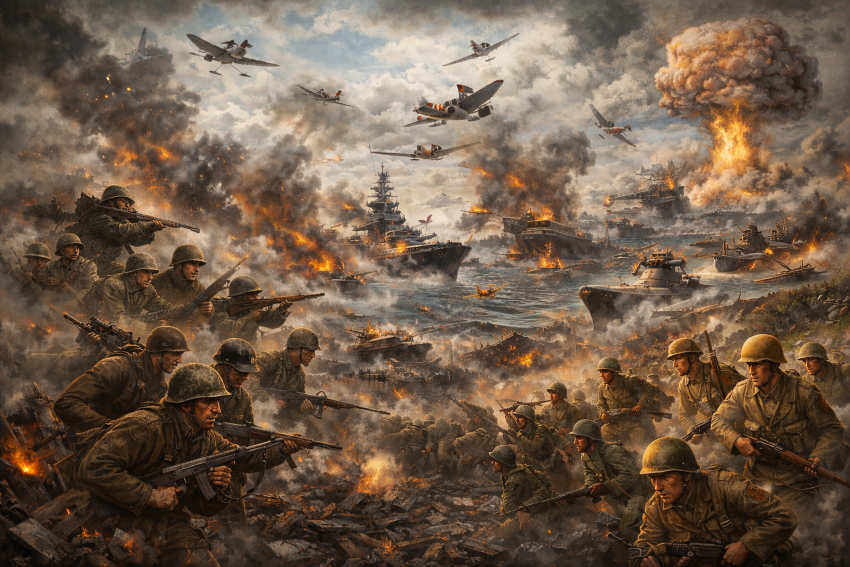
World War II is commonly dated as beginning in Europe with Germany’s invasion of Poland on 1 September 1939 and ending with Japan’s formal surrender on 2 September 1945. At the same time, many historians treat the war’s “road” as longer and more global than that European starting point suggests, because large-scale fighting in East Asia—especially the Sino–Japanese War—had already expanded sharply by 1937. The result is that “why it became war” cannot be reduced to a single spark: it was a sequence of crises, choices, and failed bargains across different regions, which eventually fused into a world war once major coalitions were committed and the conflict became strategically interdependent.
A key structural backdrop was the post–World War I international order. The interwar settlement relied on treaties and on the promise of collective security through the League of Nations, yet enforcement capacity and political commitment were uneven. One hard institutional fact was that the United States—despite the origins of the League idea in wartime diplomacy—did not join the League. This did not “cause” the next war by itself, but it mattered because it narrowed the set of credible punishments or deterrents available when aggressions occurred and when treaties were tested. The system that emerged after 1919 also carried revisionist pressures: some states and movements sought to revise borders, security arrangements, and imperial domains. Historians differ on how much weight to place on Versailles-era grievances versus later 1930s decisions, but there is broad agreement that the interwar system was vulnerable to sustained challenge once major powers were unwilling or unable to enforce its rules consistently.
Economic stress compounded those vulnerabilities. The Great Depression, beginning in 1929, destabilized economies and politics across continents. In strictly factual terms, depression-era constraints affected budgets, trade, employment, and political coalitions. In interpretive terms, many scholars see the Depression as an amplifier: it made international competition over markets and resources more acute, and it encouraged political movements promising rapid national restoration—sometimes through coercive expansion. The important methodological caution is that economic crisis did not determine outcomes; different states facing similar shocks made different strategic choices. But it altered the landscape in which leaders assessed risk, opportunity, and the viability of compromise.
In Asia, Japan’s trajectory illustrates how regional war predated the European outbreak. The 1931 Mukden Incident and the subsequent occupation of Manchuria signaled that force could be used to reshape regional order despite international condemnation. In 1937, the Marco Polo Bridge Incident became the pivot into full-scale war between Japan and China. That war generated mounting international consequences: humanitarian concern, competing diplomatic alignments, and—over time—economic and strategic friction between Japan and the United States. In Europe and Africa, Italy’s invasion of Ethiopia (1935) and Germany’s remilitarization of the Rhineland (1936) served as additional stress tests for collective security. The pattern that contemporaries observed was not simply that aggression occurred, but that responses often failed to restore the prior status quo. This mattered because each crisis updated expectations: if earlier violations had limited costs, later challengers could infer that risks were manageable.
In Europe, the crisis sequence accelerated in 1938–39. The Munich Agreement of September 1938 permitted German annexation of the Sudetenland from Czechoslovakia. In March 1939, Germany occupied Bohemia and Moravia and established a protectorate, an outcome widely interpreted at the time as evidence that the Sudeten settlement had not ended German expansion. Britain’s posture shifted: a parliamentary statement of 31 March 1939 tied British commitment to Polish independence, signaling a move from repeated ad hoc settlements toward a declared line of resistance. As diplomacy tightened, demands connected to Danzig and the Polish corridor became central, and negotiations became compressed into ultimatums rather than open-ended bargaining.
A decisive enabling event for the European outbreak was the German–Soviet Nonaggression Pact of 23 August 1939, including a secret protocol on spheres of influence in Eastern Europe. The factual significance is straightforward: it reduced immediate German fears of a two-front war and altered the diplomatic geometry around Poland. The interpretive significance is debated: some historians emphasize Soviet security calculations and the failure of alternative alignments; others stress how the pact facilitated German risk-taking. What can be stated with high confidence is that the pact changed expectations about who would fight whom, and when.
When Germany invaded Poland on 1 September 1939, Britain and France declared war on 3 September. At that point a European general war had begun, but it was not yet a fully integrated world war. The crucial shift from “European war plus Asian war” to a single global conflict came later, as coalitions hardened and theaters became linked by strategy, industry, and supply. That linkage was partly formalized by alignment instruments. The Tripartite Pact of 27 September 1940 bound Germany, Italy, and Japan in a political-military framework and framed the idea of a “new order” in Europe and “greater East Asia.” The pact’s text does not explain every later choice, but it shows how leaders publicly framed their coalition and signaled how they expected a wider war to evolve.
From 1940 to 1941, two escalations transformed the conflict’s scale. First, Germany’s invasion of the Soviet Union—Operation Barbarossa—began on 22 June 1941. This was not merely a new front; it reshaped the war into a vast conflict of attrition and occupation in Eastern Europe, entangling military operations with radical policies toward civilian populations. Second, the crisis between Japan and the United States reached a breaking point in 1941. U.S. measures including an asset-freeze framework (Executive Order 8832) formed part of escalating economic and diplomatic pressure. Negotiations continued into late November 1941, with the U.S. presenting a proposed basis for agreement on 26 November. Japan’s attack on Pearl Harbor occurred on 7 December 1941; the United States declared war on Japan on 8 December; Germany declared war on the United States on 11 December. This sequence is one of the clearest mechanical bridges from regional wars to world war: once the United States and Soviet Union were fully engaged alongside the British Empire and China, the war’s coalitions and industrial bases became global.
Why did war happen rather than a stable settlement? Here the evidence supports multiple, overlapping explanations rather than a single motive. One interpretive strand emphasizes bargaining failure and credibility: repeated crises produced agreements that were not durable, and each breakdown undermined confidence that the next agreement would hold. Another strand emphasizes constraints and “buying time” logic—especially in British policy—arguing that leaders faced rearmament timelines, air-defense fears, and domestic reluctance for another major war, so short-term concessions were seen as a way to delay conflict. A third strand emphasizes imperial competition and revisionism: multiple states pursued territorial or regional reordering projects, and those projects eventually collided with the interests and commitments of other powers. Confidence is highest in the general proposition that the road to war was multicausal; confidence is lower in claims that any single variable—appeasement, a treaty, an economic shock—was decisive on its own.
The results of the war can be stated at three levels: (1) immediate termination outcomes, (2) human and material consequences, and (3) institutional and geopolitical reordering.
At the termination level, Germany’s war ended through military surrender rather than negotiated peace. The Act of Military Surrender was signed at Reims on 7 May 1945, with cessation of operations effective at 23:01 CET on 8 May; an additional Berlin signing followed, reflecting political legitimacy concerns, especially on the Soviet side. On 5 June 1945, the four principal Allies declared they assumed “supreme authority” over Germany, a legal-administrative solution substituting for an immediate peace treaty. Japan’s war ended through acceptance of Allied terms framed in the Potsdam Declaration (26 July 1945) and formalized in the Instrument of Surrender signed on 2 September 1945, which subordinated governing authority to the Supreme Commander for the Allied Powers.
At the human-consequences level, World War II produced death and displacement at a scale that remains difficult to quantify precisely. Widely used syntheses often cite totals on the order of tens of millions, with variation depending on whether “war deaths” include indirect mortality and how atrocity victims are integrated into overall counts. In Europe, postwar displacement alone remained enormous: USHMM estimates that roughly 11 million people were still uprooted and displaced after Germany’s surrender. The Holocaust—the Nazi regime’s state-sponsored persecution and murder of six million Jews—stands out as a distinct, documented catastrophe within the war’s civilian toll, alongside other groups targeted for murder and mass death. The key factual point is not just magnitude but complexity: the war’s human cost includes battlefield deaths, occupation policies, genocidal violence, forced labor, and famine and disease under wartime disruption—categories that do not map neatly onto a single, universally accepted number.
At the institutional and geopolitical level, the war’s results included a new framework for international organization and accountability, but also new rivalries. The United Nations Charter was signed in June 1945 and entered into force in October 1945, setting out a postwar collective security architecture. War crimes accountability was pursued through tribunals established by the London Charter for Nuremberg (August 1945) and by the Tokyo Charter framework (January 1946), with major trials extending beyond 1945. In the longer run, the war accelerated shifts in global power: the United States and Soviet Union emerged as the dominant military-industrial powers, and the postwar settlement in Europe became intertwined with the early Cold War. The war also acted as an accelerant for decolonization processes already underway, as imperial systems were weakened and nationalist movements gained momentum—though historians differ on how much causal weight to assign to wartime factors versus longer-term trends.
In summary, World War II became war because a fragile interwar order faced repeated challenges, because crisis bargaining produced unstable settlements, and because regional conflicts in Europe and Asia escalated into coalition war once the major industrial powers were fully committed. It ended with Allied victory and Axis defeat, implemented through surrenders and occupation regimes rather than a single negotiated peace, and it produced a postwar world defined by massive humanitarian aftermath, new legal and institutional architectures, and a rebalanced global power structure whose tensions shaped the decades that followed.