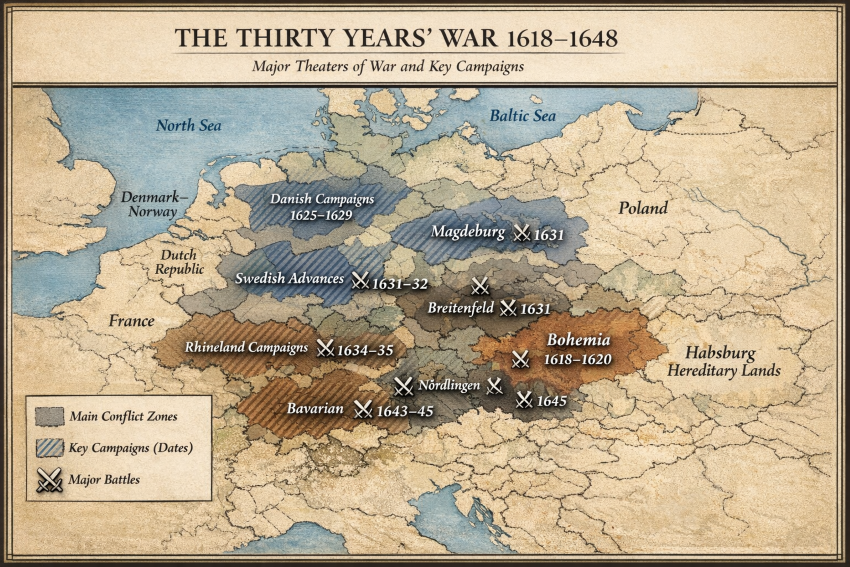
In the early seventeenth century, the Holy Roman Empire was not a single centralized state but a dense constitutional patchwork—electors, princes, ecclesiastical territories, and imperial cities—held together by law, custom, and negotiated authority. Religious settlement after the Reformation had reduced some sources of conflict without eliminating them. The Peace of Augsburg (1555) provided a legal framework for coexistence between Catholics and Lutherans, but its categories did not neatly cover every confession that mattered in practice, and its rules still required interpretation, enforcement, and—crucially—trust that future rulers would honor what earlier rulers had accepted.
Bohemia sat at the center of this tension between legal text and political reality. In 1609, Emperor Rudolf II issued the Letter of Majesty for the Kingdom of Bohemia, a document that later actors treated as a key guarantee for religious rights among the estates. Its meaning and scope were not merely theological. They were tied to who had the authority to decide where churches could be built, who could supervise compliance, and what counted as a violation. That is why, when later disputes arose over local religious arrangements, the conflict quickly became a contest over constitutional competence: whose reading of the rules would prevail, and what would happen if a party refused to accept the other side’s interpretation.
By 1617, Ferdinand of Styria—soon to become Ferdinand II—had been recognized as King of Bohemia by the Bohemian Diet. The following months brought a crisis that contemporaries framed as a breach of established guarantees. According to widely repeated accounts in reference histories and documentary introductions used in this series, Catholic officials ordered the closure of Protestant chapels being built at Broumov and Hrob—an act Protestant estates presented as incompatible with the Letter of Majesty. Whether one treats that as a straightforward legal violation or as a jurisdictional dispute depends on interpretation; what can be stated as fact is that the closures became a focal grievance and a rallying point for political mobilization.
In May 1618, the dispute crossed from petitions and legal arguments into open confrontation. A gathering of estates in Prague led to the episode later known as the Defenestration of Prague. The best-supported narrative—reflected in both documentary compilations and standard reference treatments—is that the estates’ leaders seized two royal regents (Jaroslav von Martinicz and Wilhelm Slawata) and a secretary, accused them of acting against Bohemian liberties, and threw them from a window of Prague Castle on 23 May 1618. The act was not simply symbolic; it was a public declaration that the estates considered the established political order broken enough to justify extraordinary measures. Within the estates’ own published justification, the Apologia circulated to foreign audiences, the message emphasized that they were not rebelling against monarchy in principle but punishing officials alleged to have violated legally guaranteed rights. That framing was both an argument and a strategy: it sought legitimacy at home and support abroad.
The next step was not inevitable, but it followed a logic of escalation typical of constitutional crises in a multi-actor system. The Bohemian estates formed a provisional government and sought allies among Protestant rulers. Meanwhile, dynastic succession compressed timelines. Emperor Matthias died in 1619; Ferdinand’s position strengthened when he was elected Holy Roman Emperor on 28 August 1619. The Bohemian estates then took a step that greatly raised the stakes: they deposed Ferdinand as King of Bohemia and elected Frederick V, the Elector Palatine, as king. Whatever the estates’ internal debates, this decision linked a local revolt to the broader imperial and international order. Frederick was not simply a nearby prince; he stood within the Empire’s highest constitutional tier as an elector and within the emerging alliance landscape associated with Protestant coordination. From this point, Bohemia was no longer just a domestic dispute about chapels and privileges. It had become a struggle over who could rule, under what legal settlement, with what external backing.
Military resolution arrived quickly in Bohemia itself. The battle of White Mountain on 8 November 1620 is treated in standard chronologies as decisive: the Bohemian rebel forces were defeated by Imperial and Catholic League armies, and Ferdinand reasserted control. In narrative terms, White Mountain ends one chapter and begins another. It did not end the war; it transformed it. Once a revolt is crushed, the postwar measures—confiscations, reassignments of office, enforcement of confessional arrangements—become new facts on the ground that other actors must either accept, contest through institutions, or oppose by force. The wider system, already tense, now had a precedent and a set of winners and losers that shaped later choices.
By the mid-1620s, the conflict widened again with Denmark-Norway’s intervention (commonly dated 1625–1629). Contemporary and later accounts describe Denmark’s entry as tied to opportunities and risks in northern Germany; in reference treatments used earlier in this project, Denmark’s king is described as seeing a chance to gain territory in Germany. It would be an overreach to reduce the intervention to any single motive; confessional alignment, dynastic calculation, and security concerns all feature in the literature. What is secure is that the Danish intervention added another major actor and expanded the geographic and fiscal scale of war.
The Danish phase ended with Denmark’s exit in 1629 (Peace of Lübeck), but 1629 also brought one of the war’s most consequential policy shocks: the Edict of Restitution. In documentary framing used earlier in this series, the edict aimed at restoring ecclesiastical properties secularized since 1552, enforcing a Catholic-favorable reading of the Augsburg settlement. In practice, the edict intensified anxieties among Protestant estates and sharpened the sense that the war was not merely about one crown’s authority but about the rules governing property, confession, and political standing across the Empire. Even where the edict could not be fully enforced everywhere, it altered bargaining positions: it made compromise harder by raising the potential cost of losing.
In 1630, Sweden entered the war, landing in northern Germany. Sweden’s declared framing, preserved in documentary introductions cited earlier, emphasized aid to Protestant princes and peoples; historians debate how to weigh that alongside strategic and geopolitical considerations, and the safest position is that multiple drivers likely operated simultaneously. The Swedish phase reshaped operational momentum. In 1631, Magdeburg became a symbol of civilian catastrophe: the city was stormed and burned during Imperial/Catholic League operations, with widely cited accounts reporting mass killing and extensive destruction. The episode looms large because it combined military action, urban fire, and civilian death in a way that reverberated through propaganda and fear.
Later that year came Breitenfeld (17 September 1631), fought near Leipzig, often treated as the first major Protestant victory. It mattered not only for the battlefield result but because it altered the credibility of alliances. In multi-actor wars, victory is a form of persuasion: it changes which commitments seem viable and which coalitions look durable. Swedish-led success encouraged additional alignments; defeat forced recalculation among Imperial supporters and neutrals. Yet the war’s pattern was not linear. At Lützen (16 November 1632), Swedish forces fought another major battle; Gustavus Adolphus died there, a leadership loss with political consequences even where the tactical outcome could be debated. Then, in 1634, Nördlingen delivered a major Habsburg victory that shattered Swedish dominance in southern Germany and helped drive the next major shift: France entered the war as an active belligerent in 1635, inaugurating the long Franco–Swedish phase.
From 1635 onward, the conflict becomes harder to narrate as “one war” and easier to describe as interlocked theaters. Campaigns on the Rhine, in Bavaria, in Saxony, in Bohemia, and in the Spanish Netherlands interacted with a broader Franco-Spanish rivalry that did not end in 1648. Warfare in this period was characterized by a combination of battles and sieges, but the most constant feature was logistical pressure. Armies were large for the period and expensive to maintain. When central fiscal systems were insufficient, forces often relied on requisitions, billeting, and “contributions” extracted from territories—practices that tied military movement to the availability of food, forage, and money. This, more than battlefield death alone, helps explain why contemporaries and later historians emphasize famine, disease, and displacement as primary mechanisms of civilian suffering.
Because of these mechanisms, casualty estimates remain inherently uncertain. The figures commonly cited in broad syntheses range from roughly four million to over ten million deaths, depending on scope and method, with a substantial share attributed to indirect effects—hunger and epidemic disease amplified by disruption and flight. Population loss claims also vary: earlier scholarship sometimes cited catastrophic aggregate declines, while some modern historians argue for lower empire-wide percentages paired with extreme local variation. The most defensible narrative is therefore not a single number but a picture: many communities experienced repeated waves of requisition, displacement, and disease; some regions were devastated; others recovered faster; and the documentary record is uneven.
By the 1640s, the war’s strategic balance and the exhaustion of resources made settlement more feasible, but feasibility was not agreement. Negotiations began in earnest in 1644 in Münster and Osnabrück, with separate but linked tracks—Imperial–French and Imperial–Swedish—reflecting confessional and diplomatic realities. The war continued while diplomats bargained, and the bargaining itself had to solve several problems at once: the constitutional structure of the Empire, the confessional settlement, territorial claims, and the practical issue of getting armies paid and withdrawn. In 1648, the Dutch Republic and Spain concluded a treaty (30 January 1648) within the broader settlement complex. The principal Westphalian treaties were signed in October 1648 (often dated 14/24 October due to calendar differences), and ratifications followed in late 1648 and into early 1649.
The Peace of Westphalia did not create a simple “winner takes all” outcome; it created a workable, legally framed distribution of rights and territories that major parties were willing to recognize. Sweden obtained key territories in northern Germany and a formal role in imperial politics. France obtained sovereignty over Alsace and confirmation of earlier possessions. The settlement reaffirmed and extended confessional legal standing—commonly summarized as securing toleration for Catholics, Lutherans, and the Reformed—using 1624 as a benchmark year for many ecclesiastical-property questions. It confirmed Dutch and Swiss independence. It also entrenched the autonomy of the Empire’s estates, including limited external-relations capacity under constraints, shaping how the Empire would function thereafter.
Yet even at the moment of “peace,” the European struggle was not over. France and Spain continued fighting until the Peace of the Pyrenees in 1659. And inside the Empire, confessional tension did not disappear; it was redirected into institutional and legal channels whose effectiveness varied by territory. The deepest legacy was demographic and social. Recovery was slow. In one modern historian’s public lecture formulation cited earlier in this series, population levels in some areas did not return to those of 1618 until roughly 1713—an illustration of how, in a pre-industrial economy, lost labor and disrupted communities could not be quickly replaced.
In narrative terms, the Thirty Years’ War begins with a dispute over guarantees and authority in Bohemia and ends with a continental settlement that rewrote the rules for how the Empire’s diversity would be managed. Its conduct—campaign by campaign—was shaped as much by food, money, and fortresses as by battlefield tactics. Its outcome was not a single conquest but a negotiated architecture: territorial adjustments, constitutional constraints, and a confessional compromise designed to reduce the likelihood that future disputes would again be decided by mass mobilization. Whether that architecture represents the “birth” of modern sovereignty is a debated interpretation. What is less debated is that, by 1648, the war had demonstrated the destructive capacity of prolonged coalition warfare in central Europe—and forced a settlement that tried, imperfectly, to make that kind of war harder to start and easier to stop.