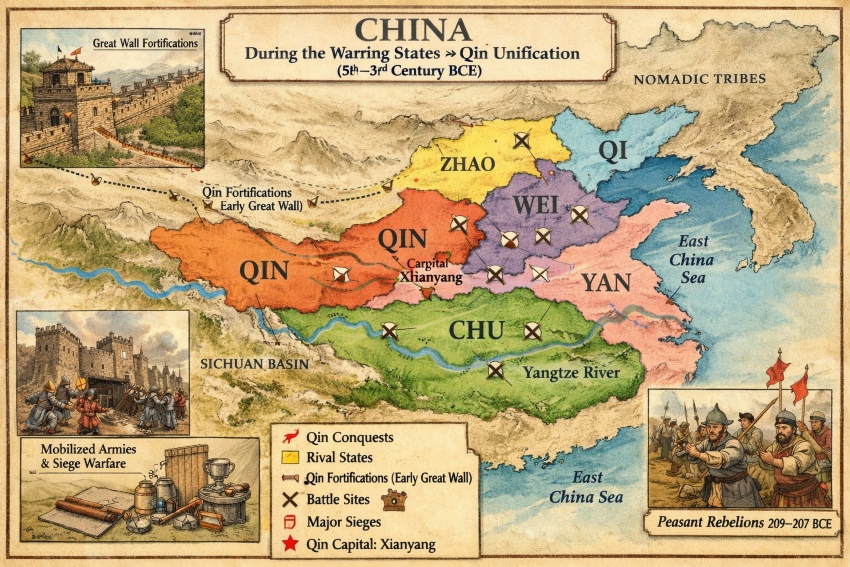
In the late centuries of the Zhou dynasty, “China” was not a single state so much as a crowded political landscape of competing kingdoms whose rulers shared many institutions and a broad cultural vocabulary, even as they fought repeatedly. Later writers and modern reference works commonly date this era—the Warring States period—to roughly 475–221 BCE, and they describe it as a time when multiple rival states contended for survival, territory, and predominance. The Zhou king endured, but increasingly as a ceremonial figure, while real power gathered in larger territorial monarchies that expanded their tax base, professionalized administration, and built the capacity to mobilize far more soldiers than earlier aristocratic coalitions could sustain.
What made this world unusually violent was not a single grievance or a single spark, but the way the system evolved. Over time, the major states grew more capable of reaching into local society: officials registered households, extracted resources, and translated that revenue and manpower into organized military force. A key scholarly synthesis in the Cambridge History of Ancient China describes dependent officials being used to register and mobilize peasant households, especially to impose broad military service, while the scale of armies encouraged the rise of military specialists and the development of diplomatic strategists who theorized persuasion and interstate maneuver. This is the background that matters for understanding the “war” in narrative terms: it was not merely that rulers wanted to fight, but that they increasingly could—repeatedly, at scale, and across long distances.
By the later Warring States, modern summaries often speak of “seven” leading powers—Qin, Chu, Qi, Yan, Han, Zhao, and Wei—as the principal contenders in the endgame. That shorthand is useful, but the lived reality was more fluid: shifting coalitions, temporary hegemonies, and repeated attempts to check whichever state appeared to be pulling ahead. Yuri Pines’ overview in the Oxford Handbook of Early China frames this late period as a sequence of interstate dynamics that intensified after the de facto dissolution of Jin (453 BCE) and ran through to Qin’s final unification in 221 BCE; he emphasizes how states rose, were checked, and rose again, with alliance-making a central feature of the competitive environment.
In this setting, bargaining and diplomacy existed constantly, but they rarely produced lasting stability. One defensible, minimal account—without pretending to read minds—is that in a multipolar world where relative strength could shift quickly, any settlement could be undermined by later opportunities. Pines explicitly highlights efforts to block Qin through anti-Qin alliances and the subsequent weakening or collapse of those efforts as Qin accelerated in the third century BCE. Interpreting why alliances failed requires caution: sources are uneven, and later narratives can overstate coherence or villainy. Still, the pattern itself—coalitions forming and fracturing under stress—is widely treated as central to the road toward the final conquest sequence.
Against this backdrop, Qin’s position in the west became increasingly decisive. Here, modern accounts converge on a basic idea: Qin was not simply a strong army, but a state with an administrative model that could sustain repeated operations and absorb conquered territories. Reference summaries of the Qin dynasty (221–207 BCE) emphasize that once Qin unified the realm it implemented a rigid central government and pursued standardizations—writing, weights and measures, and even infrastructure norms—while abolishing feudal privileges. Those policies belong mainly to the imperial phase, but they illustrate the kind of state capacity Qin was bringing to the endgame: the ability not only to defeat rivals but to convert victory into governance.
The terminal “war conduct” phase is best told as a sequence of campaigns that eliminated rival states one by one. The most commonly cited chronology—presented in multiple modern compilations—runs as follows: Qin destroyed Han (230 BCE), then Zhao (228 BCE), then Wei (225 BCE), then Chu (223 BCE), then Yan (222 BCE), and finally Qi (221 BCE). Even when details vary across accounts, this outline captures what made the unification wars distinct: they were not a single climactic battle, but an extended, systematic effort to remove the remaining independent centers of power.
This is also where the war’s human reality becomes hardest to narrate with numerical precision. Later histories and later summaries often offer very large casualty figures for particular campaigns; modern scholarship treats many such numbers with caution because the surviving record does not function like audited demographic data. What can be stated more firmly is the direction of change: Warring States institutions enabled mass armies, and the late period’s wars often involved sieges, long campaigns, and the destruction of political communities through annexation rather than negotiated peace. The world of many courts, many capitals, and many diplomatic options narrowed over a single generation into a contest whose logic became increasingly binary: absorb or be absorbed.
When Qin conquered Qi in 221 BCE, the interstate system that had defined the Warring States era ended. Britannica’s Qi entry summarizes the endpoint plainly: in 221 BCE Qin absorbed what remained of Qi, completing unification under a strong central government. The “termination” of the conflict, in other words, was not a treaty table or a compromise settlement. It was the removal of rival sovereignty itself.
After victory came the attempt to make that victory durable. Qin’s imperial program—at least as described in major reference works—resembled an imposed settlement with three pillars: administrative control, standardization, and enforcement. The Qin dynasty overview emphasizes standardized writing and measurements and the abolition of feudal privileges, while also noting large-scale state construction and an order (dated to 213 BCE in the same summary tradition) restricting books outside approved practical subjects. These measures can be described without arguing about motives: they are the kinds of policies that reduce local variation, shrink the space for rival authority, and increase the center’s capacity to command resources and information.
Yet the same sources that emphasize Qin’s state-building also stress the dynasty’s brevity. The Qin dynasty is commonly dated 221–207 BCE, making its lifespan far shorter than the scale of its ambitions. This creates one of the enduring tensions in how the aftermath is remembered: Qin’s political settlement was extraordinarily sweeping, but its ruling house did not endure long enough to stabilize it through routine succession.
The collapse phase is often narrated through a chain of rebellion and civil war that began soon after the First Emperor’s death and widened into competing coalitions. A widely cited early uprising in this breakdown is associated with Chen Sheng and Wu Guang in 209 BCE, remembered in later tradition as the first major rebellion against the Qin after unification; modern summaries date it to 209 BCE and describe it as unsuccessful in the short term, even as unrest continued and spread. Here the evidentiary caution matters again: later Han-era historiography had its own reasons to depict Qin as harsh and doomed, and many vivid anecdotes are difficult to corroborate at modern standards. But the broad outline—rebellion after 210 BCE, Qin’s fall by 207 BCE, and the emergence of a new unifying dynasty soon after—is firmly embedded in standard periodization.
So what, then, was the outcome of the “war,” in the largest sense? On the narrowest reading, Qin achieved its defining wartime objective—unification—then lost the empire it created within years. On the broader reading that focuses on institutions rather than ruling families, Qin’s unification marked a permanent change in the political imagination and administrative template of the region. The same Qin dynasty overview that notes sweeping standardizations and authoritarian governance also implicitly points to why Qin mattered beyond its lifespan: it demonstrated that a single centralized state could replace the older multi-kingdom order, and it supplied a repertoire of administrative tools for successors.
Why did this war happen at all? Any answer that claims a single motive for “everyone” would go beyond what the sources can securely show. The most defensible explanation combines (a) system structure—a multipolar arena where survival and advantage were constant stakes—with (b) state capacity—administrations that could mobilize and sustain large armies—and (c) contingency—the particular sequence of coalition failures, campaigns, and leadership choices that made Qin’s endgame possible. Pines’ framing supports high confidence in the structural picture of intense interstate dynamics and repeated balancing efforts, and the Cambridge synthesis supports high confidence that institutional change made mass war and sophisticated diplomacy increasingly feasible. The rest—the precise weighting of ideology, strategy, fear, opportunity, and domestic politics—remains an arena of interpretation, best approached as competing hypotheses rather than settled fact.
In narrative terms, then, the Warring States-to-Qin story is the story of a world that built the machinery of its own transformation. Rival courts learned to count households, raise armies, manage specialists, and fight for years rather than seasons. Coalition diplomacy tried—repeatedly—to keep any one state from dominating, but the same forces that raised everyone’s capacity for war also raised the stakes of losing. Once Qin gained decisive momentum, “peace” arrived not as agreement but as absorption, followed by an ambitious attempt to standardize and govern a newly unified realm. The final irony of the aftermath is that the dynasty that achieved unification could not itself endure—yet the political form it made possible, and the administrative habits it spread, became the starting point for the imperial centuries that followed.