The Lagash–Umma border conflict: why it became war, and what its results were
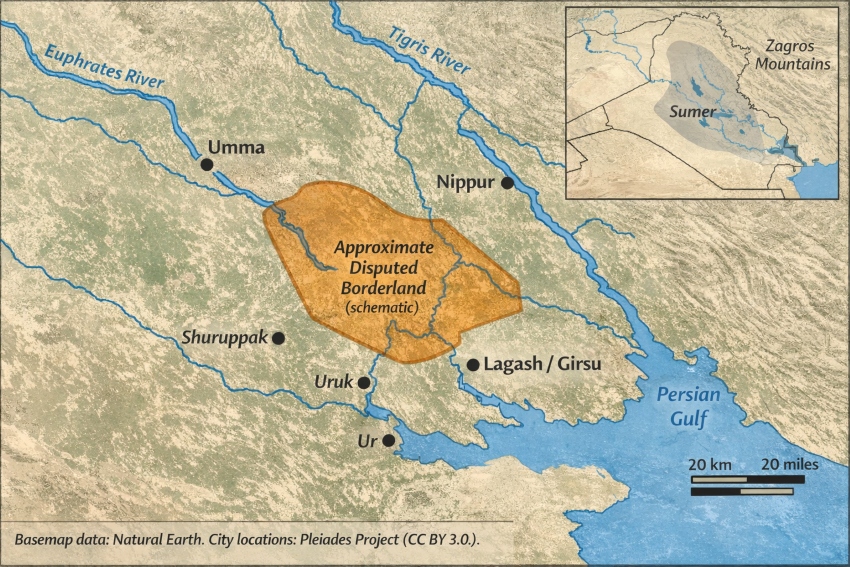
In the middle centuries of the third millennium BCE, southern Mesopotamia—Sumer—was not a unified territorial state in the modern sense. It was a dense cluster of city-based polities with overlapping economic zones, shared cultural forms, and recurrent competition over land, labor, and water infrastructure. The Lagash–Umma conflict is one of the earliest well-documented cases in which that competition becomes visible as a sustained border dispute punctuated by armed clashes and repeated attempts to formalize boundaries. The surviving record is unusually rich for such an early period, but it is also uneven: much of the narrative detail we can quote comes from texts preserved from the Lagash side, especially in an Enmetena-era account that describes earlier rulers and disputes.
Why the dispute mattered: a valuable borderland in an irrigation landscape (facts)
The immediate object of contention in the main narrative tradition is a district rendered in translation as the Eden/Edin (often presented as the Gu’edena in broader scholarship): a productive zone whose value depended on canal access and coordinated maintenance. The CDLI Wiki description of the Enmetena text is direct on this point: it relates conflicts “over land and canal management in the Eden district” between Lagash and Umma.
Hritz’s landscape study adds a second, broader factual frame: the physical environment of southern Mesopotamia was a canalized, shifting riverine system where channel management was not a marginal issue but a core determinant of agricultural stability and institutional revenue. In a setting like this, a boundary is not merely a line on the ground; it is also a set of rights and responsibilities—who digs, who dredges, who diverts, who decides, and who collects the resulting produce.
How a border becomes a cause of war: precedent, demarcation, and enforcement gaps (facts + interpretation)
The Enmetena-era narrative begins with a remembered act of arbitration linked to Mesilim of Kish, described as a figure who “measured” the field and set up a boundary stele. This is important even if we cannot independently verify every detail: the text treats Mesilim’s decision as a precedent that later rulers invoke as legitimate authority. In modern terms, Mesilim functions as an anchoring point for “what the border is supposed to be.”
The same narrative then describes the collapse of that arrangement: a ruler on the Umma side is said to have removed or violated boundary markers and advanced into the disputed zone. The text is written from Lagash’s perspective, so it is not a neutral court record. Still, it shows a structural problem that recurs in many border disputes across history: demarcation without enforcement. Markers can be erected; the harder part is ensuring compliance when seasons change, leadership changes, or opportunity presents itself.
Interpretation (confidence: high): In an irrigation economy, “enforcement” likely meant both coercive capacity (to deter encroachment) and administrative capacity (to monitor canals, levy duties, and organize maintenance). Hritz’s emphasis on landscape and canal systems supports the plausibility that monitoring and maintenance disputes were inherently difficult and recurrent.
The “bargaining failure” problem: land, canals, and a transfer mechanism (facts)
What stands out in the Enmetena account is that settlement attempts appear to mix three elements:
- Physical demarcation (boundary canal/ditch and markers),
- Sacral-legal reinforcement (monuments, chapels, divine sanction), and
- An economic transfer/obligation, described through barley accounts.
The text describes a border that is not only measured and marked, but also ritualized: it refers to boundary dikes associated with major deities (notably Ningirsu and Nanshe), and it contains explicit curse-like deterrent language later in the narrative.
It also includes a striking fiscal component: Umma’s “use” of the land is paired with barley obligations described as growing over time. The exact quantities are debated in scholarship and cannot be treated as reliable statistics. But the presence of the mechanism is itself significant: it implies that the border arrangement was not a simple “winner takes all” division. It resembled a compensatory bargain in which access or control in the contested zone was tied to continuing payments or duties.
Interpretation (confidence: medium): Such a transfer arrangement could reduce incentives for renewed conflict if it is seen as fair and enforceable; it can also become a flashpoint if one side views it as illegitimate rent extraction, if nonpayment accumulates, or if accounting claims are used rhetorically to portray the other as a defaulter. The text’s framing—especially when it later stresses limited repayment—suggests that “payment compliance” itself became part of the legitimacy contest.
Escalation into armed conflict: canal disruption and boundary transgression (facts)
In the later portion of the narrative, the Umma ruler Urlumma is depicted as escalating beyond routine encroachment. The text accuses him of diverting water, destroying monuments and chapels, hiring “people of the foreign lands” as mercenaries, and crossing the boundary dike from the north.
These are specific claims, and because they are claims from an adversarial source, they must be handled carefully. Yet they are also consistent with the kind of escalation one would expect in a canal-based agrarian system: if you want to impose costs on an opponent without permanently occupying their core city, you target water and border infrastructure—the things that determine whether the next harvest succeeds and whether institutions can provision labor. Hritz’s environmental framing makes it reasonable to see canal management as a central domain of contestation rather than incidental background.
The fighting and its presentation: “victory” as boundary enforcement (facts)
The most detailed “battle” sequence available in the CDLI-accessible narrative places a major engagement in the Ugiga-field, described as “the field of Ningirsu.” It states that the Lagash ruler Enanatum fought Urlumma there, and that Enmetena (identified as Enanatum’s son) defeated him; Urlumma is said to have escaped but been killed in Gisha/Umma territory. The text then describes abandoned draft animals and scattered remains across the Edin district.
Separately, the Louvre’s object record for the Stele of the Vultures dates it to approximately -2450 to -2425 and associates it with Eannatum (an earlier Lagash ruler) and the site of Girsu (Tello), a key Lagash center. The stele is widely treated as commemorating a Lagash victory over Umma, but what can be asserted firmly from the Louvre record alone is its dating, provenance, and association with Eannatum’s period.
Taken together, the narrative and the monument record point to an important pattern: in this conflict, “battle” is presented not primarily as conquest for its own sake, but as enforcement—a way to compel recognition of the boundary and the rights embedded in it.
What result did the war produce: settlement, partial compliance, and continued contestation (facts)
After Urlumma’s reported defeat, the text shifts to a political sequence in Umma: a ruler Il appears (the narrative calls him “ruler of Gisha”), and the text claims he repaid “only” 3,600 guru of Lagash’s barley. Again, the number should not be treated as a demographically meaningful statistic; it is, however, a concrete indicator that the text frames the aftermath in terms of obligation and compliance.
The narrative then describes diplomatic contact—envoys sent by Enmetena—and continued antagonistic claims from Il, quoted as asserting ownership over the boundary dikes of Ningirsu and Nanshe and threatening to “dry them up” across a named span. The text immediately adds that divine forces “did not allow him” to do so. From a historian’s perspective, the divine intervention line is not testable as a causal claim; it is evidence of how the Lagash narrative frames legitimacy and deterrence.
Finally, the text emphasizes reconstruction: Enmetena is described as rebuilding the boundary dike system “from the Tigris River to the Nun-canal” and reinforcing it with stone foundations. Whether every engineering detail is literal or stylized, the practical result is clear: the post-war settlement is not just words. It is also a physical reassertion of the boundary through infrastructure.
What we can—and cannot—say about motives (interpretations, attributed, with confidence)
Because direct “intent” statements from both sides are scarce and the most detailed narrative is Lagash-authored, motive claims must be cautious. Still, several interpretations are well grounded:
- Resource governance interpretation (confidence: high):
The core driver was control of arable land and canal rights/maintenance responsibilities in a landscape where water management determined output. This is strongly supported by CDLI’s summary (“land and canal management”) and by Hritz’s landscape analysis. - Legitimacy-and-precedent interpretation (confidence: medium):
The conflict was also about “who has the right to define the border,” as shown by the repeated invocation of Mesilim’s demarcation, boundary monuments, chapels, and curse language. This is consistent with the text’s structure, but harder to quantify beyond discourse evidence. - Opportunism / leadership-cycle interpretation (confidence: low-to-medium):
Some episodes may reflect opportunistic attempts by individual rulers to revise the status quo when enforcement slackened. This is plausible in general but difficult to establish from the available excerpts without overreading partisan narratives.
A note on balance: what we have from Umma (facts)
The record is not entirely one-sided. The British Museum holds a mace-head associated with Gishakidu, naming Umma and the god Shara, and it was exhibited in a modern show explicitly themed around borders (“No man’s land”). This does not, by itself, provide a full counter-narrative equivalent to the Enmetena account, but it is material evidence that Umma also produced commemorative/inscribed objects in this dispute ecology.
The bottom-line outcome (facts)
If the question is “who won,” the evidence supports a constrained answer:
- Lagash’s texts claim military success in specific episodes and depict the aftermath as boundary reconstruction and partial extraction of obligations.
- The Stele of the Vultures’ dating and association with Eannatum align with a major victory commemoration during the key mid-25th-century episode.
- But the conflict did not end permanently in a single decisive settlement; it appears as a repeated pattern of demarcation, violation claims, enforcement, and renewed disputes over the same canal-land complex.
In other words, the “result” was not durable peace. It was a series of episode-level settlements backed by monuments and infrastructure—arrangements that stabilized the border for a time, then proved vulnerable to renewed contestation.
Endnotes / Sources cited
- CDLI Wiki overview of the conflict and summary of the Enmetena text’s focus on land and canal management.
- CDLI tablet page containing the translated narrative passages (Ugiga-field battle; Urlumma; partial barley repayment; Il’s quoted claim; reconstruction).
- Carrie Hritz, “The Umma-Lagash Border Conflict: A View from Above,” landscape/hydrology framing and context.
- Louvre collections record for the Stele of the Vultures (dating and association with Eannatum; findspot Girsu/Tello).
- British Museum collection record for the Umma mace (association with Gishakidu; inscription names Umma and Shara; findspot Jokha/Umma).