Public Foundations and the Web’s Open Release (1980s–1995)
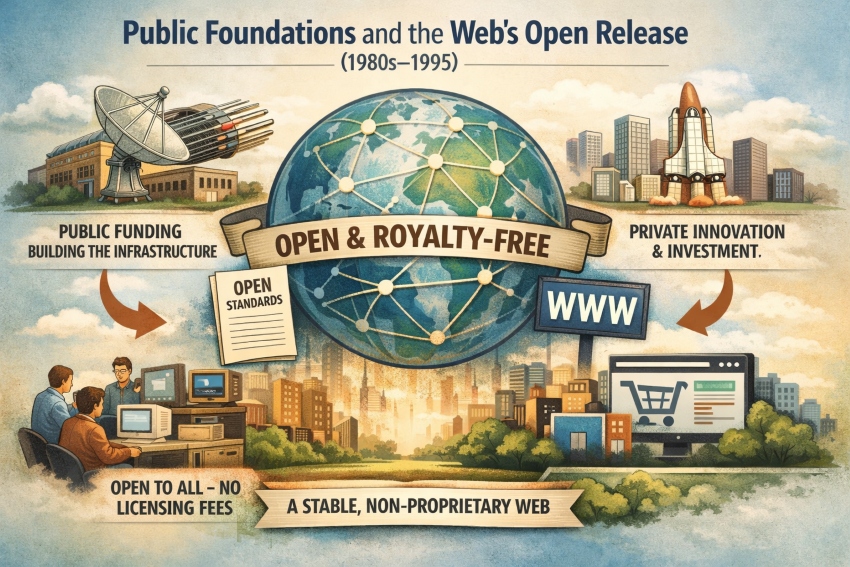
The Web did not “win” because it was the only viable technical option. It won because public funding built the underlying infrastructure, and open licensing removed barriers for companies to invest. Once the Web could be implemented without royalties, private actors could confidently build products and services on top of a stable, non-proprietary foundation.
Sources
- CERN
- U.S. National Science Foundation (NSF)
Public research funding created the substrate
Before there was meaningful commercial investment in the Web, the prerequisites were funded mainly through public research budgets and institutional spending. In the United States, government funding supported large-scale academic networking. In Europe, research institutions financed computing staff, internal networks, and experimentation that helped the early Internet mature into a usable platform.
Sources
- U.S. National Science Foundation (NSF)
A major U.S. example was NSFNET, which served as a backbone for researchers and universities through the late 1980s and early 1990s. When NSFNET’s backbone operations were retired in 1995, it marked a widely cited transition toward a more commercially operated Internet ecosystem.
Sources
- U.S. National Science Foundation (NSF)
- Internet Society
The Web began as an institutional project—and was then made broadly available
At CERN, Tim Berners-Lee’s work began as an internal proposal and prototype effort (1989–1991), not a venture-funded product. The key economic decision came later: CERN made the Web technology broadly available without royalty barriers. That reduced the risk for companies and developers, because they could invest without fear that a single rights-holder could restrict access later.
Sources
- CERN
Economic implication: When the Web’s “IP price” fell close to zero, value shifted away from controlling the protocol and toward competition in the layers above it—browsers, hosting, commerce, advertising, and eventually platform businesses.
Sources
- CERN