Chapter 2: Connectivity Hardware — From Dial-Up to Broadband and Fiber
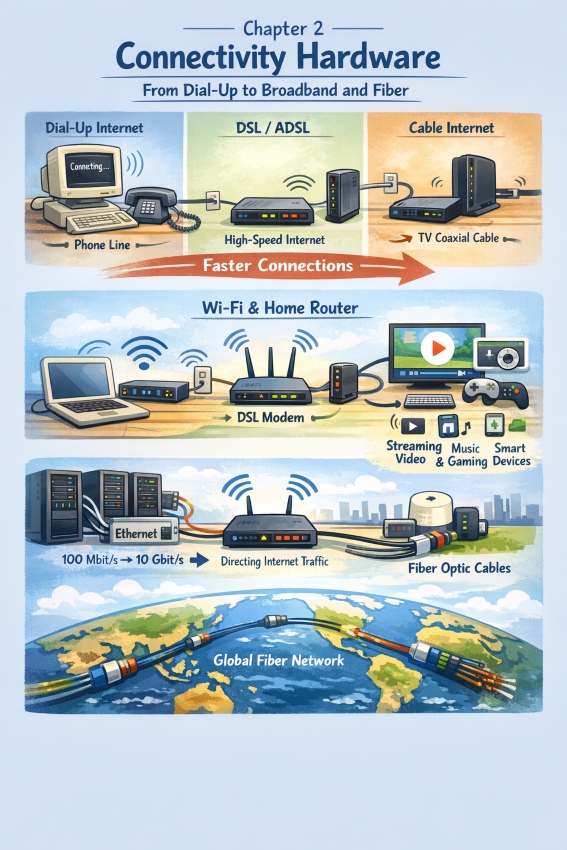
Internet connections got faster and cheaper over time. That simple change shaped how the Web felt to ordinary people. Faster connections made it possible to load bigger pages, watch video, and use services that respond instantly.
References: ITU; CableLabs; Wikipedia
Getting online: from phone-line modems to broadband and Wi-Fi
In the early days, many people used dial-up. A dial-up modem used the telephone line and was slow. Because of this, early websites were usually simple: mostly text, small images, and short pages.
References: Wikipedia
Later, broadband became common. Broadband means the connection is fast enough to stay on all the time. Two technologies mattered most:
- DSL/ADSL: internet through the telephone line
- Cable broadband (DOCSIS): internet through the TV cable network
With broadband, websites could include more images, music, and later video.
References: ITU; Wikipedia; CableLabs
When homes and offices got broadband, the next step was sharing it inside the building. Wi-Fi and home routers made it easy to connect many devices at once. That change helped the Web become part of everyday life: phones, laptops, and later smart devices were online all the time.
References: Wikipedia
The hidden network that makes the Web work: Ethernet, routers, and fiber
Inside offices and data centers, computers need fast local connections. Ethernet became the standard wired network. Over time it improved from early versions to much faster speeds (for example 100 Mbit/s and later 10 Gbit/s). This allowed companies to run larger and busier web services.
References: IEEE Standards Association; ETHW
To connect the world, the Internet needs routers. A router is like a traffic controller. It decides where data should go next so information can travel between networks and across countries. Better routers helped the Internet grow safely and reliably.
References: Science Museum Group Collection (Cisco AGS)
For long distances, the biggest upgrade was fiber optic cable. Fiber sends data as light through glass. It can carry huge amounts of information over long distances. Important fiber breakthroughs around 1970 made modern telecom networks possible, and major systems later connected continents with much higher capacity.
References: Corning; Wikipedia
In Europe, CERN (a major research center) was an important early networking hub. Accounts note that around 1991 a large share of Europe’s international Internet capacity passed through CERN, which supported early Web connectivity during its first growth period.
References: CERN (home.cern)