China and the Paper Money Precedent: From Remittance Notes to State Fiat (c. 800–1400)
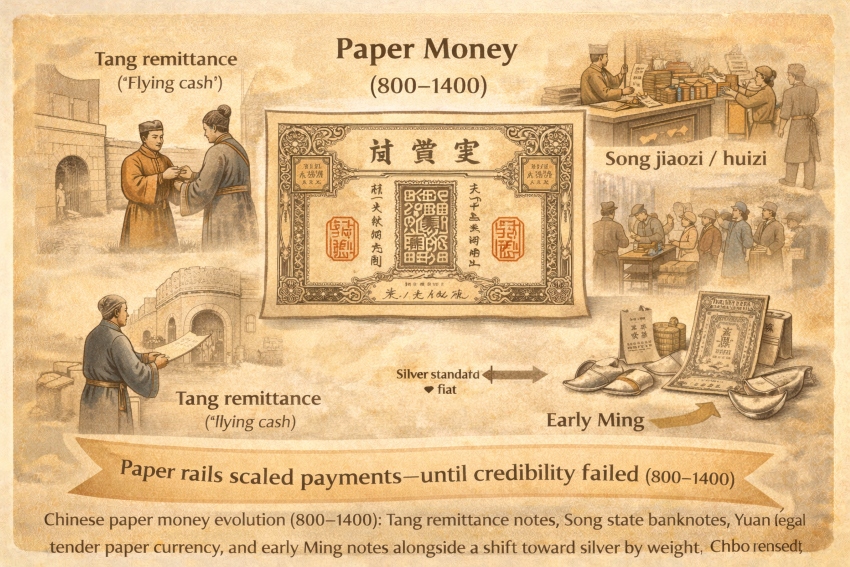
“China demonstrated that paper instruments can scale payments—if issuance rules, enforcement, and credibility hold.”
Summary of events during the period
Between roughly 800 and 1400, China produced the clearest pre-modern demonstration that payments can scale on paper, not just on metal. The sequence is instructive: Tang-era remittance instruments (“flying cash”) reduced the need to transport coin; the Song then developed large-scale state-issued banknotes (jiaozi and later huizi), supported by administration and printing; the Yuan expanded the concept into an empire-wide regime in which paper money was pushed as legal tender, moving through phases from precious-metal constraints toward fiat-like issuance; and the early Ming attempted a major paper currency system again, which struggled with credibility, counterfeiting, and value loss—contributing to a longer-run shift toward silver-by-weight practices.
Payment media (what people used to pay)
- “Flying cash” (feiqian) as remittance notes (Tang, 9th century): Often described as “money-like paper,” used to move value between cities without hauling copper cash; scholarship characterizes it as a merchant-issued remittance note that foreshadowed later banknote systems.
- Song paper money (jiaozi, then other note types): Modern economic history work identifies the Northern Song as the first dynasty to experiment at scale with convertible banknotes, beginning with jiaozi in the 11th century (originating in Sichuan and later taken over by the state).
- Southern Song huizi (from 1160): Later Song systems (notably huizi) expanded the reach and volume of paper notes, forming a major part of the monetary mix in the Southern Song era.
- Yuan dynasty paper money (chao/jiaochao): Research on Yuan monetary policy describes a regime where paper money became central and, in important phases, was enforced as the primary medium for settlement—moving across stages that included precious-metal constraints (a “silver standard”) and later over-issuance.
- Early Ming paper money (Great Ming Treasure Notes / Da Ming Baochao, from 1375): The Ming state issued paper money from 1375, but sources emphasize irregular coin supply, counterfeiting problems, and a gradual gravitation toward silver by weight in practice.
How prices were set (negotiated vs administered vs regulated)
Negotiated prices (market exchange)
- In normal commerce, prices still formed through bargaining and local supply/demand. Paper money does not eliminate negotiation; it changes what is negotiated—less about metal weight and more about acceptability and expected purchasing power of notes.
Administered obligations (state fiscal interfaces)
- A recurring pattern is that paper currency becomes most powerful when the state (a) pays with it and (b) requires it (or accepts it) for specific taxes and dues—creating “forced demand” even when convertibility is weak. This dynamic is stated explicitly for Ming paper money, which remained usable in part because it was prescribed for certain taxes despite disastrous value loss.
Regulation via issuance rules, convertibility, and enforcement
- The Chinese experience is a long experiment in monetary governance: regulating issuance, setting redemption/convertibility conditions, and—under the Yuan especially—enforcing acceptance. Modern scholarship treats these controls as decisive in whether paper money stabilized or inflated.
How payments cleared (the “rails”)
- Remittance clearing (Tang “flying cash”): Value could be transferred by paper claims redeemable or payable elsewhere—an early rail that substitutes document movement for coin movement.
- State note circulation (Song): By the 11th century, the Song ran large-scale note circulation (jiaozi and later systems), framed by scholars as a major step from “money-like paper” toward full banknote mechanics, including periods of convertibility and administrative oversight.
- Empire-wide enforcement and regime shifts (Yuan): Yuan paper money is analyzed as moving through stages—from stronger precious-metal constraints toward more fiat-like issuance—where fiscal and military pressures correlate with greater issuance and inflation.
- Early Ming paper rails under credibility stress: Ming notes circulated alongside coin and growing silver-by-weight practice; museum and art-history sources emphasize how practical payment life shifted as confidence in paper eroded.
Trust and governance (why anyone accepted it)
- Administrative credibility + printing technology: Paper money requires trust in issuer rules and anti-counterfeiting capacity; the Song period is associated with major commercial expansion and widespread printing, which supported information spread and document standardization.
- Metal anchors and redemption constraints (partial and evolving): Modern economic analysis of Yuan money highlights periods where silver convertibility constrained issuance, followed by weaker constraints and higher inflation risk.
- Fiscal acceptability as “floor demand”: Even when paper depreciated, states could keep it in circulation by requiring it for certain payments (notably taxes), as described for Ming paper money.
Revenue model (who made money from the system)
- Seigniorage and fiscal capacity: Paper money can fund the state when issuance exceeds redemption constraints—creating short-run fiscal relief at the cost of long-run credibility. Modern research explicitly links Yuan over-issuance and inflation to fiscal/military pressures in fiat phases.
- Intermediation and remittance services: Merchant and state intermediaries benefit when paper rails reduce transport costs and risk (a logic already visible in “flying cash” remittances).
Failure modes and constraints
- Over-issuance → inflation → trust collapse: This is the headline constraint across dynasties. Yuan evidence is analyzed quantitatively with price indices and issuance series, showing periods of stability and periods of high inflation associated with issuance growth and fiscal stress.
- Counterfeiting and enforcement costs: Ming paper money is frequently discussed as suffering from counterfeiting and operational weaknesses, accelerating the shift toward alternative media (especially silver by weight).
- Convertibility is politically fragile: Even when convertibility or metal constraints exist, war finance and regime stress can pressure authorities to relax constraints—turning a managed paper system into a credibility crisis.
What scaled it (the scaling technology)
- Paper instruments that move claims instead of metal: “Flying cash” remittances show the basic scale mechanism: settlement through documents rather than hauling heavy coin.
- State capacity: printing, standard forms, and legal-tender enforcement: Large-scale paper money requires administrative reach and enforcement, emphasized in modern treatments of Song–Yuan–Ming paper regimes.
- Metal standards as stabilizers (sometimes): Yuan monetary analysis highlights a precious-metal (silver) standard phase as a constraint that improved stability relative to later fiat periods.
Caption:
“China demonstrated that paper instruments can scale payments—if issuance rules, enforcement, and credibility hold.”
Sources
- Lowenstein, M.K. (2022). Paper Money in the Late Qing and Early Republic… (background section referencing Tang “flying cash” and Song banknotes).
- Cambridge University Press (Hans-Ulrich Vogel). “Mothers and children: discourses on paper money during the Song period” (chapter).
- Horesh, N. (2012). The Transition from Coinage to Paper Money in China (PDF).
- Encyclopaedia Britannica. “Song dynasty” (commerce expansion; increasing use of paper currency).
- Guan, H. (2022). The Rise and Fall of Paper Money in Yuan China, 1260–1368 (working paper/discussion paper).
- Guan, H. (2024). The rise and fall of paper money in Yuan China, 1260–1368 (Economic History Review).
- CEPR VoxEU (2024). “The rise and fall of paper money in Yuan China, 1260–1368” (summary of stages and inflation dynamics).
- Encyclopaedia Britannica. “China: Coinage” (Ming paper money nonconvertible and value loss; tax prescription).
- Smarthistory. “Ming banknote” (Ming paper money from 1375; counterfeiting and shift toward silver by weight).
- Museu do Dinheiro (Bank of Portugal museum). “1 guan, China, 1375–1424 (Da Ming baochao)” (basic description and denominations).