The Coinage Revolution: State-Stamped Money and Market Scaling (c. 600–300 BCE)
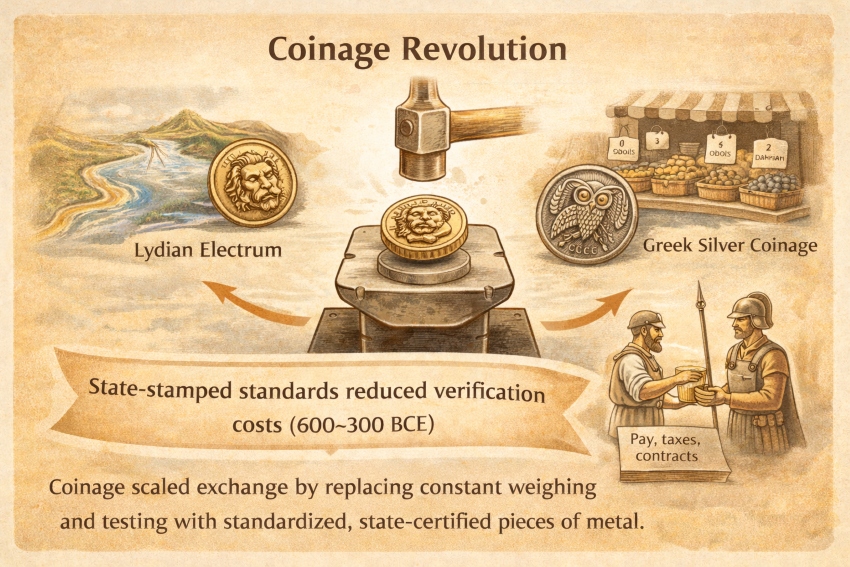
“Infographic illustration of the coinage revolution: minting dies striking a coin, with Lydian electrum origins, Greek silver coinage, and coins used for state payments (600–300 BCE).“
Summary of events during the period
Coinage did not replace earlier “money by weight” overnight; it solved a specific bottleneck: verification costs. In bullion systems, every transaction required weighing (and often testing) metal. Coinage introduced a state-backed shortcut: a standardized piece of metal whose weight/fineness was certified by an issuing authority. The earliest coins appear in western Asia Minor (Lydia and neighboring Greek cities) in electrum (gold–silver alloy) during the later 7th century BCE, with rapid diffusion into Greek city-states and, soon after, into imperial systems such as Achaemenid Persia. By 300 BCE, coinage had become a durable institutional technology supporting taxation, military pay, and expanding market exchange.
Payment media (what people used to pay)
- Electrum coins (Lydia / western Asia Minor, late 7th century BCE): Early coins were stamped electrum pieces of standard weights—an authoritative “certificate” that reduced the need to negotiate each piece’s acceptability from scratch.
- Silver coinage in Greek city-states (6th century BCE onward): Greek poleis adopted silver coinage early (e.g., Aegina, Corinth, Athens), and the practice spread across the Mediterranean.
- High-value silver denominations (e.g., the Athenian tetradrachm): Athens introduced the tetradrachm as a large silver denomination suited to higher-value transactions and broad circulation.
- Imperial coinage (Achaemenid Persia): Achaemenid rulers developed an imperial gold/silver system (daric and siglos) toward the end of the 6th century BCE, building on monetary practices inherited from Lydia.
How prices were set (negotiated vs administered vs regulated)
Negotiated pricing (market exchange expands, but bargaining remains real)
- Coinage makes prices easier to quote and compare because the unit is portable and standardized, yet most everyday pricing still emerges from bargaining and local conditions. The key change is that the “price conversation” moves from “how much does this silver weigh and how pure is it?” to “how many drachmas/obols?”
Administered payments (states become major monetary actors)
- Once states mint coins, they can pay soldiers, officials, and suppliers in a standardized medium, and they can also accept that medium in taxes and public dues. This materially increases the share of transactions that clear in money rather than in-kind. Evidence linking coin production to warfare and military pay is strong in the Classical Greek world.
Regulation through standards (coin types as policy)
- Authorities do not need to dictate all prices to shape monetary life. By choosing denominations, weight standards, and accepted coin types, they influence how contracts are written and how markets clear—effectively a regulatory layer on exchange.
How payments cleared (the “rails”)
- Immediate settlement (“hand-to-hand” money): Coinage enables spot settlement without weighing metal at every transaction, because acceptability is anchored in issuer reputation and standardization.
- Cross-border circulation via trust in standard types: Highly trusted coinages (notably Athenian silver) could circulate widely beyond their issuing city because market participants recognized their standard and reliability.
- State and imperial clearing channels: Imperial coinage (e.g., Achaemenid darics/sigloi) helps unify payments and provisioning across wide territories—especially where the issuer can enforce acceptance for public payments.
Trust and governance (why anyone accepted it)
- Issuer credibility replaces constant metal testing: Coinage is a governance technology: the stamp externalizes verification into the authority of the mint. Early electrum posed a credibility challenge because natural electrum composition varies; the “coin solution” is to rely on issuer certification rather than buyer metallurgical certainty.
- Visual identity as anti-fraud and brand: City and imperial symbols make coins legible in circulation; recognizability lowers transaction costs and supports acceptance in unfamiliar markets.
Revenue model (who made money from the system)
- Seigniorage and mint charges: Issuers can earn revenue from coinage if the face value and acceptance of coins exceed production costs (and, historically, by charging for minting or by small spreads embedded in standards). This concept—profit from issuing money—is known as seigniorage.
- Fiscal capacity and military finance: Even when “profit per coin” is small, the strategic gain can be large: coinage makes it easier to mobilize resources for armies and public works by creating a predictable payment instrument at scale.
Failure modes and constraints
- Credibility shocks (debasement, emergency issues, and trust loss): Monetary stress can force extraordinary measures. Athens, for example, issued emergency gold coinage in 406 BCE during wartime crisis—evidence that even strong monetary systems can face liquidity constraints.
- Material uncertainty (electrum problem): Natural electrum’s variable gold/silver ratio makes it hard to value precisely by simple testing, which is one reason early coinage raises enduring questions about how value and trust were managed in practice.
What scaled it (the scaling technology)
- Minting as standardization at industrial repeatability: Struck coinage is mass-producible standard value—an administrative and technical system (mints, dies, control of standards).
- Denominational systems: Introducing structured denominations (obols/drachmas, etc.) makes pricing and accounting easier for both small and large transactions. The Athenian tetradrachm is a clear example of a denomination designed for higher-value exchange.
- Diffusion through networks: Once a few credible issuers establish reliable coin standards, others adopt the technology; by c. 550 BCE coinage had crossed the Aegean and spread rapidly among Greek communities.
Caption:
“Coinage scaled exchange by replacing constant weighing and testing with standardized, state-certified pieces of metal.”
Sources
- American Numismatic Society (Money Museum). “Lydia & the First Coins.”
- Encyclopaedia Britannica. “Coin: Origins of coins.”
- Oxford Research Encyclopedia of Classics. “Coinage, Greek.”
- British Museum (Room 68 Money gallery PDF). “The spread of silver coinage… (Aegina, Corinth, Athens).”
- Sardis Expedition. “The Coins of Sardis” (electrum and Croeseids context).
- Oxford Handbook of Greek and Roman Coinage (OUP). “The Coinage of Athens…” (Laurion, scale of output).
- Encyclopaedia Iranica. “Daric” (Darius I and Achaemenid coinage).
- Harvard Art Museums. “Emergency stater of Athens (406 BCE).”
- Investopedia. “Seigniorage” definition.
- CEPR VoxEU. “Reasons for the Lydian electrum coins…” (electrum valuation problem context).