Iron Age Monetization Pressures: Bullion, Standards, and the Road to Coinage (c. 1200–600 BCE)
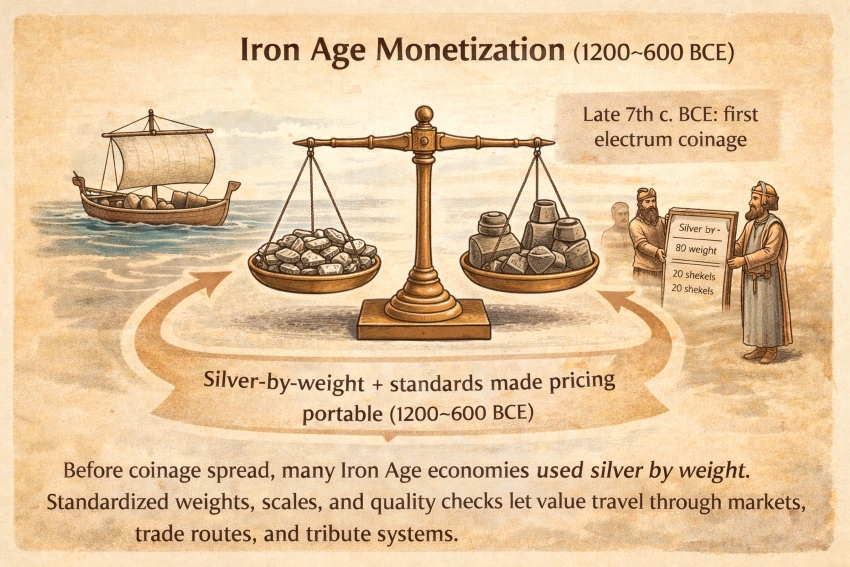
“Iron Age monetization: hacksilver weighed against stone weights on a balance scale, with maritime trade and tribute systems in the background (1200–600 BCE).”
Summary of events during the period
After the Late Bronze Age collapse, the Eastern Mediterranean and Near East reorganized into new political units and trade circuits. Over the following centuries—especially with the rise of expansive empires (notably Neo-Assyria) and high-volume seaborne commerce (Phoenician and Greek networks)—economic exchange faced a scaling problem: how to price, settle, and enforce obligations across distance when trust is limited and political authority is uneven. A durable solution emerged in many regions: silver used as payment and value by weight, supported by increasingly standardized weights and measures and by verification practices (cutting/hacking silver to test and parcel it). This is the key “monetization pressure” of the era: not coins yet, but portable, auditable value that could travel through markets, tribute systems, and merchant networks.
Payment media (what people used to pay)
- Silver by weight (“bullion money”): In the southern Levant, evidence supports silver exchanged by weight as a dominant measure of value and a practical means of payment across a long span that includes the Iron Age down to ~600 BCE.
- Hacksilver (cut/hacked silver pieces and fragments): Iron Age hoards frequently contain chopped silver and small balancing pieces, consistent with a system where each payment required weighing and quality control, not face-value tokens.
- Standardized stone weights and balances: Weights are repeatedly found in Iron Age contexts and are central to how bullion money works: they make value measurable across different parties and localities.
- In-kind payments (still important): Grain, textiles, metals, and labor remained critical for taxation, provisioning, and local exchange; bullion pricing often coexisted with in-kind settlement.
How prices were set (negotiated vs administered vs regulated)
Three-layer pricing regime:
1) Negotiated market pricing (ports, market towns, itinerant trade)
- Where exchange depended on merchants and private deals, price formation is best understood as negotiated—bounded by what could be verified (weight/purity) and what could be enforced (reputation, local authority, contracts). The very need for hacking and weighing implies continual verification during exchange rather than simply accepting a stamped value.
2) Administered obligations (tribute, taxation, provisioning)
- Empires and kingdoms assessed obligations in valuable materials, especially precious metals. Neo-Assyrian records and related scholarship highlight tribute demands where silver commonly appears prominently, reflecting state extraction and high-level settlement in metal.
3) Regulated standards (weights/measures as a form of governance)
- States and city authorities did not need to set every price to shape the market: controlling or standardizing weights and measures constrains cheating, improves comparability, and reduces transaction costs—effectively “regulating the marketplace.”
How payments cleared (the “rails”)
- Weighed settlement at point of transaction: In a hacksilver system, payment clears when the parties agree that (a) the silver’s weight meets the obligation and (b) its quality is acceptable—hence the prevalence of hacking/cutting and the presence of small silver pieces that can function as balancing elements on scales.
- Recorded obligations alongside bullion: Bullion settlement does not eliminate credit; it complements it. Scholarship on “silver, money, and credit” in Mesopotamian/Assyrian traditions emphasizes silver’s role as payment material, unit of account, and store of value, embedded in documented obligations.
- End-of-epoch transition toward coined money (late 7th century BCE): By the late 7th century BCE, electrum coinage appears in western Asia Minor (Lydia). This does not replace bullion overnight; it is best interpreted as a new certification technology layered onto a world already accustomed to weight-based metal value.
Trust and governance (why anyone accepted it)
- Metrological trust (weights/measures): Standard weight systems create a portable “truth standard” for value—especially when money is metal by weight. Scholarly surveys of weights/marketplaces in the Near East emphasize the long-run importance of metrology for exchange.
- Material verification (hacking, cutting, balancing): The hacksilver literature argues that repeated hacking/weighing is not a primitive precursor to coins so much as a different monetary logic: value is continuously re-verified at each transaction.
- Political enforcement for large obligations: Tribute and extraction work because power enforces them; the documentary tradition around Assyrian tribute illustrates how states convert coercion into measurable, movable value (often silver).
Revenue model (who made money from the system)
- Merchants and transport specialists earned from arbitrage and intermediation—moving scarce inputs and luxury goods between regions with different supply constraints and price structures. Standard measures and bullion settlement reduce disputes, making repeat trade more profitable.
- States and empires extracted value through tribute/taxation assessed in high-trust materials (notably precious metals), then redistributed or stored it to fund administration and warfare.
- Lenders and credit intermediaries benefited where silver-based payments and documented obligations supported enforceable lending and repayment discipline.
Failure modes and constraints
- Transaction friction: When value depends on weight and purity, trade requires tools (scales/weights) and procedures (testing/hacking). This is robust, but slower than token money.
- Security and hoarding: In politically volatile environments, bullion hoards can reflect both savings and “flight to safety,” and they concentrate risk (theft, confiscation).
- Standard mismatch: Multiple overlapping weight standards can complicate exchange; scholarship on weights highlights plurality rather than a single universal system.
What scaled it (the scaling technology)
- Portable verification infrastructure: balances + standardized weights are the core scaling technology for bullion money.
- Interregional standard alignment: evidence from weights studies indicates cross-regional metrological influence (Near Eastern standards echoed or adapted elsewhere), supporting exchange beyond a single polity.
- Coinage as a late-epoch certification layer: early electrum coinage is best treated as a new mechanism to reduce verification costs (certifying weight/metal under authority), emerging within a broader bullion-by-weight world rather than replacing it instantly.
Caption:
“Before coinage spread, many Iron Age economies used silver by weight. Standardized weights, scales, and quality checks let value travel through markets, trade routes, and tribute systems.”
Sources
- Eshel, T. (2025). One Thousand Years of Mediterranean Silver Trade… (Springer). (Silver exchanged by weight as key means of payment in the southern Levant through ~600 BCE.)
- Gentelli, L. et al. (2021). Metal provenance of Iron Age Hacksilber hoards… (ScienceDirect). (Hacksilver as transaction medium; long-run use and analytical evidence.)
- Eshel, T. et al. (2018). Four Iron Age Silver Hoards from Southern Phoenicia: From Bundles to Hacksilber (ResearchGate / BASOR version). (Weighing + hacking practices; interpretation of bullion-currency mechanics.)
- Peyronel, L. (2019). Weights and Marketplaces… (PDF). (Metrology and marketplaces as exchange infrastructure.)
- Brill Reference Works. Weights and Measures entry (overview of shekel-based standards and regional variation).
- Israel Museum (Jerusalem). White Gold: Revealing the World’s Earliest Coins (intro). (Late 7th century BCE electrum coinage context.)
- Sardis Expedition (Kroll). The Coins of Sardis (electrum coinage and Lydian context).
- Meadows, A. (2021). White Gold: Studies in Early Electrum Coinage (Oxford PDF). (Scholarly framing and chronology for earliest Lydian electrum issuers.)