Macroeconomics — a compact, guiding description
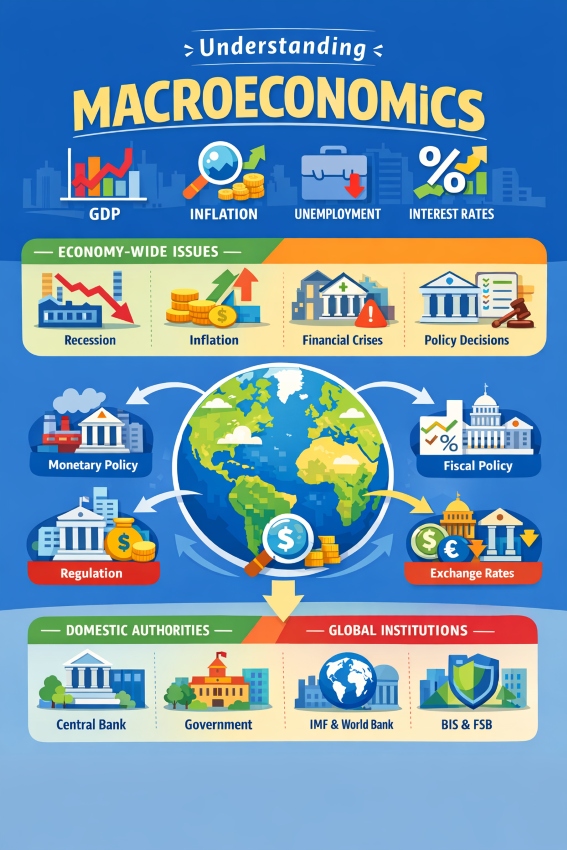
Macroeconomics is the branch of economics that studies the economy as a whole: overall production (GDP), overall price growth (inflation), overall job conditions (unemployment), overall borrowing costs (interest rates), and the ups and downs of activity (business cycles). It asks questions like: Why do recessions happen? Why does inflation rise? What can governments and central banks do about it?
Why macroeconomics exists
Macroeconomics exists because some problems are system-wide and cannot be understood by looking at single markets alone:
- Recessions and unemployment: economy-wide drops in spending and confidence can cause many firms to cut output and jobs at the same time.
- Inflation: general price increases are an aggregate outcome tied to economy-wide demand, supply constraints, and expectations.
- Financial crises: problems in banks and credit markets can spread across the whole economy, turning shocks into deep downturns.
- Policy decisions: societies need structured ways to decide how to stabilize the economy and manage trade-offs.
How it emerged (short history)
Macroeconomics became a distinct field mainly in the 1930s–1940s, for practical reasons:
- The Great Depression created mass unemployment and prolonged slumps that older frameworks struggled to explain.
- Governments improved national accounting (measuring total output and income), making “the economy” measurable.
- Keynesian ideas provided an influential framework for how aggregate demand can fall short and how policy might stabilize it.
- After World War II, international institutions (notably those created at Bretton Woods) formalized global economic cooperation.
Policy “steering tools” in macroeconomics
Macroeconomic steering is mainly done through four toolkits:
1) Monetary policy
What it is: Actions by the central bank to influence interest rates and financial conditions to keep inflation stable and the economy on track.
Common instruments:
- Policy rate changes (the central bank’s key short-term interest rate)
- Open market operations (OMO) (buying/selling securities to manage short-term rates/liquidity)
- Forward guidance (signaling future policy intentions)
- Quantitative easing (QE) in special circumstances (large-scale asset purchases)
2) Fiscal policy (government budget)
What it is: Changes in taxes, government spending, and transfers to influence demand and longer-run capacity.
Two modes:
- Automatic stabilizers: built-in features (e.g., unemployment benefits, progressive taxes) that automatically cushion downturns without new laws.
- Discretionary fiscal policy: deliberate stimulus or austerity passed through the political process (investment programs, tax cuts, targeted transfers).
3) Macroprudential policy (financial stability regulation)
What it is: System-wide financial rules designed to reduce the risk that credit booms, leverage, and banking fragility trigger crises.
Examples: countercyclical capital buffers, loan-to-value limits, stress tests (depending on the country).
4) Exchange-rate and external policies (in some regimes)
What it is: Tools related to managing the exchange rate, foreign reserves, and cross-border financing conditions—especially in fixed/managed exchange-rate systems.
Which tools react fastest, and which are most effective?
Fastest reaction
- Monetary policy is usually the fastest to affect financial markets (interest rates, asset prices, exchange rates) because the central bank can act quickly and markets reprice immediately.
- Automatic stabilizers are usually the fastest to affect household income during downturns because they activate automatically as jobs/incomes change.
Important nuance: even if markets react immediately, the full effect on real activity (employment, output) and inflation typically takes time—policy works with lags.
“Most effective” depends on the target
There is no single best tool in all situations; effectiveness depends on the shock and the objective:
- Controlling sustained inflation: monetary policy is typically the core tool over the medium term (especially when policy is credible and expectations are anchored).
- Countering deep recessions: fiscal policy—especially timely, targeted measures plus automatic stabilizers—can be highly effective, particularly when monetary policy is constrained.
- Preventing financial crises: macroprudential tools and supervision are central because they directly target system-wide financial vulnerabilities.
Who “governs” macroeconomic policy domestically?
Most countries split responsibilities across institutions to balance expertise, speed, and democratic legitimacy:
- Central bank — monetary policy; often also a financial stability role
- Ministry of Finance/Treasury — fiscal policy design and debt management
- Parliament/legislature — authorizes taxes, spending, and major fiscal packages
- Financial regulators/supervisors — banking and systemic-risk regulation
- Statistical agencies — produce the data (inflation, GDP, labor market) that guides decisions
Are there global steering bodies ?
There is no single global macroeconomic government. Instead, there is coordination through international institutions:
- IMF (International Monetary Fund): monitors national economies, provides policy advice, and offers financing in balance-of-payments crises.
- BIS (Bank for International Settlements): supports cooperation among central banks; a hub for research and coordination.
- FSB (Financial Stability Board): coordinates international financial stability work among national authorities and standard-setters.
- BCBS (Basel Committee on Banking Supervision): sets widely used global standards for bank capital and supervision (“Basel” standards).
- World Bank: focuses on long-run development and poverty reduction (complements IMF’s macro-stability focus).
- G20 / OECD: forums for policy coordination and comparative analysis (they influence agendas and norms but do not “run” national policy).
Glossary: key terms, abbreviations, and jargon
- GDP (Gross Domestic Product): total value of final goods and services produced in an economy over a period.
- Inflation: the general rise in prices over time (often measured with CPI).
- CPI (Consumer Price Index): a common index tracking the cost of a basket of consumer goods/services.
- Unemployment rate: share of the labor force actively seeking work but without a job.
- Interest rate: cost of borrowing / return to saving; central banks influence short-term rates directly.
- Business cycle: recurring expansions and recessions in economic activity.
- Aggregate demand: total spending in the economy (households + firms + government + net exports).
- Aggregate supply: total production capacity and cost conditions in the economy.
- Policy rate: central bank’s main short-term interest rate used to steer financial conditions.
- Transmission mechanism: how policy changes (like rate moves) affect borrowing, spending, employment, and inflation.
- Policy lags: delays between a policy action and its full effect on output/inflation.
- Automatic stabilizers: budget components that move automatically with the economy to stabilize demand.
- Discretionary fiscal policy: tax/spending changes requiring active political decisions.
- Debt-to-GDP: government debt level relative to annual economic output; a common sustainability metric.
- Macroprudential policy: system-wide financial regulation aimed at preventing crises and reducing systemic risk.
- Systemic risk: risk that problems in parts of the financial system spread broadly and harm the whole economy.
- Exchange rate (FX): price of one currency in terms of another.
- Reserves (FX reserves): foreign currency assets held by a central bank, used to support financial stability and manage external shocks.
- Balance of payments: accounting of transactions between a country and the rest of the world (trade, income, capital flows).
- Inflation targeting: a policy regime where the central bank commits to keeping inflation near a stated target.
- Credibility: belief that policymakers will do what they say; crucial for stabilizing inflation expectations.
- Expectations: what households/firms/investors believe about future inflation, growth, and policy; these beliefs affect behavior today.
- OMO (Open Market Operations): central bank purchases/sales of securities to manage short-term rates/liquidity.
- QE (Quantitative Easing): large-scale asset purchases to ease financial conditions when short-term rates are constrained.
- ZLB (Zero Lower Bound): situation where policy rates are near zero, limiting conventional rate cuts.