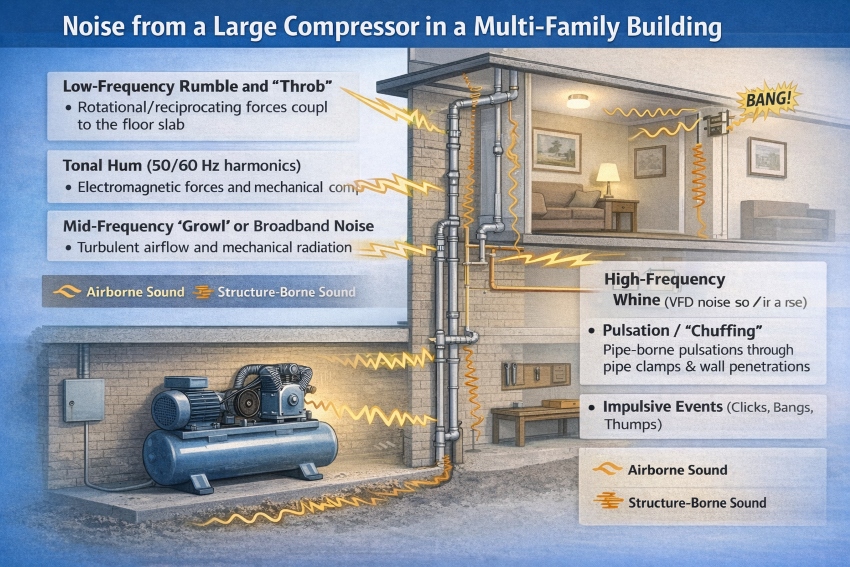
A vibration becomes audible sound when it causes air pressure fluctuations in (roughly) the 20 Hz–20 kHz band at a level your ear can detect. In practice, this happens when at least one of these is true:
- The vibration itself is in the audible band, and it couples efficiently to air.
- The vibration creates higher-frequency components (harmonics, impacts, turbulence).
- The vibration excites a structure or cavity resonance that radiates efficiently.
A useful engineering phrase is: “Vibration must couple to the air as pressure waves.”
Not all vibration couples well; some stays in the structure and is mostly felt, not heard.
1) What kinds of sound can a large floor-mounted compressor create?
A. Low-frequency rumble and “throb” (structure-borne dominant)
What it sounds like: deep rumble, pulsing “whoom-whoom,” sometimes felt as vibration in floors/sofas/bed frames.
Typical cause: the compressor’s cyclic forces couple into the slab. Even if the compressor room seems “not that loud,” residents may still experience low-frequency sound because the building acts as a transmission path.
Where it comes from (mechanisms):
- Rotational imbalance and cyclic loading
- Reciprocating compression pulses (for piston compressors)
- Torque ripple from motor drive
- Mount stiffness (rigid mounting injects more vibration)
Frequency clue (rule of thumb):
- If the motor runs around 1500 rpm, the rotation rate is: That 25 Hz may be felt more than heard, but its harmonics at 50, 75, 100 Hz can be clearly audible.
B. Tonal hum (50/60 Hz family) and harmonics
What it sounds like: steady “hum,” sometimes with a “buzz” quality.
Typical cause: electromagnetic forces from the motor and power system; also mechanical components excited at harmonics.
- Common tonal lines: 50 Hz (Europe) and 100 Hz, 150 Hz, etc.
- If a variable speed drive (VFD) is used, you can also get distinct tones that move with speed (and sometimes a high-frequency “whine,” see below).
Why it can be prominent in apartments: tonal noise is very noticeable to humans, and structure-borne coupling can make these tones appear strongly even if airborne levels in the compressor room are moderate.
C. Mid-frequency “growl” or broadband noise (airborne dominant)
What it sounds like: continuous “machine noise,” sometimes like a rough hiss/roar.
Typical cause: turbulent airflow, cooling fans, gas flow through valves, and general mechanical radiation from housings.
- Often strongest from a few hundred Hz up to several kHz.
- This component is typically more controllable with enclosures, absorption, and airborne isolation, but it can still leak through doors, vents, and shafts.
D. High-frequency whine (often VFD-related) or “screech”
What it sounds like: sharp whine, sometimes 2–10 kHz or higher, occasionally very irritating.
Typical cause:
- VFD switching-related tonal components, motor magnetostriction, or inverter-driven effects
- Smaller fans also can generate tonal blade-pass components
This is usually airborne, but it can also couple into structure if components excite panels or brackets.
E. Pulsation/“chuffing” and pressure-related noise in connected piping
What it sounds like: rhythmic “chuff,” “puff,” or low-frequency “pumping,” sometimes audible far away through walls.
Typical cause: pressure pulsations in suction/discharge lines, especially for reciprocating machines or poorly damped systems.
Transmission path: this often becomes pipe-borne vibration, which can:
- travel along pipes through the building,
- excite pipe clamps and wall penetrations,
- and re-radiate as sound inside apartments.
F. Impulsive events: clicks, bangs, start/stop thumps
What it sounds like: occasional “clunk,” “bang,” “click,” or sudden thud—especially at start/stop or load changes.
Typical cause: contactors/relays, check valves, pressure relief events, mechanical looseness, or mounts bottoming out.
These events can be disproportionately annoying because they are intermittent and attention-grabbing.
2) Why can residents hear it even if the compressor room is not extremely loud?
Because the building structure can act like a distributed loudspeaker:
- Compressor vibration enters the slab.
- Vibration travels through concrete/steel with relatively low attenuation at low frequencies.
- In apartments, floors/walls/ceilings vibrate slightly and re-radiate sound into the air.
This is why complaints often describe:
- “I hear it in my bedroom at night,”
- “I feel it more than I hear it,”
- “It’s a constant hum with a pulse.”
3) A concrete “example spectrum” you might expect (illustrative)
Assume a compressor motor near 1500 rpm (25 Hz rotation rate) and mains at 50 Hz:
- ~25 Hz: rotational fundamental / low-frequency structural vibration (often felt)
- 50 Hz, 100 Hz, 150 Hz: strong tonal hum family (often clearly audible)
- 200–800 Hz: structural resonances, casing radiation (“growl”)
- 1–5 kHz: airflow/fan noise, possible tonal components
- 2–10 kHz: possible VFD/motor whine (if present)
The dominant bands depend heavily on compressor type (reciprocating vs screw), mounting, slab type, and piping layout.
4) What determines which of these dominates?
Key practical factors:
Building structure: continuous slabs and rigid connections transmit low frequencies efficiently.
Mounting and isolation: rigid mounts transmit structure-borne energy; resilient isolators reduce it (if correctly sized).
Operating mode: constant speed vs VFD; load/unload cycles; start/stop frequency.
Piping supports: hard clamps and wall penetrations can inject vibration into the structure.
Room acoustics: hard rooms amplify airborne noise; panels and cavities can resonate.
Summary: A Practical Decision Rule
Vibration becomes audible sound when it produces measurable pressure fluctuations in the audible band. This usually happens via one of these paths:
- Direct radiation (vibration already in 20 Hz–20 kHz and couples well)
- Harmonics (non-sinusoidal periodic motion creates audible multiples)
- Resonance (structures/cavities amplify and radiate at audible frequencies)
- Nonlinear impacts/friction (create broadband high-frequency sound)
- Sharp pulses/turbulence (wideband content even if repetition is low)