Part 1 — Oregano: What It Is, Why It Works Indoors, and What It Wants
What oregano is
Oregano (Origanum vulgare) is a perennial herb in the mint family (Lamiaceae). It is widely used for its aromatic leaves and is naturally adapted to bright, open conditions and well-drained to dry soils. In practical terms, oregano succeeds when you give it:
- High light
- Fast drainage
- Modest feeding
- A wet–dry watering cycle (not constant dampness)
Extension and plant references consistently emphasize full sun and good drainage as the foundation for healthy oregano growth.
Why oregano is a strong candidate for indoor pot culture
Oregano is well suited to indoor pots because it:
- Tolerates periods of dryness better than many leafy herbs.
- Responds well to pruning/harvesting (which doubles as training).
- Can be kept compact with adequate light and regular trimming.
- Produces useful yields from a small footprint (ideal for a 1 m² setup).
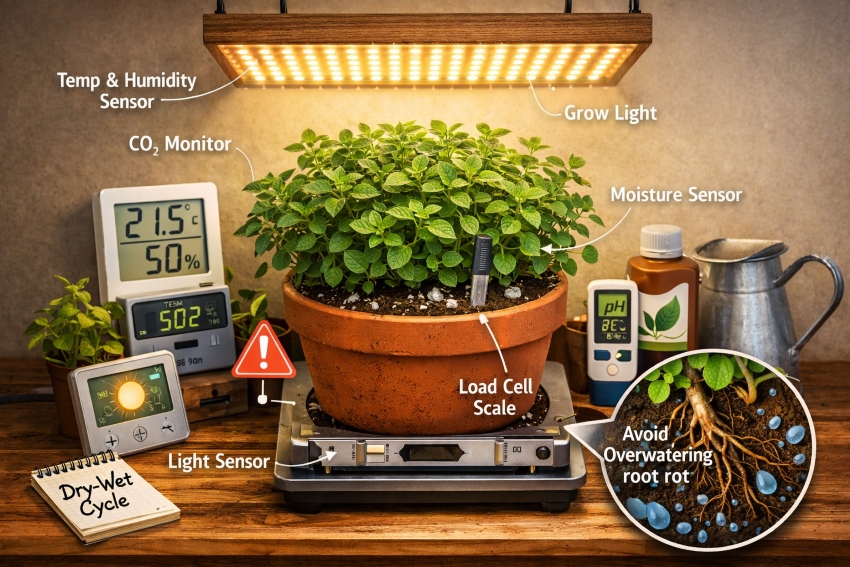
The primary indoor failure mode is not “lack of fertilizer”—it is poor drainage plus overwatering, which can lead to weak growth and root decline. Guidance for oregano repeatedly warns against damp/heavy conditions because roots are liable to rot when drainage is poor.
A quick “needs profile” (at a glance)
- Light: Full sun equivalent; strong supplemental light is often required indoors.
- Soil: Light, moderately fertile, well-drained (often improved with mineral content like perlite/sand).
- Water: Prefer “on the drier side”; water when the top portion of the medium has dried (then water thoroughly and drain).
- pH tolerance: Commonly reported as neutral to slightly alkaline; oregano is often described as tolerant in roughly pH ~6–8.
Growth stages (useful for indoor planning)
Even indoors, oregano passes through predictable stages:
- Germination (seed → emergence)
- Seedling establishment (first true leaves → root development)
- Vegetative maintenance (main production phase: repeated harvest cycles)
- Flowering (optional; can be delayed by harvesting for best leaf production)
For most apartment growers, the “real work” is the long vegetative maintenance phase: stable light, stable watering rhythm, and routine pruning.
Part 2 — How to Grow Oregano in Pots Indoors (Sweden): A Sensor-Guided Method to Prevent Root Stress
Core principle: treat water as the main control variable
For indoor oregano, the highest-impact strategy is simple:
Water thoroughly → drain completely → allow meaningful dry-down before watering again.
This matters because oregano is adapted to well-drained/drier conditions and is repeatedly described as intolerant of poorly drained or persistently wet situations.
In an apartment, “constant wetness” can happen easily due to:
- Low winter evapotranspiration (low light, cooler window zones)
- Overly organic potting mixes that hold water
- Saucers that retain runoff
- Large pots relative to plant size (slow dry-down)
Pot + medium (set yourself up to succeed)
Pot
- Must have drainage holes.
- Prefer a pot material that does not trap water (terracotta can help dry-down).
- Keep the pot slightly elevated (air under the pot improves drainage and reduces cold-soil risk near windows).
Medium
Aim for a fast-draining blend. A practical approach:
- Quality potting soil cut with 25–40% perlite (or similar mineral aeration component).
- Avoid very peat-heavy, fine mixes without aeration—these stay wet longer indoors.
This aligns with the repeated recommendation that oregano does best in light, well-drained conditions rather than heavy, moisture-retentive mixes.
Light (the second control variable)
Insufficient light is the main driver of leggy growth and weak water use (which then increases “too wet too long” risk).
Target (practical indoor)
- PPFD: ~300–600 µmol/m²/s at canopy for strong vegetative maintenance
- Photoperiod: 12–16 h
- DLI: ~20–28 mol/m²/day (a “productive herb” range)
The horticultural “why” is consistent: oregano is a full sun plant. Indoors, you must recreate that intensity with an LED grow light, especially in Swedish winters.
Environmental targets (simple ranges)
You do not need perfection—just avoid extremes that amplify stress.
- Air temperature: 18–24 °C (stable is better than ideal)
- RH: 40–60% (reduce fungal risk, support stable transpiration)
- VPD: ~0.9–1.4 kPa (derived metric that helps interpret transpiration and watering rhythm)
The instrumentation approach (minimal but high leverage)
The goal of instrumentation is not “data for its own sake.” It is to detect conditions that lead to root stress before the plant shows irreversible symptoms.
Tier 1 sensor stack (recommended baseline)
- Air temperature + RH (I²C)
- Placement: canopy height, shaded from direct LED beam.
- Lux sensor (I²C) as a light proxy
- Placement: canopy plane, unshaded.
- Pot weight (load cell + HX711)
- Placement: under pot on a rigid, stable platform.
- Soil moisture probe (capacitive, analog)
- Placement: mid-root zone, consistent depth and position.
Why pot weight matters most
A moisture probe can drift with salts and varies by soil type. Pot weight is a direct measure of water content and plant water use:
- After watering and draining, the pot hits a “full” baseline.
- Over time, weight drops as the plant uses water and as evaporation occurs.
- If weight does not drop when it should, you can catch root problems or overwatering early.
Irrigation control logic (the “no constant wetness” rule set)
Step 1 — Establish your two anchors (calibration you can actually trust)
- W_fc (Field capacity weight): Water to runoff → drain 30–60 minutes → record stable weight.
- W_dry (Safe dry trigger): Let the pot dry down until the plant is still healthy/turgid (not wilting badly) → record that weight.
From there, your watering trigger becomes:
- Water when pot weight approaches W_dry, not when the top looks dry (visual cues are unreliable indoors).
This implements the widely recommended practice of watering oregano only once the medium has dried meaningfully—rather than keeping it damp.
Step 2 — Add a root-stress prevention alarm (high value)
Flag a likely “roots not happy” condition if all are true for 24–48 hours:
- Soil moisture reading remains high and
- Pot weight is not declining much day-to-day and
- Light (lux) is not unusually low (i.e., it should be using water)
This pattern often precedes visible decline and helps you stop watering early.
Nutrition (keep it modest)
Oregano generally performs best in moderately fertile media; excessive nitrogen can push weak, leggy growth indoors. Many extension-style references frame oregano as tolerant and not demanding, provided light and drainage are correct.
A practical indoor plan:
- Start feeding only after strong establishment.
- Use a balanced fertilizer at low concentration (e.g., 1/4 strength) every 2–4 weeks during active growth.
- In low-light winter periods, reduce feeding rather than increasing it.
Minimal data fields and sampling (enough to automate decisions)
Record these as timestamped fields:
tsair_temp_c,air_rh_pct→ derivevpd_kpalux(and optionalppfd_est)pot_mass_g(plus smoothed value)pot_water_loss_g_per_h(slope)soil_moisture_rawirrigation_event(0/1), optionalirrigation_ml
Sampling rates:
- Air T/RH + lux: every 30–60 seconds
- Pot mass: every 1–5 minutes
- Soil moisture: every 5 minutes
Practical troubleshooting (symptom + data pattern → action)
1) Drooping while soil reads wet
- Pattern: high moisture, pot weight not dropping, low VPD or low light
- Likely: “too wet too long” → root stress risk
- Action: stop watering; ensure drainage; increase airflow/light; let weight drop toward dry trigger
2) Leggy growth
- Pattern: low lux (or low estimated DLI), low water use
- Likely: insufficient light for a full-sun herb
- Action: increase grow light intensity or duration; prune to encourage branching
3) Yellowing lower leaves
- Pattern: persistently high moisture + slow dry-down
- Likely: overwatering/poor drainage
- Action: extend dry-down interval; improve medium aeration; eliminate standing runoff water
These corrective actions are consistent with general oregano guidance emphasizing dry, well-drained conditions and warning about problems in damp/heavy conditions.
Closing checklist (operational)
- Drainage: non-negotiable (holes + no standing saucer water)
- Medium: fast draining (add mineral aeration)
- Light: treat oregano like a full-sun plant indoors
- Watering: weight-based triggers; avoid constant dampness
- Sensors: at minimum air T/RH + lux + pot weight; moisture probe as secondary