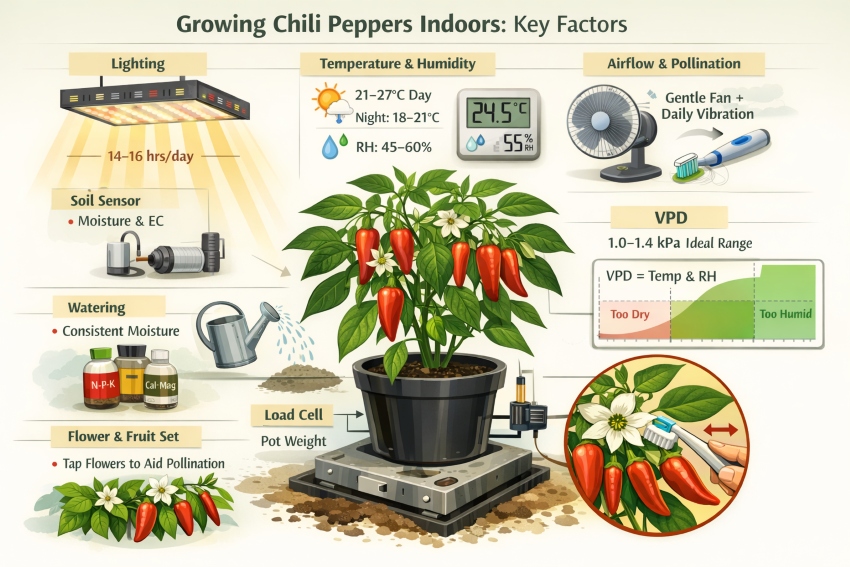
Indoor chili growing can be extremely productive, but only if you treat the plant like a small biological factory with clear environmental inputs: light, temperature, humidity (VPD), water, nutrients, and pollination mechanics. Most indoor failures—especially flower drop and poor fruit set—come from one of three gaps: not enough light (DLI), unstable water availability, or the wrong humidity/temperature at the moment pollen needs to work.
This post is split into two parts:
- Chili Pepper (Capsicum) as a plant system—growth stages and what it is trying to do.
- How to grow it indoors—target ranges, what to measure, sensor stack, calibration, data schema, and troubleshooting.
Part 1 — Chili Pepper: the plant and its growth logic
What you’re growing (Capsicum in one paragraph)
Chili peppers (Capsicum annuum and C. chinense) are warm-season perennial shrubs often grown as annuals. Indoors they can live for years, but their performance depends on whether they receive enough photosynthetic energy (light) and whether their reproductive process (flower → pollination → fruit set) is supported by the right microclimate. Leaves build the energy budget; flowers and fruits spend it.
The five growth stages (and what matters most in each)
1) Germination (seed → emergence)
- Primary driver: warmth
- Secondary: high humidity to prevent desiccation
- Light is not essential until emergence, but helps immediately after.
2) Seedling / establishment (cotyledons → 4–6 true leaves)
- Objective: build a sturdy stem and first leaf area without stretching.
- Primary drivers: moderate light + stable moisture + gentle airflow
- Common failure: too little light (leggy seedlings), or oversaturated media (root stress).
3) Vegetative growth / canopy build (branching and structure)
- Objective: create enough leaf area and branching to support later fruit load.
- Primary drivers: more light + good transpiration conditions (VPD) + balanced nutrition
- Common mistake indoors: excess nitrogen producing lush leaves but weak flowering.
4) Flowering + fruit set (buds → flowers → set)
This is the critical stage indoors.
- Objective: viable pollen release + transfer + fertilization + early fruit stability.
- Primary drivers: light (DLI), canopy temperature, VPD, airflow/pollination, and stable water availability
- Common failure: flower drop caused by heat spikes, air too dry/humid, insufficient DLI, or drought swings.
5) Fruit fill + ripening (fruit enlargement → color change → harvest)
- Objective: maintain energy supply and avoid stress that triggers fruit drop.
- Primary drivers: stable DLI + steady watering + appropriate potassium and calcium availability
- Common failure: intermittent drought and/or salt buildup in pots.
Part 2 — How to grow chili peppers indoors (soil/pot) with control and instrumentation
The core rule for reliable indoor fruit
If you only remember one metric, make it this:
For reliable indoor fruit set, target DLI ≥ 25 mol·m⁻²·day⁻¹ (better: 30–35).
DLI (Daily Light Integral) is the day’s total usable light. Without enough DLI, plants may flower but won’t consistently set and carry fruit.
Stage-by-stage indoor targets (temperature, RH, VPD, light, water, nutrition)
Key derived metrics (you calculate these)
- VPD (kPa): derived from air temperature + RH
- DLI (mol·m⁻²·day⁻¹): derived from PPFD + photoperiod
DLI formula:DLI=PPFD×photoperiod(h)×3600/1,000,000
Environmental targets by stage
| Stage | Air temp (°C) | RH (%) | VPD (kPa) | Indoor priority |
|---|---|---|---|---|
| Germination | 26–30 | 70–90 | 0.3–0.8 | Warmth, don’t soak media |
| Seedling | 22–26 day / 18–21 night | 60–75 | 0.6–1.0 | Prevent stretch and damping-off |
| Vegetative | 22–28 day / 18–22 night | 50–65 | 0.9–1.2 | Strong growth, stable transpiration |
| Flowering + fruit set | 21–27 day / 18–21 night | 45–60 | 1.0–1.4 | Most flower-drop prevention happens here |
| Fruit fill + ripening | 20–26 | 45–60 | 1.0–1.4 | Keep steady; reduce mold risk |
Flower-drop “danger zones”
- Heat: sustained canopy temps above ~30–32°C
- Too dry: VPD > ~1.6–1.8 kPa (common in heated winter apartments)
- Too humid: VPD < ~0.6 kPa (poor pollen release + fungal risk)
- Cold nights: sustained < ~16–17°C slows set and increases abortion risk
Light targets (PPFD, photoperiod, DLI)
| Stage | PPFD (µmol·m⁻²·s⁻¹) | Photoperiod (h) | DLI (mol·m⁻²·day⁻¹) |
|---|---|---|---|
| Seedling | 150–250 | 14–16 | 10–15 |
| Vegetative | 250–450 | 14–16 | 15–25 |
| Flowering + fruit set | 400–700 | 14–16 | 25–35 |
| Fruit fill + ripening | 400–700 | 14–16 | 25–35 |
Minimum PPFD guidance (to hit DLI targets)
- DLI 25 at 16 h ≈ ~434 PPFD
- DLI 30 at 16 h ≈ ~521 PPFD
- DLI 35 at 16 h ≈ ~608 PPFD
This is why many indoor chili setups “look bright” but still fail to fruit: the plant is under the DLI threshold.
Soil moisture strategy (most practical control method)
In pots, the highest-return control approach is pot weight (load cell) plus a calibrated moisture proxy.
Principle: during flowering and set, prioritize stability over aggressive drying.
| Stage | Watering style | Practical trigger (weight-based) |
|---|---|---|
| Seedling | small doses, avoid saturation | water after ~10–20% drop from “field capacity mass” |
| Vegetative | allow moderate dry-down | ~15–25% drop from field capacity mass |
| Flowering + set | reduce stress swings | smaller, more frequent events; avoid large dips |
| Fruit fill | keep steady | avoid drought spikes; keep transpiration stable |
Nutrition strategy (soil/pot)
A simple working model:
- Vegetative: complete feed, modestly N-forward
- Flowering/fruit: reduce N dominance; increase K; ensure Ca/Mg + micros
If you measure EC:
- Seedling: ~0.8–1.2 mS/cm
- Veg: ~1.5–2.2 mS/cm
- Flower/fruit: ~2.0–2.8 mS/cm
- Fruit fill: ~2.0–3.0 mS/cm (watch salt buildup in pots)
If you do not measure EC: use conservative label rates and watch plant response; pot salt buildup is a common hidden issue indoors.
Pollination and fruit set (the indoor-specific section)
Why indoor pollination fails
Outdoors, wind and insects provide mechanical vibration and pollen transfer. Indoors, even when flowers open normally, pollen may:
- not release well if air is too humid,
- desiccate if air is too dry,
- lose viability if it’s too hot at the canopy,
- fail to move due to stagnant airflow.
A simple indoor pollination protocol
During peak flowering:
- Run a gentle oscillating fan across the canopy daily.
- Once per day: tap stems or use an electric toothbrush to vibrate main branches for 5–10 seconds per plant.
- Keep RH ~45–60% during flower-open periods (supports pollen function).
What to measure vs what to calculate vs what to proxy
Directly measurable (hobby-feasible)
- Air temperature, RH
- Light: lux (trend) or PPFD (true measurement)
- Pot weight
- Soil temperature
- Soil moisture proxy
- Optional: CO₂, leaf temperature
Derived (calculated)
- VPD, dew point
- DLI
- Dry-down rate (Δpot mass per hour/day)
- Irrigation triggers and alarms
Not practical to measure continuously (use proxies)
- Root oxygenation → proxy: pot design + moisture stability + dry-down slope + symptoms
- Nutrient availability in soil → proxy: dosing log + periodic runoff/slurry checks + symptoms
- Pollen viability → proxy: canopy temp + VPD + airflow + flower behavior
Recommended sensor stacks (and physical placement)
Tier 1 (high ROI)
- Air T/RH (I²C) at canopy height, shaded from direct LED, ideally with a small aspirating airflow
- Light (I²C lux sensor) at canopy plane for trend/failure detection
- Load cell + HX711 under the pot for irrigation control
- Soil moisture probe (calibrated to your mix) at ~1/3–1/2 depth
- Soil temp probe near root zone
Tier 2 (fruiting reliability upgrade)
- True PAR/PPFD sensor (best single upgrade if you’re serious about yield)
- CO₂ NDIR (optional but useful if you run high light)
- Leaf temperature IR (helps detect stress and transpiration mismatches)
Tier 3 (process control)
- Better soil water potential sensing (tensiometer/Watermark-type)
- Periodic pH/EC workflow for runoff/slurry
- Multi-point T/RH (canopy + intake area)
- Camera for time-lapse and flower/fruit tracking
Calibration and validation (short but operational)
Soil moisture probe calibration (do this once, properly)
Calibrate against pot weight using your real medium:
- Saturate and drain to field capacity; record pot mass + sensor value.
- Let dry; at several points record pot mass + sensor value.
- Fit a simple mapping (piecewise linear is enough).
- Set irrigation thresholds based on performance (especially during flowering).
Load cell calibration
- Calibrate with known weights across your full range.
- Check drift (“creep”) under load and average readings.
Lux → PPFD (only if you lack a PAR sensor)
Lux conversion is spectrum-dependent. If you can:
- borrow/rent a PAR meter once, or use manufacturer PPFD map,
- fit a site-specific conversion for your exact lamp and distance.
Minimal data schema + sampling (practical)
Record 1-minute averages for climate/light; keep higher-rate raw data only if needed.
Fields
tsair_temp_C,air_rh_pctvpd_kPa(derived)ppfd_umol_m2_sorluxdli_mol_m2_d(daily derived)pot_mass_kg,pot_mass_change_g_per_h(derived)soil_moisture_raw(and mapped value if calibrated),soil_temp_C- Events:
irrigation_ml,feed_strength,notes_pollination_done
Sampling
- Air T/RH: 10–30 s → store 1-min avg
- Light: 10–30 s → store 1-min avg
- Pot weight: 1–5 s → store 10–60 s avg
- Soil moisture: 1–5 min
Fast “if–then” diagnostics (flower drop focus)
If flowers drop without swelling (no set)
Data pattern: DLI < 25, VPD out of 1.0–1.4, or canopy temp spikes >30°C
Action: increase PPFD/photoperiod to hit DLI; stabilize VPD; reduce heat; add airflow + vibration.
If flowers open but never set (no visible fruit initiation)
Data pattern: RH too high (>70%) or stagnant air; VPD very low
Action: lower RH to 45–60%; increase airflow; daily vibration pollination.
If small fruits form then drop
Data pattern: pot mass shows big drought swings; possible salt buildup
Action: smaller, more frequent irrigation; consider leaching if salts suspected; stabilize environment.
Closing: what “success” looks like indoors
A productive indoor chili setup is not mysterious. It is mostly about hitting light dose (DLI) and keeping flowering microclimate and watering stability inside the plant’s reproductive comfort zone—then providing mechanical pollination help.