What temperature is
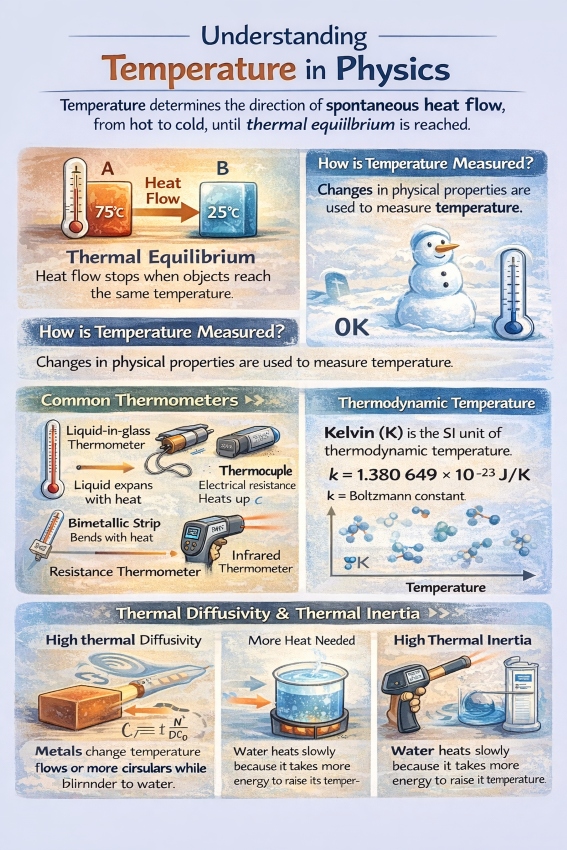
In physics, temperature is a property that characterizes a system’s “thermal state” and determines the direction of spontaneous heat flow: when two objects are placed in thermal contact, energy flows as heat from the object at higher temperature to the one at lower temperature until equilibrium is reached. Encyclopedia Britannica
A very important underpinning is the idea of thermal equilibrium: if object A is in thermal equilibrium with object B (no net heat flow), and B is in thermal equilibrium with object C, then A is also in thermal equilibrium with C. This principle makes it meaningful to compare temperatures and to build thermometers.
How temperature is defined (from “practical” to “fundamental”)
1) Operational definition (how temperature is used in the lab)
Operationally, the temperature of an object is what a thermometer reads when the thermometer and object have reached thermal equilibrium (no net heat flow between them). This is the day-to-day definition used in experiments and engineering.
This definition works because of:
- thermal equilibrium (so the thermometer and object can share a stable temperature), and
- a reproducible physical property in the thermometer that changes with temperature.
2) Thermodynamic temperature (the “absolute” definition)
The most fundamental physics definition is thermodynamic temperature, measured on an absolute scale where 0 K (absolute zero) represents the lower limit of thermal energy available for random motion in the classical sense.
In modern metrology, the kelvin (K) is the SI unit of thermodynamic temperature and is defined by fixing the numerical value of the Boltzmann constant k. The SI Brochure states that the kelvin is defined by taking when expressed in J·K⁻¹. bipm.org
Interpretation (pedagogical): temperature is the knob that links energy at the microscopic level (random motion and accessible states) to macroscopic thermal behaviour. Fixing anchors that link.
How temperature is measured
All thermometers rely on the same core idea:
Some physical property changes predictably with temperature, and we calibrate that change against standards.
Common contact thermometers
- Liquid-in-glass thermometers: rely on thermal expansion of a liquid (historically mercury or alcohol).
- Bimetallic strips: two metals expand differently, producing bending used in thermostats.
- Resistance thermometers (RTDs, e.g., platinum Pt100/Pt1000): electrical resistance of metals changes with temperature; platinum is popular because it is stable and reproducible.
- Thermistors: semiconductor resistors with a strong temperature dependence (very sensitive, but often less linear and less stable than platinum RTDs).
- Thermocouples: generate a small voltage when two dissimilar metals form junctions at different temperatures (the Seebeck effect). Widely used because they cover wide ranges and are rugged.
Non-contact thermometers
- Infrared (IR) thermometers / pyrometers / thermal cameras estimate temperature from thermal radiation emitted by a surface. These are essential for moving objects, very hot objects, or situations where contact would disturb the system—though accuracy depends strongly on emissivity and reflections.
Calibration and standards: “realizing” temperature in practice
At high accuracy, temperature is not just “read off”—it is realized through internationally agreed procedures and reference points. A major practical framework is the International Temperature Scale of 1990 (ITS-90), supported by detailed guidance from national metrology institutes. NIST Publications
NIST describes ITS-90 as spanning approximately 0.65 K to 1357.77 K and notes an additional low-temperature scale (PLTS-2000) for the millikelvin region. NIST
Why it is possible to measure temperature
We can measure temperature reliably because two things are true in the physical world:
- Thermal equilibrium is well-defined. Many systems settle into a stable equilibrium state where “temperature” is meaningful and reproducible.
- Multiple material properties are temperature-dependent in repeatable ways. Expansion, resistance, thermoelectric voltage, and emitted radiation all change with temperature. Because these changes are systematic, we can calibrate instruments and trace them back to standards (e.g., ITS-90 procedures). NIST Publications+1
“Why doesn’t the probe significantly disturb what it measures?”
Good measurement practice aims to ensure the probe has minimal influence on the object’s temperature. The main strategies are:
- Low thermal mass sensor: a small sensing element needs little heat to change its own temperature, so it draws less energy from the object.
- Good thermal contact, controlled placement: improves equilibration and reduces errors from gradients.
- Reduced heat leakage: thin wires, proper insulation, and careful routing reduce heat conduction away from the sensing point.
- Avoid self-heating: electrical sensors (RTDs/thermistors) can warm themselves if measurement current is too high; instruments use low currents or pulsed measurements to reduce this.
- Use non-contact methods when needed: IR thermometry avoids adding a physical object into the system, though it introduces emissivity-related uncertainties.
So: the probe is affected by temperature, but a well-designed measurement minimizes back-action on the system and quantifies remaining uncertainty.
How many temperature scales are used in modern times?
There are many historical temperature scales, but in modern everyday and technical use, a small set dominates:
- Kelvin (K): the SI base unit for thermodynamic temperature. bipm.org
- Celsius (°C): used widely in science, engineering, and daily life; it is linearly related to kelvin by a fixed offset.
- Fahrenheit (°F): still common in public use in the United States; also appears in some industry contexts. Encyclopedia Britannica
- Rankine (°R): an absolute scale like kelvin but using Fahrenheit-sized degrees; used in some engineering fields.
Practical metrology note: in precision work, you will often see reference not only to units (K, °C) but also to practical scales like ITS-90 that define how temperatures are realized and interpolated across ranges. NIST Publications+1
Why some materials change temperature faster than others
When you say “material X changes temperature quickly,” there are two different phenomena that might be meant:
1) How quickly heat spreads inside the material (internal equilibration)
This is governed largely by thermal diffusivity, commonly written:
where:
- = thermal conductivity (how easily heat flows),
- = density,
- = specific heat capacity.
A higher means temperature differences inside the material “smooth out” faster—heat penetrates more rapidly. ScienceDirect+1
This is why metals often equalize internally quickly: they tend to have relatively high thermal conductivity.
2) How much the material’s temperature changes for a given heat input (thermal inertia)
Even if heat reaches the material, its temperature rise depends on how much energy is required to raise its temperature:
- Large mass m and/or high heat capacity c means more energy is needed to change temperature by the same amount, so temperature changes more slowly for a given heat flow.
Real-world cooling/heating speed also depends on environment and geometry
Even with identical material properties, the rate of temperature change depends on:
- surface area-to-volume ratio (thin objects respond faster),
- airflow or liquid flow (convection),
- contact quality (contact resistance),
- surface emissivity (radiation),
- phase changes (melting/evaporation can absorb large heat with little temperature change).
Summary
- Temperature is a physical property that determines heat flow direction and describes thermal state. Encyclopedia Britannica
- The kelvin is the SI unit of thermodynamic temperature, defined by fixing the value of the Boltzmann constant. bipm.org
- Temperature is measurable because systems reach thermal equilibrium and because many physical properties vary reproducibly with temperature, allowing calibrated instruments and international scales (e.g., ITS-90). NIST Publications+1
- Probes are affected by temperature; good measurement minimizes how much the probe disturbs the object.
- Materials respond at different rates due to thermal diffusivity (how fast heat spreads) and thermal inertia (how much energy is needed to change temperature). ScienceDirect+1