Part 5: Aftermath (Short- and Long-Run)
1) Immediate Post-Unification Order (221–210 BCE)
FACTS (institutional and material outcomes documented in later syntheses and reference works):
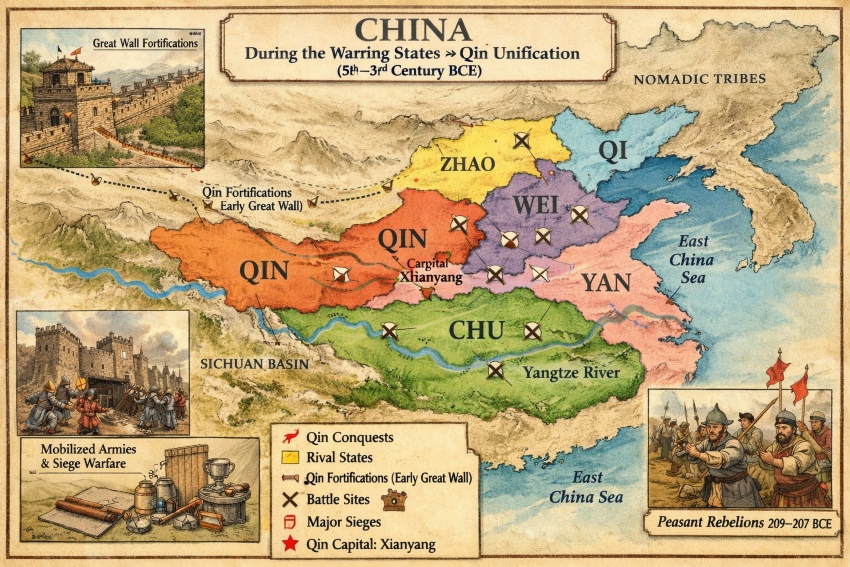
After the final conquests (ending in 221 BCE), the Qin court under Qin Shihuangdi (Ying Zheng) proclaimed a new imperial order and implemented a set of administrative and standardizing measures that later sources present as foundational for subsequent dynasties. Encyclopaedia Britannica summarizes the Qin program as including: (a) a centrally directed government, (b) standardization of the writing system and of measures of length/weight (and related infrastructure norms), (c) abolition of feudal privileges, and (d) large-scale construction associated with defensive works later grouped under “the Great Wall,” alongside restrictive measures toward texts and dissent (notably an edict dated to 213 BCE in traditional chronologies).
Britannica’s longer treatment of the Qin empire adds several often-cited features of the consolidation period: an expanded commandery/prefecture (or commandery/county) style administration with centrally appointed officials, the construction of roads to facilitate troop movement, conscription of large workforces for major projects, relocations of wealthy and influential provincial families to the capital area, and confiscation of weapons.
Smithsonian’s National Museum of Asian Art teaching materials likewise highlight standardization (weights/measures, coinage, writing) and a centrally organized bureaucracy as prominent Qin legacies, explicitly presenting these reforms as influential well beyond the dynasty’s short duration.
INTERPRETATIONS (what historians infer from these outcomes):
Many modern historians treat these measures as the “minimum viable toolkit” of early empire-building: uniform administrative units, legible and transportable law, standardized writing and measures, and transport infrastructure that reduces the transaction costs of rule across distance. That is an analytical framing rather than a direct statement of intent in surviving Qin proclamations as commonly accessible to general readers; it is offered here as a synthesis consistent with how Qin reforms are summarized in major reference overviews.
2) Collapse and the Transition to a New Settlement (210–202 BCE)
FACTS (sequence and endpoints):
Britannica dates Qin Shihuangdi’s death to 210 BCE and states that rebellion erupted after his death; by 207 BCE, the dynasty was overthrown, and after a brief transitional period it was replaced by the Han dynasty (traditionally dated 206 BCE–220 CE).
One major strand of the transition is presented in Britannica’s biographical entries: Xiang Yu is described as a leader of rebel forces who overthrew the Qin and then competed with Liu Bang for control; Liu Bang (Gaozu) is described as becoming ruler of China after the civil war culminated in 202 BCE with Xiang Yu’s death.
A separate reference overview (Berkshire Publishing’s encyclopedia material) describes a major rebellion breaking out in 209 BCE at Daze Village and associates it with Chen Sheng and Wu Guang, framing it as the first large-scale “peasant revolt” in later historical memory and noting that it attracted participation from former nobles and other groups opposed to Qin rule.
INTERPRETATIONS (why the Qin fell so quickly):
Competing explanations appear in both traditional historiography and modern scholarship. Below are the main families of explanation, with attribution and a confidence rating about the explanation as a broad driver, not about every anecdote in later narrative sources:
- Burden-of-rule explanation (High confidence as a contributing factor): Britannica directly links rebellion to the cumulative toll of “harsh methods” and “huge tax levies” used to fund construction projects and wars, implying a fiscal-labor burden that generated widespread resistance.
- Succession/palace-politics explanation (Medium confidence as a contributing factor): Many reconstructions emphasize post-210 BCE court instability and contested succession dynamics as an accelerant of breakdown. General-audience reference summaries often treat this as important but differ in detail; where details rely on later narrative sources, confidence is lower than for the broad claim that leadership transition was a vulnerability. (This is best treated as plausible and widely argued rather than strictly “proven” in modern evidentiary terms.)
- Elite-alienation and legitimacy explanation (Medium confidence): The Qin’s removal of old feudal privileges, relocations of elites, weapon confiscations, and harsh penal reputation are commonly cited as factors that reduced elite buy-in and made coalition-building against Qin more feasible once central control weakened. Britannica’s account explicitly notes relocations, confiscations, and punitive measures toward critics.
A further methodological caution matters here: the most influential narrative source tradition for Qin’s fall runs through Han-era historiography, which had incentives to justify regime change. Yuri Pines’ Oxford Handbook chapter stresses that the historical record for late Warring States and early empire is shaped by losses of earlier archives and by later compilation choices; he quotes Sima Qian lamenting that what survived could be “sketchy and incomplete.” That does not invalidate the collapse narrative, but it does lower confidence in highly specific set-piece stories and precise quantification.
3) Institutional Inheritance Under the Han (206 BCE onward)
FACTS (continuities explicitly stated in major references):
Britannica states that the Han “copied” the highly centralized Qin administrative structure, dividing the country into administrative areas ruled by centrally appointed officials and building a salaried bureaucracy where promotion was based primarily on merit.
Yuri Pines’ encyclopedia overview frames Qin’s longer-run significance in terms of bequeathing “the concept of emperorship,” the idea of a universal polity, and “manifold administrative arrangements,” noting that the unified empire was re-established under the Han after civil war and then endured (with interruptions) for roughly two millennia in various forms.
INTERPRETATIONS (what “Qin legacy” means in practice):
A common interpretation is that the Qin “lost politically but won institutionally”: the dynasty fell quickly, yet later regimes selectively retained Qin’s governing architecture while modifying policies that were remembered (rightly or wrongly) as especially destabilizing. This interpretation is broadly consistent with Britannica’s explicit “copied structure” claim for Han and with Pines’ emphasis on durable institutional bequests. Confidence is High for the claim of significant institutional continuity; confidence is Medium for any claim that continuity was a consciously articulated program of “learning lessons,” because that depends on how later courts explained themselves rather than on an unambiguous policy manifesto.
4) Stakeholder Winners and Losers (Short Run vs Long Run)
Because this is a state-formation conflict ending in unification (rather than a two-party peace settlement), “winners/losers” is best treated as distributional outcomes across groups, not as moral evaluation.
A) Qin ruling coalition (court, senior officials, top commanders)
- FACT: In the short run, this coalition achieved centralized control over a vast territory (221 BCE), but the ruling house was overthrown by 207 BCE.
- INTERPRETATION (High confidence): The coalition’s gains were therefore time-limited at the dynastic level, while aspects of its administrative model outlived it under successor regimes.
B) Former rival-state aristocracies and local powerholders (the “conquered” elites)
- FACT: Britannica reports abolition of feudal privileges and compelled relocation of wealthy and influential provincial men to the capital, which implies a direct reduction of local autonomy and status for many non-Qin elites after 221 BCE.
- INTERPRETATION (Medium confidence): Some local elites likely adapted by entering imperial service, while others became focal points for anti-Qin mobilization during the collapse. The broad pattern is plausible and consistent with how rebellions are described (including participation by “former nobles”), but specific individual trajectories are unevenly documented.
C) Commoner households (farmers, conscripts, corvée laborers)
- FACT: Britannica describes large-scale labor conscription for construction and infrastructure and notes widespread burdens in the unification decade; it explicitly connects fiscal-extraction burdens to post-210 BCE rebellion.
- INTERPRETATION (High confidence): For many households, the short-run aftermath likely involved heavier state demands (labor, taxes, military service). In the long run, however, standardization of writing/measures and routinized administration could reduce some forms of local arbitrariness and lower transaction costs—effects often credited to early imperial consolidation in comparative state-formation studies. The second clause is more speculative in household-level terms, so confidence is Medium there.
D) Mobile specialists and “merit” entrants (clerks, lower officials, soldiers eligible for advancement)
- FACT: Pines emphasizes that Qin society had become unusually merit-structured in some respects, including rank systems tied to service and an administrative model later recognized even by critics.
- INTERPRETATION (Medium confidence): Such systems can create real upward mobility for some, while also intensifying extraction from others. Evidence for the general structure is strong; evidence for its net distributive effects across regions and decades is weaker.
E) Border populations and neighboring polities (steppe frontier interaction)
- FACT: Britannica describes the Great Wall complex as marking a frontier between steppe nomads and Chinese farmers and links Qin construction to defense policy and troop mobility.
- INTERPRETATION (Medium confidence): Frontier fortification and garrisoning often reconfigure local economies and migration patterns; however, for Qin specifically, granular demographic effects are difficult to quantify with high confidence given source limitations.
5) What Is Well-Established vs What Is Disputed (Aftermath-Focused)
Well-established (High confidence):
- The Qin created the first unified empire dated 221–207 BCE in common periodization.
- Post-unification reforms included standardization (writing/measures) and centrally appointed administration, and these features influenced the successor Han state.
- Rebellion erupted after 210 BCE and the dynasty ended by 207 BCE, followed by the Han.
Disputed or less secure (Medium to Low confidence depending on item):
- Scale and specifics of repression narratives (e.g., numbers involved in intellectual persecutions; exact extent of “book burning” impacts). These are heavily mediated by later historiography and losses of earlier archives; even strong reference summaries acknowledge controversial elements, and scholarship urges caution on literalism.
- Precise causal weighting for the collapse: fiscal/labor burdens are strongly suggested in reference accounts, but the relative importance of succession politics, elite coalition dynamics, and regional military situations varies by historian and by evidentiary standard.
Key Sources Used
- Encyclopaedia Britannica, “Qin dynasty” (overview, dates, reforms, collapse framing).
- Encyclopaedia Britannica, “China: The Qin empire (221–207 BCE)” (administration, infrastructure, labor burdens, frontier wall framing).
- Smithsonian National Museum of Asian Art (Qin dynasty teaching materials; standardization and bureaucracy).
- Encyclopaedia Britannica biographies: Xiang Yu; Gaozu (transition and endpoint of Chu–Han contention in 202 BCE).
- Encyclopaedia Britannica, “Han dynasty” (explicit statement of copying Qin administrative structure).
- Yuri Pines, “China, imperial: 1. Qin dynasty, 221–207 BCE” (institutional legacy framing).
- Yuri Pines (Oxford Handbook chapter PDF excerpt), The Warring States Period: Historical Background (source-loss and historiography cautions; Shiji lament).
- Berkshire Publishing encyclopedia entry on Qin dynasty (209 BCE uprising framing and coalition composition claims).
Open Questions / Uncertainties
- Quantification: What credible ranges (if any) can be reconstructed for deaths attributable to late Warring States wars, Qin construction labor, and the civil wars of 210–202 BCE, given the limits of transmitted narratives and archaeological proxies?
- Policy attribution: Which reforms should be attributed to pre-imperial Qin (e.g., Shang Yang-era) versus imperial decrees, and how did that affect who experienced “change” as abrupt versus gradual?
- Repression narratives: How much of the “book burning / scholar persecution” tradition reflects literal policy outcomes versus later moral-political framing, and what can be cross-validated through manuscript/archival evidence?
- Regional variation: To what degree did Qin administrative integration produce uniform governance across regions versus layered, locally adapted practice in the first decade of empire?
- Frontier effects: How did Qin’s northern wall and garrison system reshape frontier economies and polities, and what is the best evidence (textual vs archaeological) for those changes?