Part 4 — Termination (settlement design, enforcement, and “victory criteria” vs outcomes)
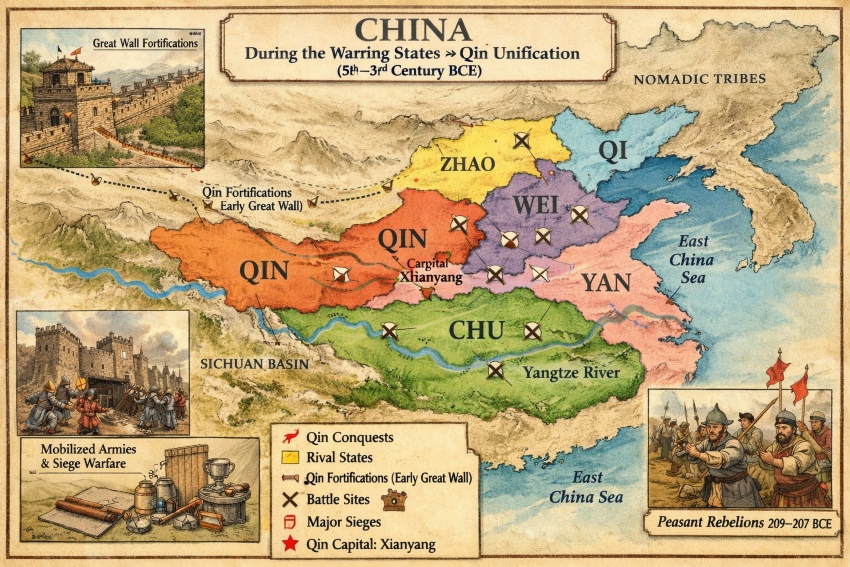
1) What “termination” meant in this case: conquest plus administrative absorption
Facts (source-grounded):
- The terminal phase of Qin unification is commonly dated to 230–221 BCE, during which Qin conquered the remaining major rival states in a stepwise sequence, culminating in 221 BCE.
- In 221 BCE, the Qin ruler claimed the title “First Sovereign Emperor” (Shihuangdi) and presented the outcome as a political unification of “all under heaven.”
- Britannica’s account emphasizes that Qin’s consolidation was not framed as a negotiated interstate settlement, but as an imperial reorganization: abolition of the old feudal order and extension of centrally appointed officials through a prefecture/county administrative system.
Interpretations (attributed):
- Modern syntheses often describe Qin’s endgame as “sequential conquest” followed by institutional standardization. That characterization is consistent with the conquest chronology and the policy package described in reference works, but it compresses regional variation and the uneven pace of incorporation.
2) Milestone timeline: from last conquests to consolidation (230–213 BCE)
- 230 BCE: Qin destroys/absorbs Han.
- 229–228 BCE: Qin defeats Zhao in the late-stage campaign sequence.
- 225 BCE: Qin ends Wei as an independent state.
- 227–222 BCE: Qin defeats Yan in the late-stage sequence.
- 226–223 BCE: Qin completes the decisive phase against Chu (as dated in the HarvardX transcript).
- 221 BCE: Qin conquers Qi; the Qin ruler proclaims a new imperial title (Shihuangdi).
- 221 BCE (post-conquest governance): abolition of feudal arrangements and rollout of centrally appointed local administration across the former rival states (prefectures and counties; inspectors).
- Early Qin empire (221–210 BCE): major integration measures reported by Britannica: weapons confiscations, forced relocation of influential households to the capital, and large state labor mobilizations for roads/walls; codification and standardization measures.
- 213 BCE: imperial order to restrict circulation of books (with exceptions for designated practical subjects), often treated as a coercive enforcement measure within the early imperial settlement.
3) “Settlement terms” without a treaty: what Qin imposed after victory
Because the final outcome was conquest rather than bargaining, “terms” are best captured as institutional changes applied to the defeated polities.
A. Territorial-administrative settlement
- Britannica describes a post-221 settlement in which Qin abolished the feudal system and extended an administrative grid of prefectures and counties, with officials appointed by the central government; “circuit inspectors” were dispatched to oversee local magistrates, and China was divided into “some 40 prefectures” in that account.
- The Smithsonian’s National Museum of Asian Art similarly emphasizes a centralized bureaucracy in which the empire was divided into provinces/prefectures governed by appointed officials, presenting this as a durable model for later Chinese statecraft.
Interpretation (attributed):
- These measures are commonly interpreted as a structural attempt to prevent a return to the interstate fragmentation associated with the Warring States. That motive is frequently stated in modern descriptions, but the more defensible point (based strictly on cited accounts) is that the reforms reduced the autonomy of former royal houses and regional aristocracies by replacing hereditary territorial power with appointed administration.
B. Standardization as a governance “peace clause”
- Britannica’s Qin dynasty entry highlights a cluster of standardizations and harmonizations associated with Qin rule: writing system, measures of length/weight, even the width of highways, alongside abolition of feudal privileges.
- Britannica’s Chinese-languages entry specifies that the first government standardization of characters during Qin is associated with the statesman Li Si, and it situates this within the broader Qin standardization program.
- The Smithsonian summary likewise notes standardization of weights/measures, coinage, and writing, treating these as integrative measures intended to make a single administrative and economic space.
Interpretation (attributed):
- In modern institutional terms, this resembles a “settlement” that substitutes uniform standards and administrative routines for negotiated autonomy. This is an interpretation, but it maps cleanly onto the reported content of the reforms: shared script/standards facilitate tax collection, record-keeping, and command transmission in a newly unified polity.
C. Elite control, disarmament, and security measures
- Britannica reports that “wealthy and influential men in the provinces were compelled to move to the capital” and that “weapons were confiscated,” framing these as part of the burden of rapid change during the early empire.
- A scholarly discussion by Lukas Nickel (Cambridge/BSOAS) connects an early imperial narrative—ultimately traceable to classical historiography—to the claim that weapons were collected and melted down to cast monumental bronzes (commonly linked to the “twelve bronze men/colossi” tradition).
Interpretation (attributed):
- Read together, these accounts are often interpreted as a strategy of postwar pacification: deprive former rival elites of their local power bases and reduce the availability of arms. The interpretation is plausible, but the strongest claim supportable from the cited material is that elite relocation and weapons confiscation were reported policies associated with consolidation.
4) Enforcement: how Qin attempted to make the settlement “stick”
Facts (source-grounded):
- Enforcement relied on an administrative chain of command rooted in centrally appointed officials in local jurisdictions, with oversight through inspectors (as described by Britannica) and a “central and systematic bureaucracy” (Smithsonian).
- Britannica links consolidation to a physical integration program: highways built to facilitate troop movement, and major mobilization of labor to connect/strengthen northern defenses later called the Great Wall complex.
- Britannica also describes an information-control component: restricting circulation of books outside specified domains (dated to 213 BCE in Britannica’s Qin dynasty entry).
Interpretations (attributed):
- Some later accounts, and some modern summaries, treat these enforcement measures as unusually severe; Britannica itself notes that accusations by historians (e.g., about book burning and “indiscriminate” killings of intellectuals) may be exaggerated.
- A cautious analytic reading is therefore to treat the existence of coercive enforcement mechanisms as well supported, while treating the scale and selectivity of repression claims as more uncertain unless tied to specific, critically evaluated primary evidence.
5) Victory criteria vs results: what “winning” meant, and what Qin demonstrably achieved
Victory criteria (inferred only when anchored to sources):
- The clearest criterion was territorial-political unification, publicly marked by the imperial title and the end of independent rival states by 221 BCE.
- A second implied criterion—explicit in the reform package—is durable governability: a uniform administrative system and standardized rules/measurements enabling command, taxation, and legal enforcement across the former Warring States space.
Results (fact-focused):
- Qin achieved rapid unification and rolled out a centrally administered territorial system, with standardization measures described in multiple reference accounts.
- Qin’s dynasty was short-lived (Britannica dates it 221–207 BCE), but Britannica also stresses that the Qin established “basic administrative” patterns that influenced subsequent dynasties for a long period.
Interpretations (attributed):
- This combination—short dynastic duration but long institutional shadow—is a common framing in modern reference literature. It does not require assuming motives; it is simply an observation about institutional persistence as described by Britannica and museum-level summaries.
What is well-established vs what is disputed
Well-established (High confidence)
- End state: Qin completed conquest of rival states by 221 BCE and proclaimed a new imperial order.
- Administrative settlement: post-221 governance emphasized centrally appointed officials in a prefecture/county-type system, with inspectors/oversight mechanisms described in major reference accounts.
- Standardization program: Qin is consistently credited with standardizing key administrative/economic systems (script, weights/measures, and related integrative standards).
- Postwar security measures: elite relocation to the capital and weapons confiscation are explicitly reported by Britannica as part of early imperial consolidation.
Disputed / uncertain (Medium to Low confidence on specifics)
- Severity and scale of repression narratives: Britannica notes that some accusations (e.g., book burning scale; “indiscriminate” killings of intellectuals) may be exaggerated, indicating uncertainty about magnitude and selectivity.
- Details of the “weapons-to-colossi” episode: Nickel’s scholarly discussion supports the existence and political meaning of the tradition, but the episode still rests on transmitted historiography and its interpretation; quantification and operational details remain uncertain.
- Granularity of “terms of surrender” for each defeated state: the high-level sequence of conquest is secure in modern summaries, but the precise local bargains (if any), elite treatments by region, and administrative sequencing are unevenly documented in accessible syntheses.
Key Sources Used
- Encyclopaedia Britannica, “China — The Qin empire (221–207 BCE)” (postwar reforms; prefecture/county system; inspectors; roads/walls; weapons confiscation; elite relocation; notes on exaggeration).
- Encyclopaedia Britannica, “Qin dynasty” (standardization program; abolition of feudal privileges; 213 BCE book restrictions; dynasty dates and significance).
- HarvardX transcript PDF, “Forging a Unified Empire: Qin” (dated conquest sequence 230–221 BCE; proclamation context).
- Smithsonian / National Museum of Asian Art (administrative model; standardization of coinage/weights/measures/writing).
- Encyclopaedia Britannica, “Chinese languages — Qin dynasty standardization” (Li Si and state character standardization).
- Lukas Nickel, Bulletin of the School of Oriental and African Studies (tradition of weapons collection and monumental bronze casting; interpretive framing).
Open Questions / Uncertainties
- Local incorporation mechanics: To what extent did Qin rely on negotiated elite accommodation (titles, hostages, resettlement deals) versus uniform coercive templates, and how did this vary by former state? (Confidence: Medium–Low)
- Administrative sequencing and timing: How quickly were prefecture/county structures implemented across each conquered region, and what interim military governance existed? (Medium)
- Disarmament scope: What portion of weapons confiscation should be understood as total disarmament vs controlled redistribution to Qin forces and arsenals? (Medium–Low)
- Information-control magnitude: Which parts of the “book burning / intellectual persecution” narrative can be pinned to specific, contemporary evidence rather than later polemic or moralized historiography? (Medium–Low)
- Institutional persistence vs dynastic fragility: Which Qin institutions most directly survived into the Han settlement, and which were repudiated or rapidly modified? (Medium)