Part 3: War Conduct: Kadesh as a Late Bronze Age “Chariot Battle,” and What the Sources Can (and Cannot) Tell Us
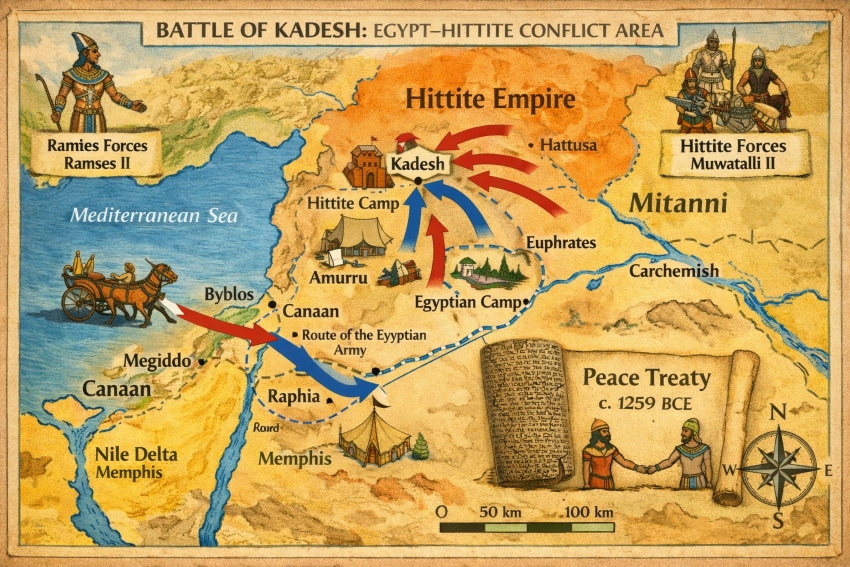
Evidence base for “war conduct” at Kadesh
FACT: Our most detailed descriptions of the battle come from Egyptian royal texts and monumental relief programs: the long narrative commonly called the “Poem” (often associated with the scribe Pentaur) and the “Bulletin/Record” captions, preserved in multiple temple copies and in later scribal papyri. A hieratic manuscript in the British Museum, Papyrus Sallier III, preserves part of the Kadesh “Poem,” but begins mid-text because the opening lines do not survive.
INTERPRETATION (attribution): Modern translators and commentators commonly treat these Egyptian accounts as highly stylized royal narration. John A. Wilson’s classic translation explicitly warns that “caution” is required when extracting historical fact from the more rhetorical portions of the “Poem,” noting that its intent is to glorify the king and that skepticism is warranted beyond the opening section.
FACT: Hittite narrative accounts of the battle itself are comparatively limited in the accessible record; this asymmetry is a major constraint on reconstructing intentions, casualty levels, and precise outcomes from both sides.
3.1 Operational setting and the nature of the engagement
FACT: The battle is conventionally placed near Kadesh on the Orontes River in Syria (modern regional geography), in the broader contest between Egyptian and Hittite power in Syria/Canaan.
FACT (dating uncertainty): Modern reference works commonly place the battle in the mid-1270s BCE, with reputable summaries differing between 1274 BCE and 1275 BCE depending on chronological conventions.
FACT: Reputable summaries describe Kadesh as one of the largest recorded chariot engagements, sometimes presenting totals on the order of ~5,000 chariots in the fighting—best understood as an indicative scale rather than a firmly audited count.
3.2 Phases of the battle (as reconstructed primarily from Egyptian accounts)
Phase 1 — Approach, intelligence failure, and deception
FACT (as presented in Egyptian texts): Wilson’s translation describes Egyptian forces approaching Kadesh while the Hittite force is concealed in proximity to the city. The text also depicts the Egyptians receiving misleading information from “Bedouins” (often identified in scholarship as Shasu nomads) who were sent “falsely,” with the explicit purpose of delaying Egyptian deployment.
INTERPRETATION (attribution): Most reconstructions treat this as an example of operational deception and reconnaissance failure—but the evidentiary base is still Egyptian narration. The tactical fact pattern (surprise contact at close range) is plausible; the exact mechanism (who said what, when, and under what coercion) is less secure because it is preserved in a royal narrative designed for commemoration.
Phase 2 — The Hittite chariot strike and the shock to Egyptian formation
FACT (synthesis from reputable summaries): Britannica’s account emphasizes that the Egyptians discovered the main Hittite army only after their forward elements had reached the camping area; it then describes a Hittite strike by a large chariot force, with three men to a chariot compared with Egyptian two-man chariots, and reports that leading Egyptian divisions were surprised and broke in disorder.
FACT (from Egyptian narrative framing): Wilson’s translation presents the Hittite force as positioned “behind Old Kadesh,” and it depicts Egyptian awareness lagging behind enemy proximity and readiness.
Phase 3 — Crisis at the Egyptian camp and counteraction
FACT (as described in mainstream syntheses): Britannica portrays a moment of acute danger in which Ramesses II is left exposed with a relatively small household chariot contingent after initial Egyptian disarray, implying a localized crisis and a struggle to stabilize the situation.
INTERPRETATION (attribution): Egyptian royal narration places the king at the center of the recovery and depicts exceptional personal action; Wilson explicitly cautions that later portions of the “Poem” prioritize glorification over accuracy. A methodologically conservative reading is that a command-and-control breakdown and surprise shock occurred, followed by some form of Egyptian reconstitution, without accepting every heroic detail as literal.
Phase 4 — Reinforcements and loss of momentum on the Hittite side
INTERPRETATION (attribution): Breasted’s military-historical reconstruction argues that the Hittite assault lost coherence when elements diverted to plunder in the Egyptian camp—an interpretation he frames as consistent with broader patterns in ancient warfare. He also notes the arrival of a body of troops that is “difficult to connect with any of the four divisions,” suggesting a reinforcement event that helped stabilize the Egyptian position.
FACT vs. uncertainty: The general proposition—reinforcements arrived and contributed to stabilization—appears across many retellings, but identifying which forces arrived (e.g., the frequently discussed “Ne’arin” contingent in later secondary literature) remains dependent on interpretive linkage across texts and is not uniformly secure in the surviving, accessible wording in any single source used here.
Phase 5 — End state of the fighting (stalemate framing) and immediate outcomes
FACT (synthesis): Britannica describes a large chariot battle with heavy fighting but “no outright victor,” which aligns with the common modern classification of the battle as inconclusive.
FACT (war-level outcome beyond the day of battle): A widely cited view in modern scholarship is that hostilities and rivalry over Syrian influence continued for years after Kadesh, with the well-attested peace settlement coming later (often placed around 1259 BCE, roughly 15 years after the battle).
3.3 Technology and tactics that mattered
Chariot design and battlefield roles
FACT (reported contrast): Britannica highlights a qualitative distinction: Hittite chariots described as heavier, with three-man crews, versus Egyptian two-man chariots—a difference that matters for how scholars model shock impact, missile delivery, and stamina in repeated charges.
INTERPRETATION (reasoned, medium confidence): If one accepts the three-man vs. two-man contrast as broadly accurate, it implies different tactical emphases:
- Three-man crews plausibly support a division of labor (driver + shield-bearer + archer/spearman) and can increase missile volume or close-combat resilience.
- Two-man crews imply a tighter integration of driving and missile work, potentially favoring speed and maneuver.
This remains medium confidence because the point is derived through synthesis from narrative summaries, not from a technical manual or excavated vehicle series.
Intelligence, deception, and the tempo of deployment
FACT (source-based): Wilson’s translation explicitly frames deceptive informants as being “made” to deliver false information to prevent Egyptian deployment “to combat.”
INTERPRETATION (high confidence): Regardless of the precise identity of informants, the narrative and the battle’s structure support a high-confidence conclusion that information and timing were decisive: the side that forced contact before the opponent’s full concentration gained early advantage.
Battlefield geography and control of crossings
FACT (general setting): The battle is associated with the Orontes River and the environs of Kadesh.
INTERPRETATION (medium confidence): River proximity increases the plausibility of (a) constrained maneuver corridors, (b) chokepoints at fords/bridges, and (c) higher risk of rout casualties via drowning/riverbank congestion—though quantifying this at Kadesh is not possible with the surviving numbers in the cited sources.
3.4 Logistics, mobilization, and the political economy of campaigning
FACT (limits): No audited budgets, ration tables for the campaign, or reliably complete order-of-battle payroll survives in the sources used here; much discussion is necessarily inferential.
INTERPRETATION (attribution): Breasted—writing explicitly as a military-historical analyst—argues that Egyptian campaigning in Syria relied on securing operational bases and communications (including coastal approaches) in a broader strategic pattern. While his claim is interpretive and reflects early 20th-century scholarship, it illustrates the kind of logistical reasoning applied to New Kingdom campaigning.
INTERPRETATION (medium confidence): For an army with a large chariot component, the operational burden is plausibly dominated by fodder and water (horses), draft/repair capacity (wheels, axles, harness), and march discipline (spacing of divisions). These are standard constraints in chariot-era warfare, but Kadesh-specific quantification is not recoverable from the cited materials.
3.5 Civilian impacts and local effects
FACT: The accessible Egyptian sources are not designed as humanitarian accounting and do not provide reliable civilian casualty totals, displacement counts, or systematic destruction assessments.
INTERPRETATION (low-to-medium confidence): It is reasonable to expect that the approach of major forces, foraging, and combat near a fortified city disrupted local production and security; however, the degree of displacement, the scale of property destruction, and the civilian death toll are not recoverable from the sources cited here without speculative extrapolation. Methodologically, this should remain a bounded inference rather than a numeric claim.
Timeline: War Conduct Milestones (battle-centered)
- Spring (mid-1270s BCE) — Egyptian campaign moves north toward Kadesh in the Orontes region (exact route details vary by reconstruction).
- Approach phase — Hittite forces remain concealed near/behind Kadesh in Egyptian narration.
- Pre-contact intelligence episode — Deceptive informants provide false location information in Egyptian account.
- Egyptian encampment near Kadesh — Egyptian forward elements establish camp before full situational awareness (summary tradition).
- Initial chariot strike — Hittite chariot force attacks; leading Egyptian elements break/disorder (summary tradition).
- Crisis at camp — Egyptian command element described as isolated and under heavy pressure (summary tradition).
- Egyptian counteraction — Fighting stabilizes; Egyptian narrative centers the king’s role (source-critical caution applies).
- Reinforcement event (contested specifics) — Additional troops arrive in Breasted’s reconstruction; identification debated.
- End of day outcome — Battle framed as lacking a decisive victor in modern syntheses.
- Post-Kadesh continuation — Rivalry/hostilities over Syrian influence continue for years.
- c. 1259 BCE — Peace settlement concluded roughly 15 years after Kadesh (war termination mechanics treated in Part 4).
What is well-established vs. what is disputed
Well-established (high confidence)
- A major Egyptian–Hittite battle occurred at/near Kadesh on the Orontes in the mid-1270s BCE.
- The Egyptian evidentiary record is unusually extensive for an ancient battle (multiple monumental copies; papyrus witnesses), but is royal-commemorative in genre.
- Modern summaries broadly agree on an inconclusive / non-decisive outcome on the day.
- A later peace treaty is commonly dated around 1259 BCE, well after the battle.
Disputed / uncertain (medium-to-low confidence unless noted)
- Exact year and month (1274 vs 1275 BCE in common references).
- Total chariot and troop numbers: often reported at large scale, but likely include rhetorical inflation, partial engagement, or uncertain counting conventions.
- Precise sequence and timing of division movements and reinforcement arrivals (including which contingent arrived and when).
- Degree of tactical success achieved by each side on specific sub-phases (e.g., whether Hittites lost momentum primarily due to plunder vs. organized counterattack).
- Casualties (military and civilian): not quantifiable from the cited record without speculation.
Key Sources Used
- John A. Wilson, The Texts of the Battle of Kadesh (translation and source-critical cautions; excerpts as accessed).
- British Museum collection entries for Papyrus Sallier III (object description; survivals/limitations; genre notes).
- J. H. Breasted, The Battle of Kadesh: A Study in the Earliest Known Military Strategy (1903; early scholarly reconstruction, used here as attributed interpretation).
- Encyclopaedia Britannica entries on Battle of Kadesh and Ramesses II (battle scale framing; chariot crew contrast; stalemate characterization).
- Trevor Bryce, “The ‘Eternal Treaty’ from the Hittite perspective” (for post-Kadesh settlement interval and context).
Open Questions / Uncertainties
- What is the most defensible absolute date for the battle within competing Egyptian/Hittite chronological frameworks (and what uncertainty range should be stated)?
- Can troop/chariot figures be decomposed into engaged vs. present but not committed forces in a way that is consistent across texts?
- What is the best-supported identification of the reinforcing contingent described in reconstructions (and how strong is the linkage to the text witnesses)?
- How should historians weigh genre and purpose in the “Poem” and “Bulletin” when extracting operational detail (especially after the opening portion Wilson treats as more credible)?
- What (if any) independent Hittite-side material can be securely connected to Kadesh battle conduct rather than to later diplomatic narratives?