Part 1 — Pre-War System: Late Bronze Age “Great Kings,” the Orontes Corridor, and the Evidence Base (Kadesh + Peace Treaty)
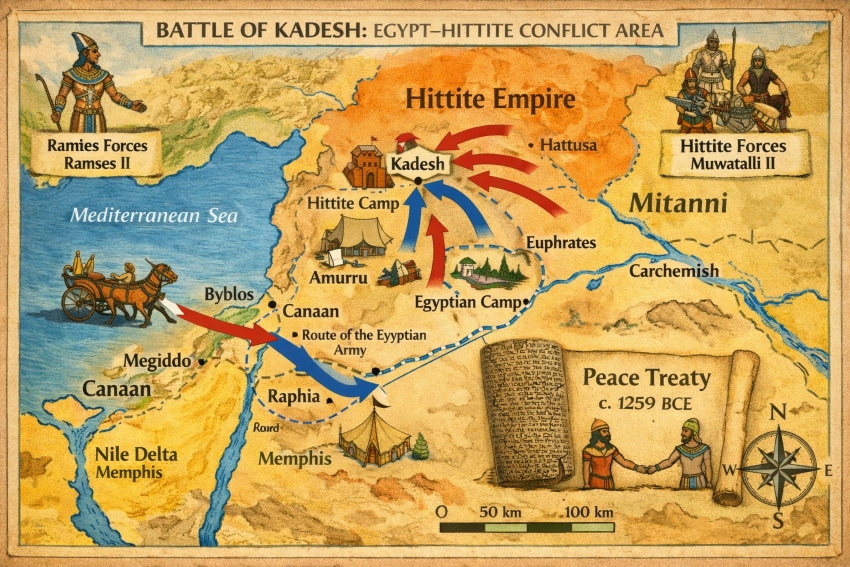
Conflict Snapshot
- Conflict: Egypt–Hittite war (Syrian/Levantine rivalry) culminating at Kadesh and followed by a formal peace treaty
- Approx. dates (this series scope): c. 1290s–1259 BCE (background under Seti I → Kadesh under Ramesses II → treaty)
- Type: Inter-polity (interstate/imperial rivalry) conflict in the Late Bronze Age international system
- Primary theater/focal node: Kadesh on/near the Orontes corridor (western Syria)
- Principal actors (core):
- Egypt: Seti I (background phase), Ramesses II (Kadesh and treaty era)
- Hatti (Hittite Empire): Muwatalli II (Kadesh era per modern summaries), Ḫattušili III (treaty partner)
- Outcome label (high-level): Kadesh commonly summarized as indecisive/no outright victor, followed by a formal peace treaty (often framed as an alliance/brotherhood pact in later presentation).
- Casualties: Not recoverable as a defensible range from surviving evidence (no neutral casualty accounting; sources are primarily royal commemorative/diplomatic texts). (See “Evidence base” below.)
- Displacement: Not recoverable in a modern quantitative sense for this case (no reliable displacement accounting survives).
- Last updated: 15 January 2026 (Europe/Stockholm)
How this series will separate Facts vs Interpretations
- FACTS here mean: (a) dates/reigns as given in reputable reference works; (b) the existence and character of primary texts/objects (papyrus copies, temple inscriptions, cuneiform treaty tablet traditions); (c) what those texts explicitly claim.
- INTERPRETATIONS here mean: reconstructions of “stakes,” “constraints,” and “what mattered most,” which must be attributed to scholarship or clearly marked as inference grounded in the source limitations.
1) The Late Bronze Age “Great Kings” system: institutions and constraints
FACT: Scholarship on Late Bronze Age diplomacy commonly describes an interstate environment dominated by a small number of “Great Kingdoms,” whose rulers maintained relations through regular correspondence, messengers, gift exchange, and marriage diplomacy—alongside periodic warfare. Trevor Bryce’s synthetic treatment explicitly discusses rulers styled “Great Kings,” addressing one another as “My Brother,” and using diplomacy to manage contentious issues.
FACT: Bryce also emphasizes practical constraints: communications and travel risks, the logistics of moving missions and armies, and the difficulty of sustaining control over distant territories in a geographically and politically complex region.
INTERPRETATION (attributed, confidence: Medium): If we treat Egypt and Hatti as participants in this “Great Kings” environment, then the Egypt–Hittite rivalry over Syria/Levant can be analyzed as a struggle occurring within a diplomatic system that sometimes rewarded accommodation as much as battlefield success. That is, war and diplomacy are not separate stories; they are alternating instruments in a single regional order. This framing is consistent with Bryce’s depiction of Late Bronze Age “Realpolitik” and negotiated settlements.
2) Why Kadesh mattered in that system: geography and node control
FACT: Modern reference summaries place the Battle of Kadesh on the Orontes River in Syria and treat it as a major Egyptian–Hittite clash.
FACT: Archaeological and textual scholarship commonly identifies Tell Nebi Mend as ancient Qadesh/Kadesh on the Orontes. A peer-reviewed article on the cuneiform tablets from Tell Nebi Mend reports Akkadian tablets from a Late Bronze Age deposit and argues that their content—linked with Hittite sources—supports identifying the site as Qadesh on the Orontes.
FACT (contextual detail): Regional settlement scholarship refers to Tell Nebi Mend as “generally believed” to be Kadesh and notes its comparatively modest tell size in relation to nearby centers—useful for avoiding assumptions that the battle’s fame implies a uniquely massive city.
INTERPRETATION (inference, confidence: Medium): In a corridor politics framework, Kadesh’s importance is less about the intrinsic scale of the city and more about its positional value in regulating movement, supply, and allegiance networks along the Orontes route system. This is an inference consistent with why Late Bronze Age powers repeatedly contest nodal points rather than attempting continuous territorial occupation everywhere.
3) The principal actors: what is solid and what is shorthand
Egypt (Seti I and Ramesses II)
FACT: Britannica dates Seti I’s reign to c. 1290–c. 1279 BCE.
FACT: Britannica dates Ramesses II’s reign to 1279–1213 BCE, noting he likely exercised some power earlier as a coregent/crown prince.
FACT (source-based framing): The University of Chicago’s ISAC description of The Road to Kadesh characterizes the book as exploring Seti I’s wars and the pattern of Egyptian–Hittite relations that culminated first at Kadesh and later in the treaty under Ramesses II.
Hatti (Muwatalli II and Ḫattušili III)
FACT (summary-level): Britannica’s Kadesh entry identifies the opposing Hittite king at the battle as Muwatalli(s) and describes Ramesses II as seeking to recapture Kadesh and contest control in Canaan/Syria.
FACT (treaty-era): CDLI describes a treaty concluded in 1259 BCE between the Hittite and Egyptian rulers, whose kingdoms had previously been at odds over territory in the Levant.
FACT (scholarly chronology): An Oxford Academic (OUP) chapter title and summary explicitly frames “The Reign of Hattusili III (c.1267–1237)” and discusses, among other topics, his treaty with Egypt.
DISCREPANCY NOTE (Fact about disagreement): Britannica’s standalone biography page gives a different reign range for Ḫattušili III (c. 1286–c. 1265 BCE), which does not align neatly with a 1259 BCE treaty date.
Interpretive resolution (confidence: Medium): For this series, the OUP/Bryce scholarly dating framework will be treated as the default for regnal chronology when it conflicts with brief encyclopedia ranges, while still flagging the discrepancy as an uncertainty to be tracked.
4) Stated aims and stakes: what we can say without mind-reading
FACT (attributed): Britannica states that Ramesses II sought to recapture the Hittite-held city of Kadesh and to contest control in Canaan and Syria, and it adds that the battle produced no outright victor.
FACT (textual self-presentation): The British Museum description of Papyrus Sallier III characterizes the “poem” of Kadesh as a long narrative, sometimes in the first person from Ramesses II’s perspective, describing the battle and “subsequent triumph,” attributing the victory to Ramesses with the aid of Amun-Ra, and noting that the poem appears on temple walls at Abydos, Karnak, Luxor, and the Ramesseum.
INTERPRETATION (confidence: Medium): The combination of (a) a geopolitical summary aim (Britannica) and (b) an Egyptian monumental narrative emphasizing royal prowess suggests that “war aims” operated on two levels: external control/position in Syria and internal legitimacy/royal ideology. This is an inference about how aims are communicated—not a claim about private motives.
5) The evidence base: why Kadesh is “richly attested” yet still hard to reconstruct
5.1 Egyptian battle accounts and their limits
FACT: Papyrus Sallier III is one witness to the Egyptian “poem” tradition; the British Museum explicitly notes that this text is not unique and exists in multiple monumental copies.
FACT: The Egyptian account’s function is visible in its framing: first-person royal perspective at points, attribution of success to the king (and deity), and temple-wall dissemination.
INTERPRETATION (confidence: High): Because this is commemorative royal literature/inscriptional display, it should be treated as a source for (a) what the regime wanted audiences to believe and remember and (b) some operational detail—while remaining cautious about taking it as neutral reporting (especially on “victory” claims and losses). This follows directly from the genre and dissemination context described by the British Museum.
5.2 The treaty tradition and its limits
FACT: CDLI frames the treaty as concluded in 1259 BCE and provides a scholarly edition trail.
FACT (philological caution): Langdon & Gardiner’s publication (as accessible in PDF form) discusses how the hieroglyphic version’s phraseology was recognized as non-Egyptian and argues the formulation was “purely Babylonian,” indicating the treaty exists through translation/adaptation into Egyptian idiom and an Akkadian diplomatic tradition; it also notes the Hattusa fragments are incomplete.
INTERPRETATION (confidence: High): The treaty is excellent evidence for formal termination and normalization of relations (peace/brotherhood/alliance language), but it is not a detailed battle chronicle; moreover, translation layers and incomplete tablets impose constraints on over-precise readings of individual clauses.
5.3 Why casualties and displacement are not responsibly quantifiable here
FACT: The best-preserved materials highlighted above are (1) a royal commemorative narrative tradition and (2) a diplomatic treaty tradition.
INTERPRETATION (methodological, confidence: High): Neither genre is designed for verifiable casualty or displacement accounting. As a result, this series will treat “casualties” and “displacement” as unknown/not recoverable unless a credible administrative corpus emerges in the literature for a specific sub-question (and it will be cited explicitly if used).
Timeline — 10 dated milestones (approximate; chronology varies by scheme)
- c. 1600–1200 BCE: Late Bronze Age interstate system of “Great Kings,” diplomacy, and periodic wars (framework period).
- c. 1290 BCE: Accession of Seti I (Egypt).
- c. 1290–1279 BCE: Seti I’s wars and the broader Egypt–Hittite pattern leading toward Kadesh (as studied via Karnak reliefs).
- 1279 BCE: Accession of Ramesses II (Egypt).
- 1275 BCE: Battle of Kadesh (Britannica date; other chronologies differ by ~1 year).
- After 1275 BCE (Ramesses II reign): Repeated inscriptional dissemination of the Kadesh “poem” on major temple walls; papyrus witness (Sallier III) attests the tradition.
- c. 1267 BCE (short chronology): Beginning of Ḫattušili III’s reign (Hatti), in scholarly chronologies.
- 1259 BCE: Treaty concluded between Ramesses II and Ḫattušili III (CDLI).
- Treaty textual tradition: Akkadian treaty tradition and Egyptian monumental version involve translation/phraseological transfer; Hattusa fragments are incomplete.
- Archaeological identification context (Late Bronze Age evidence): Akkadian tablets from Tell Nebi Mend strengthen identification with Qadesh/Kadesh on the Orontes.
What is well-established vs what is disputed
Well-established (higher confidence)
- Existence and centrality of Kadesh in the Egyptian commemorative record, including multiple temple-wall copies and papyrus witness.
- A major Egypt–Hittite battle at/near Kadesh on the Orontes, associated with Ramesses II and a Hittite king (named Muwatalli in modern summaries).
- A formal treaty between Ramesses II and Ḫattušili III, preserved in cuneiform/diplomatic tradition and reflected in Egyptian monumental presentation; treaty dated to 1259 BCE by CDLI.
- Late Bronze Age diplomatic “Great Kings” environment in which diplomacy and war interleave as tools of statecraft.
- Tell Nebi Mend as Qadesh/Kadesh is strongly supported in the archaeological literature via cuneiform tablet evidence and linked historical identification arguments.
Disputed / less certain (flagged for careful handling)
- Exact absolute year of Kadesh (often 1275 or 1274 BCE depending on chronology); even reputable summaries vary.
- Outcome characterization: Egyptian commemorative texts present triumph; modern summaries often stress “no outright victor.” The balance between these is interpretive.
- Ḫattušili III reign range: encyclopedia ranges can conflict with scholarly chronologies used in specialist literature; this affects how dates are expressed.
- Clause-by-clause treaty interpretation: translation layers and incomplete tablets limit precision.
- Quantification (troop strengths, casualties): not responsibly recoverable as firm totals from the main surviving genres used here.
Key Sources Used (Part 1)
- Britannica: Seti I reign dates (c. 1290–1279 BCE).
- Britannica: Ramesses II reign dates (1279–1213 BCE).
- Britannica: Battle of Kadesh summary (location; no outright victor; 1275 BCE in that entry).
- British Museum: Papyrus Sallier III description (nature of the “poem”; multiple monumental copies; ideological framing).
- CDLI: Treaty between Ḫattušili III and Ramesses II (1259 BCE; scholarly edition trail).
- Langdon & Gardiner (JEA 1920, PDF access): treaty philology/translation issues; incompleteness of Hattusa fragments.
- ISAC (University of Chicago): The Road to Kadesh description (Seti I wars; pattern culminating in Kadesh and treaty).
- Bryce (2003), Letters of the Great Kings… (PDF): “Great Kings” diplomacy framework and constraints.
- Millard (2010, Levant): Tell Nebi Mend cuneiform tablets supporting identification with Qadesh.
- Philip (2016, Syria via OpenEdition): Tell Nebi Mend generally believed to be Kadesh; contextual site-size note.
Open Questions / Uncertainties (to carry into Part 2)
- Chronology choice: Which absolute-year scheme we will use as the baseline (and how we will annotate alternates) for Kadesh and treaty-related dates.
- Operational reconstruction limits: Which specific elements of the Egyptian narrative can be cross-validated versus treated primarily as commemorative framing.
- Territorial stakes: How explicitly the sources (Egyptian/Hittite) describe control over particular Syrian polities versus how much must be inferred from later diplomatic language.
- Kadesh’s local political context: What can be established about Kadesh/Qadesh’s rulers and affiliations immediately before the battle from the wider cuneiform record (beyond the basic site identification).
- Treaty mechanics: What enforcement mechanisms and reciprocity expectations can be stated as text-level facts versus interpretive reconstructions.