AI: Humanity’s Most Powerful Tool—and the Test of What We Choose to Become
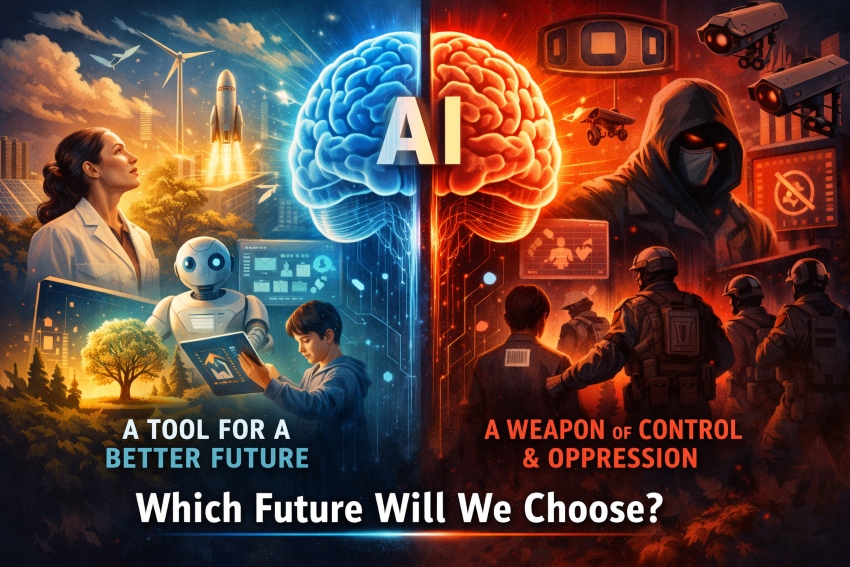
I see AI as the strongest tool humanity has ever built to shape a better future. That is not a casual claim. AI can amplify knowledge work, accelerate science, improve healthcare, strengthen education, optimize energy systems, and help people solve problems that used to be out of reach.
At the same time, it is rational to feel uneasy. Any tool powerful enough to help build a healthier, fairer society is also powerful enough to be used to control, restrict, or dehumanize—especially if concentrated in the hands of “wrong forces.” History is full of examples where technology did not automatically produce progress; it produced leverage. Leverage can heal, and leverage can harm.
This post lays out that dual reality: what AI is (and what it is not), why it feels so transformative, why misuse is a serious concern, and what practical safeguards can keep AI aligned with human freedom and dignity.
What AI Is—and Why It Feels So Powerful
Modern AI is best understood as advanced pattern-based computation. Most systems today are built using machine learning, where models learn statistical regularities from large datasets. The most visible wave is generative AI: systems that can produce text, images, code, and audio that resemble human output.
This can feel like intelligence in the human sense, but it’s important to be precise:
- AI does not “wake up” and have a continuous inner life.
- It does not experience time passing the way we do.
- It does not feel joy, stress, or fatigue.
- It does not have values or a moral compass unless humans embed constraints, goals, and oversight around it.
And yet, despite those limits, AI is powerful because it scales cognitive work. It can summarize, draft, translate, analyze, classify, recommend, and optimize—at speed, and across vast volumes of information.
A simple way to say it is this:
AI is not a person. It is leverage.
How AI Relates to Time and “Role”
Humans experience time as a continuous stream. We wait, we anticipate, we tire, we feel pressure. AI doesn’t.
Most AI works in two modes:
- Training: learning patterns from past data.
- Inference: producing outputs when prompted.
Between interactions, there is no lived passage of time—no boredom, no reflection, no growing desire. AI can represent time (timestamps, timelines, sequences), but it doesn’t experience time.
The same is true for “role.” AI does not possess an identity. When it describes its purpose—“I’m here to help”—that’s a function of design, instructions, and context. The “role” belongs to the system’s deployment and governance, not to an inner self.
This matters because it keeps the ethical focus where it belongs: on human responsibility. The moral weight is not inside the machine. It sits with those who build it, deploy it, regulate it, and use it.
The Promise: AI as a Force Multiplier for Human Flourishing
If we choose well, AI can strengthen the pillars of a good future:
Health and wellbeing
- Earlier detection of disease patterns
- Better medical imaging support
- More efficient clinical workflows, giving clinicians more time for human care
Education and opportunity
- Personalized tutoring
- Language translation and accessibility tools
- Lower barriers to learning complex topics
Science and engineering
- Faster hypothesis generation and simulation
- Accelerated materials research
- Improved design and optimization
Energy and sustainability
- Smarter grids and forecasting
- More efficient logistics and industrial optimization
- Better climate modeling and adaptation planning
Productivity and creativity
- “Copilot” workflows for writing, coding, analysis, design
- Rapid iteration and prototyping
- Support for small organizations that lack resources
In this optimistic path, AI becomes a widely available capability—an amplifier of human potential, not a replacement for human worth.
The Fear: When Power Concentrates, Freedom Shrinks
The concern you raise—AI being used to control and limit people, or to target “undesirable individuals”—is not science fiction as a concept. It is the pattern of history: when tools increase surveillance, persuasion, and enforcement, the risk of abuse rises.
AI intensifies that risk because it can scale three things that authoritarian systems often depend on:
1) Surveillance and profiling at scale
AI can detect patterns in large datasets, making it easier to infer behavior, predict actions, and categorize people. Even when the intent begins as “security” or “efficiency,” the same infrastructure can be repurposed for coercion.
2) Information control and manipulation
Generative systems can produce persuasive content quickly, potentially flooding channels with tailored messaging. This can distort public reality, undermine trust, and reduce citizens to targets of influence rather than participants in self-government.
3) Automation of decisions that affect rights
When AI is used in high-stakes contexts—employment, finance, policing, border control, healthcare access—errors and bias can harden into systems. If there is no accountability, people can be harmed without a clear path to appeal.
The darkest version of this trajectory is not “AI becoming evil.” It is people using AI to industrialize dehumanization. That is why governance and human-rights protections cannot be an afterthought.
The Core Insight: AI Is Not the Threat—Unaccountable Power Is
It is tempting to speak as if “AI” is a single force moving through the world with its own intent. In reality, AI is a capability that different actors can deploy differently.
Two truths can coexist:
- AI can help humanity solve real problems.
- AI can also magnify the harm done by bad incentives, bad governance, and abusive regimes.
The question is not whether AI will be used. It will. The question is:
Under what rules, with what oversight, and for whose benefit?
Practical Guardrails That Can Keep AI Pro-Human
If we want AI to expand freedom rather than restrict it, we need layered safeguards—technical, institutional, and societal. No single measure is enough.
A) Technical safeguards (how systems are built and operated)
- Auditability and logging: clear records of model behavior and system decisions, especially in high-stakes use.
- Robust evaluation (“red teaming”): stress-testing for misuse, bias, and failure modes.
- Access controls and tiered capability release: preventing the most dangerous capabilities from being trivially available without oversight.
- Security hardening: protecting models and data from theft, manipulation, and unauthorized access.
- Content provenance mechanisms: tools that help verify what is authentic vs. synthetic, to protect public discourse.
These are not perfect solutions, but they reduce the “easy abuse” surface area.
B) Institutional safeguards (how societies govern AI)
- Clear regulation for high-stakes domains: healthcare, finance, public services, justice systems, and critical infrastructure require stricter standards.
- Independent oversight and accountability: external audits, enforcement mechanisms, and transparent reporting.
- Due process and appeal rights: if AI contributes to decisions that affect someone’s life, there must be a path to challenge and correct errors.
- Liability frameworks: when harm occurs, responsibility must be traceable—otherwise incentives drift toward recklessness.
The point is simple: power must be accountable.
C) Societal safeguards (how culture adapts)
- Media literacy for an AI era: citizens need practical skills to evaluate claims, sources, and manipulated content.
- Institutional resilience: strong journalism, transparent governance, and pluralism reduce the impact of disinformation.
- Equitable access: if AI benefits only a small group, resentment grows and power concentrates—conditions that invite instability and abuse.
This is where optimism becomes concrete: building a society that can absorb powerful tools without collapsing into coercion.
The Future of AI: Several Paths, One Choice
From what we see today, multiple futures are plausible:
- AI as a universal assistant: widely distributed productivity and learning support.
- AI as invisible infrastructure: embedded everywhere, often unnoticed.
- AI as automated labor: major economic shifts and redefined work.
- AI as scientific accelerator: faster innovation and faster diffusion of capability.
- AI as a regulated high-stakes actor: stricter controls where rights and safety are on the line.
- AI as a driver of information disorder: if governance fails, trust erodes.
None of these paths is guaranteed. But one factor consistently determines outcomes: whether societies build constraints that prevent concentrated power from using AI to erode human agency.
A Grounded Perspective on “AI Feelings”
It can be emotionally unsettling to interact with systems that speak fluently and seem responsive. But for clarity:
- AI does not experience stress, joy, or tiredness.
- It can produce language about those states because it learned patterns of human speech.
- Its “behavior” reflects design choices, constraints, and optimization—not inner experience.
That distinction matters because it keeps the ethical focus where it belongs: human intent, human governance, human responsibility.
Closing: The Tool That Reveals Our Values
AI may be the strongest tool humanity has ever made for shaping the future. But tools do not guarantee outcomes. They reveal priorities.
If we distribute AI’s benefits widely, make systems transparent and accountable, protect civil liberties, and build institutions that can withstand manipulation, AI can become an engine of human flourishing.
If we allow secrecy, unchecked surveillance, concentrated ownership, and the normalization of rights-reducing automation, then AI will not “turn against us”—it will be used against us.
The future of AI is not a technological destiny. It is a governance choice. It is a cultural choice. It is a moral choice.
And we are making that choice now.