Part 5 — Aftermath (short vs long run, stakeholder winners/losers on BOTH sides, what remained disputed)
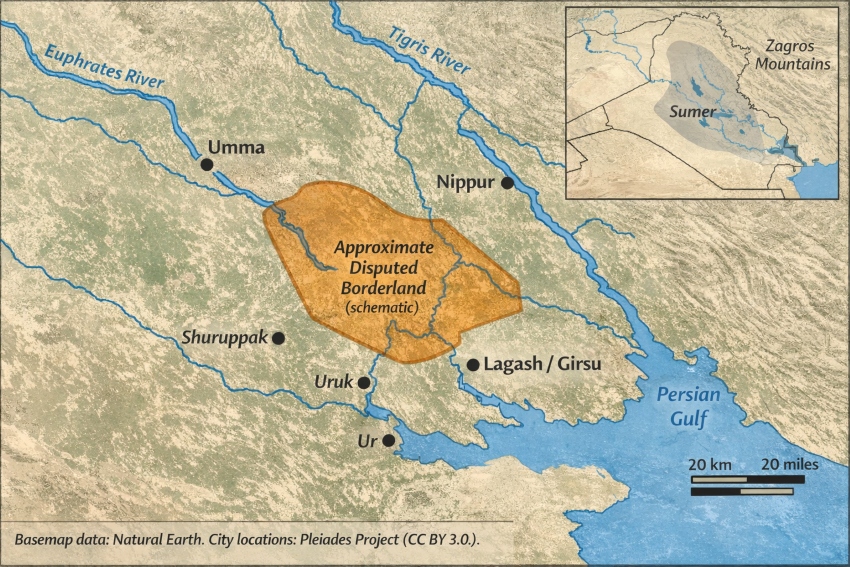
Timeline (8–15 dated milestones)
- Undated: Enmetena’s reconstruction and curse formula represent an “aftermath package”: rebuild + warn + memorialize.
- Undated: Partial repayment and continued verbal contestation (“the boundary dikes are mine”) indicate unresolved claims.
- Undated: Material commemoration persists (Stele of the Vultures tradition and later scholarly preservation).
- c. 2900–2350 BCE: Early Dynastic institutional setting continues to shape how disputes are recorded and remembered.
- c. 2500–2350 BCE: The dispute remains a long-running reference point in scholarship for early interstate conflict and water-rights contention.
- Modern period: Museum curation and digital corpora (CDLI) make the dispute unusually legible compared to many Bronze Age conflicts.
- 2018–2019: British Museum exhibit history for the Umma-associated mace demonstrates modern interpretive framing around “borders.”
Short-run aftermath: what changed immediately after major episodes
1) Infrastructure reassertion.
The described reconstruction from the Tigris to the Nun-canal is an immediate “aftermath” action—repairing the physical boundary system that the narrative claims had been sabotaged.
2) Legal-ritual reinforcement.
The curse formula functions as a public warning: it sets out consequences for future boundary crossing, framed in divine terms and in communal terms (the violator’s citymen killing him).
3) Continued dispute signals.
The quoted assertion by Il (“the boundary dikes … are mine”) shows that even after fighting and partial repayment, claims remained contested.
Long-run aftermath: institutional memory and the politics of border legitimacy
The dispute as a template for later thinking about borders (interpretation; confidence: medium).
Modern curation and scholarship treat this conflict as an early example of “border dispute” documentation. The long-run impact that can be defended from the evidence base is not “it caused X later empire,” but that:
- it helped establish (or at least preserves evidence for) a repertoire of border legitimation practices: measuring, stelae, shrine-building, treaty-like terms, and curse enforcement.
Stakeholder winners and losers (both sides; bounded to what we can infer)
Lagash (potential winners)
- Ruling house / elite administration (short run): The narrative presents successful enforcement—defeating a violator ruler and reasserting the boundary.
- Temple institutions tied to Ningirsu/Nanshe (short run): Reconstruction and protection of temple lands and boundary dikes are explicit objectives in the text tradition.
Lagash (potential losers)
- Borderland producers (short run; inference, confidence: medium): recurring canal conflict implies repeated disruption risk—labor demands for repairs and vulnerability to diversion.
- Diplomatic credibility (long run; inference, confidence: low-to-medium): repeated need to reassert boundaries suggests that earlier settlements did not fully stabilize expectations.
Umma (potential winners)
- Access to contested resources (episodic): The settlement structure (as translated) implies Umma retained some controlled access (e.g., a defined strip and an exploitation right framed in barley terms).
- Independent ideological claim-making: The existence of Umma-associated objects naming Umma and Shara indicates an Umma capacity to articulate its own legitimacy, even if we cannot reproduce the full argument from the excerpted record here.
Umma (potential losers)
- Ruling elites in losing episodes: The narrative describes the death of Urlumma and characterizes successors as “field thief,” which—regardless of bias—signals elite turnover and reputational contestation.
- Fiscal burden (if obligations were materially enforced; confidence: low): The “loan/interest” framing depicts Umma as accumulating large barley liabilities and making only partial repayment. Whether this was literal is uncertain, but the claim itself indicates an ideological portrayal of Umma as debtor/defaulter.
What remained disputed
Boundary ownership and water control did not settle cleanly.
The most direct evidence is the persistence of explicit counter-claims after fighting (“the boundary dikes … are mine”). Combined with the broader framing of a long-running dispute, this indicates that the underlying disagreement—who owns the border infrastructure and the productive land it services—remained live.
What is well-established vs what is disputed
Well-established
- After major episodes, the record emphasizes reconstruction, monumentation, and curse-based deterrence as the aftermath toolkit.
- The dispute persisted as an enduring inter-polity friction point within the Early Dynastic system.
- Modern institutions curate both “sides” materially, even where textual symmetry is limited.
Disputed / uncertain
- Distributional impacts on ordinary households (food security, displacement) are not measurable from the sources used here.
- Whether economic transfer terms were implemented as stated is uncertain given translation/accounting issues.
- Balance of legitimacy claims remains partially opaque because the most detailed narrative survives in Lagashite tradition.
Endnotes (Part 5)
- Enmetena-related aftermath actions: reconstruction, partial repayment, continued claims, and curse formula.
- Early Dynastic system context for why multi-polity border disputes recur.
- Museum and digital-corpus infrastructure that preserves and frames the dispute (Louvre; CDLI; British Museum).
- CDLI Wiki synthesis as a modern reference framing of the conflict.
Key Sources Used (Part 5)
- CDLI Tablet translation page.
- Carrie Hritz chapter.
- British Museum object record (Gishakidu mace).
- Louvre collections entry (Stele of the Vultures).
- CDLI Wiki overview.
Open Questions / Uncertainties (Part 5)
- Can future remote sensing and fieldwork narrow the location of key toponyms (Ugiga-field, specific levees) enough to model conflict intensity spatially?
- What additional Umma administrative or commemorative texts might exist (lost or unpublished) that would rebalance the narrative?
- How should scholars interpret the interaction between ecological instability (channel shifts) and political escalation frequency?
- Do the curse formulas reflect shared interstate norms, or mainly Lagash’s preferred idiom of enforcement?