Part 2 — Road to War (triggers, bargaining failure, mobilization, stated aims)
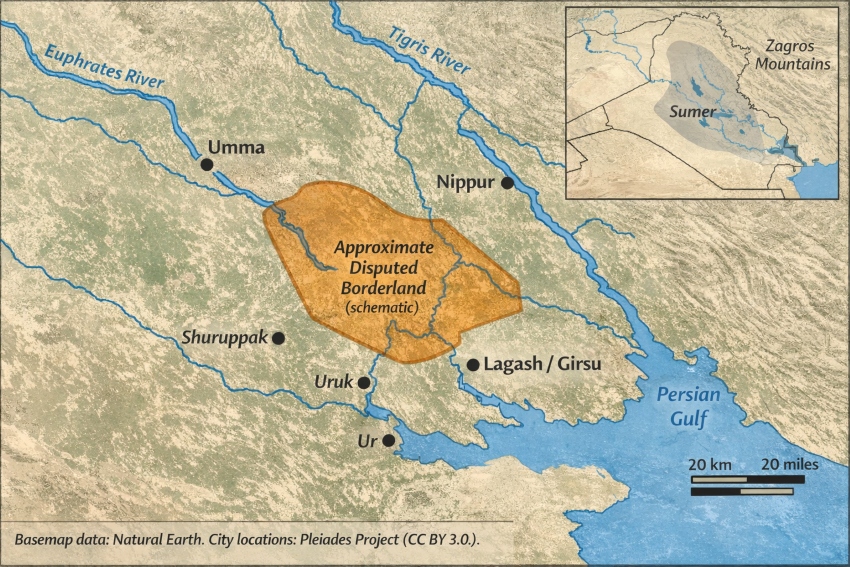
Timeline (8–15 dated milestones)
- Undated (Early Dynastic): Boundary demarcation attributed to Mesilim of Kish; stele erected after measurement.
- Undated: Umma-side action described (removal of stele; entry into the Gu’edena/Eden district).
- Undated: Lagash narrative frames response as enforcement under divine authority (Ningirsu vs Shara).
- c. mid-25th century BCE: Lagash ruler tradition (E’annatum) described as redemarcating boundary with an Umma ruler (Enakale).
- Undated: Boundary canal/levee is described as being led from one canal to Gu’edena; a “no-man’s land” strip is established.
- Undated: Barley “loan/interest” arrangement is stated as part of the settlement structure.
- Undated: Accumulation of barley obligations and alleged nonpayment; renewed tensions.
- Undated: Umma ruler (Urlumma) described as diverting water, damaging monuments and chapels; mercenaries hired; border transgression north-to-south.
Triggers: boundary markers, water control, and contested precedent
The Mesilim precedent as a bargaining anchor.
One prominent tradition in the textual corpus presents the boundary as originally demarcated under Mesilim of Kish, including measurement and erection of a stele. In bargaining terms, this acts as a precedent claim: if both parties accept it, it supplies a focal point for “where the border should be.”
Why precedent did not settle the dispute.
The same tradition asserts that Umma removed the stele and entered the contested district. Whether this reflects an actual initial act or a retrospective Lagash framing, the functional implication is that the enforcement capacity behind the precedent was insufficient to prevent unilateral revision, at least intermittently.
Hydraulic triggers are structurally plausible.
Landscape scholarship emphasizes that the local fluvial setting east of the Shatt al-Gharraf involved large leveed branches and mixed channel systems, and that canal maintenance is repeatedly foregrounded in written accounts. This makes “water control” a plausible structural driver, but motive attribution still requires care: the safest claim is that the parties’ texts treat canals/levees as core objects of contestation.
Bargaining failure: credible commitment and monitoring problems
Demarcation is not enforcement.
Erecting monuments, naming levees, and building chapels on the boundary created visible markers and ritualized claims. But those measures do not, by themselves, solve:
- monitoring (detecting diversions, encroachments, or illicit cultivation),
- credible commitment (ensuring the other side will refrain once immediate coercion fades),
- retaliation control (preventing spirals after alleged violations).
The “no-man’s land” strip as a governance tool (interpretation; confidence: medium).
The text describes establishing a 215 nindan strip (translated as about 1,290 m) under Umma control with a no-man’s land adjacent. One interpretation is that this is an attempt to create buffer space and reduce day-to-day friction. The confidence is “medium” because the passage is explicit about the strip, but less explicit about the governance logic beyond boundary marking.
Economic instruments: grain obligations as compensation or rent.
The text describes Umma’s ability to exploit “1 gur” of barley as an interest-bearing loan, followed by an enormous stated accumulation and subsequent claims of inability to repay. Even allowing for translation and accounting uncertainties, this indicates that the settlement was not merely territorial; it included a transfer mechanism—a common feature of border bargains where one side accepts constraints in exchange for ongoing compensation.
Mobilization and stated aims: what the sources say (and do not say)
Stated aims in Lagash sources.
Lagash narrative framing in the translated text emphasizes:
- restoration of a divinely sanctioned boundary (Enlil’s command; Ningirsu vs Shara),
- punishment for “crossing the boundary dike” (curse formula),
- reconstruction of boundary infrastructure “from the Tigris to the Nun-canal.”
These are best treated as declared justifications rather than transparent intent.
Umma-side framing and the limits of our window.
A material counterpoint exists in an Umma-associated object (a pottery mace) linked to ruler Gishakidu and naming Umma and the god Shara. The British Museum record establishes association and provenance, but it does not, in the accessible lines, provide the full argumentation text; consequently, reconstructing Umma’s stated aims with parity of detail is constrained.
Mobilization indicators (interpretation; confidence: medium).
The translated Lagash text describes hiring “people of the foreign lands” as mercenaries and depicts organized armed action across named fields and canals. This supports a medium-confidence inference of mobilization beyond purely local militia, though the scale is not recoverable.
What is well-established vs what is disputed
Well-established
- Boundary precedent and its contestation are central: the corpus explicitly references measurement, stelae/monuments, and alleged violations.
- Economic transfers and canal/levee actions (construction, diversion, restoration) are integral to the dispute narrative.
- The sources present the dispute as recurring, implying that one-off bargains did not permanently settle claims.
Disputed / uncertain
- Which side initiated specific escalations at each stage is not independently verifiable; much of the narrative survives through Lagashite commemorative tradition.
- Meaning and magnitude of barley figures remain uncertain; using them as literal quantities is risky.
- Extent and role of “foreign mercenaries” (who they were, how many, and whether this is standard rhetoric) is unclear.
Endnotes (Part 2)
- Mesilim demarcation tradition; stele removal; entry into disputed district; buffer strip; canal and chapels; barley “loan/interest”; mercenary hiring.
- Landscape/hydrology framing for why canal/levee disputes could be structurally destabilizing.
- Overview synthesis emphasizing the dispute’s long-running character and evidentiary basis.
- Umma-associated artifact record (Gishakidu mace; Umma; Shara; findspot Jokha/Umma).
Key Sources Used (Part 2)
- CDLI Tablet translation page (Enmetena-related tradition).
- Carrie Hritz chapter (hydrology and context).
- CDLI Wiki overview.
- British Museum collection record (Umma-associated mace; Gishakidu).
Open Questions / Uncertainties (Part 2)
- Was the Mesilim arbitration a one-time event, or a remembered template reused by later claimants?
- How should scholars interpret the “no-man’s land” strip: buffer, conditional concession, or later textual rationalization?
- Do “foreign lands” mercenaries indicate unusual escalation or routine hiring language?
- What is missing from the Umma narrative record that would balance stated aims and grievance framing?