Hub Gears vs. Cassette (Derailleur) Gears on a Bicycle
Two drivetrain concepts dominate geared bicycles:
- Hub gear : the gear mechanism is sealed inside the rear hub, typically using planetary gears.
- Cassette + derailleur : multiple sprockets on a rear cassette and an external derailleur that moves the chain across sprockets.
Both can be excellent. The right choice depends on whether you prioritize low maintenance and robustness, or maximum efficiency, low weight, and easy configurability.
1) Power transfer and efficiency
Derailleur/cassette systems are usually the most mechanically efficient—when clean and well adjusted. Lab measurements commonly put derailleur drivetrains in the high-90% range under good conditions.
Hub gears tend to have slightly higher internal losses, because power passes through multiple gear meshes and bearings inside the hub. Efficiency varies by model and by gear; “direct drive” gears (where internal gear trains are not multiplying) are typically the most efficient.
Practical implication:
- If you are chasing performance (racing, fast group riding), a derailleur system typically wins on efficiency and weight.
- In bad weather and gritty commuting conditions, hub gears can be competitive in practice because the gearing is protected and there are fewer exposed parts to foul with mud and debris.
2) Speed and gear range
Neither system is inherently “faster.” Your top speed depends on:
- your highest gear ratio,
- your cadence,
- aerodynamics and fitness.
Where systems differ is how easily they provide the ratios you want:
- Derailleur/cassette: very wide gearing options are easy to configure by changing cassette sizes and chainrings. Many systems also provide small steps between gears, which helps you maintain an efficient cadence.
- Hub gear: modern hubs can offer substantial range (especially high-end models), but lower-cost hubs may have a more limited range. Hub gears often provide a well-ordered progression, but you are generally more “locked in” to the hub’s built-in ratios compared to swapping cassettes.
3) Shifting behavior (real-world usability)
Shifting while stopped
A major hub-gear advantage: you can shift while stationary, which is especially useful in stop-and-go city riding (traffic lights, sudden braking).
Shifting under heavy load
A common derailleur advantage: derailleur systems are generally more tolerant of shifting under load (though “mashing” shifts is still hard on components). Many hub gears are less happy shifting under high torque, and manufacturers often recommend easing off pedal pressure during shifts.
4) Mechanical robustness and stability
Hub gears are mechanically protected. With no exposed derailleur, they are less prone to impact damage and misalignment. BikeRadar specifically notes that derailleur hanger misalignment is a major cause of shifting problems in derailleur systems, while hub gear misalignment is far less likely because the mechanism is internal.
Derailleur systems are more exposed. The derailleur and hanger can be knocked or bent, and the cassette/chain are directly exposed to weather and road grime.
Trade-off:
- If something does go wrong inside a hub, repairs are usually more complex and expensive than replacing common derailleur parts.
5) Maintenance and longevity
Hub gear maintenance profile
Hub gears are popular on urban bikes because the internals are weatherproofed, leading to low maintenance requirements and high reliability.
You still maintain the external drivetrain (chain/sprocket), but it is often a simpler single-chainline setup that is easier to keep clean. BikeRadar also highlights that the straight chainline reduces chain wear and friction losses versus angled chainlines.
Hub gears are also commonly paired with belt drives for an even cleaner, low-maintenance setup.
Derailleur/cassette maintenance profile
Derailleur systems typically require:
- more frequent cleaning (grit affects shifting and wear),
- occasional derailleur adjustment,
- more regular replacement of chain and cassette in high-mileage use.
6) Weight, cost, and practicality
Weight
Hub gears are generally heavier. For example, BikeRadar notes even simple internal hubs start around ~1 kg and more complex hubs can exceed 2 kg, while derailleur rear hubs are much lighter.
Canyon also summarizes derailleur systems as typically 500–1000 g lighter than internal hub gears.
Cost
Hub gears are often more expensive, especially high-end models.
Wheel removal and roadside repairs
A practical hub-gear disadvantage: fixing a puncture can be more involved because many hub-geared wheels are secured with axle nuts and have additional cabling/attachments. BikeRadar notes puncture fixing is generally harder and may require carrying a spanner.
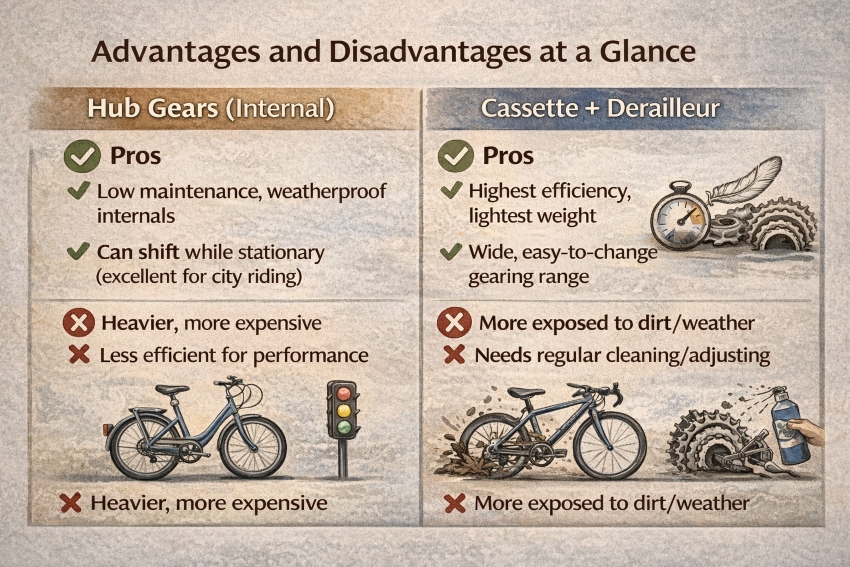
Advantages and disadvantages at a glance
Hub gears (internal)
Pros
- Low maintenance; internals protected from weather and dirt
- Robust: fewer exposed parts, less misalignment risk
- Can shift while stationary (excellent for city riding)
- Straight chainline; often compatible with belt drives
Cons
- Heavier and often more expensive
- Some efficiency loss vs a clean derailleur system; varies by gear and hub design
- Shifting under high load can be less forgiving
- More complex repairs; puncture fixes can be more fiddly
Cassette + derailleur
Pros
- Typically highest efficiency and lowest weight in real-world performance setups
- Wide gearing options; easy to change cassette/chainrings
- Fine gear steps are common (good cadence control)
Cons
- Exposed mechanism: more sensitive to dirt, weather, and impact damage
- Requires more frequent cleaning, adjustment, and wear-part replacements
Which should you choose?
- Choose hub gears if your priority is reliability, low maintenance, commuting convenience, winter riding, or a clean belt-drive setup.
- Choose cassette/derailleur if your priority is maximum efficiency, low weight, wide and easily changeable gearing, and straightforward field serviceability.