Chapter 3: Server and Data-Center Scaling—From Single Machines to Cloud Industrialization
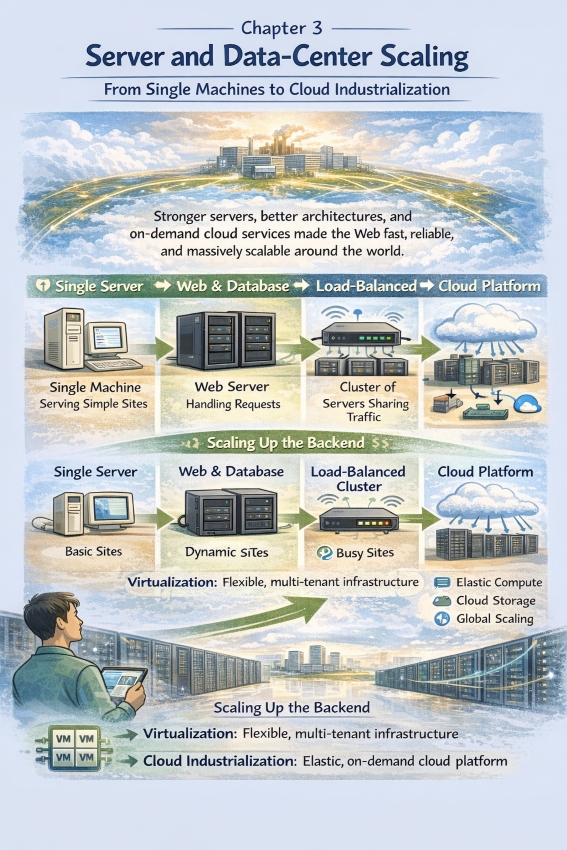
The Web’s “front end” became richer as client hardware improved, but its global reliability and scale came from server and data-center evolution: stronger machines, better storage and networking, and architectures designed for redundancy and horizontal growth.
References: CERN (home.cern); IEEE Standards Association
Servers and data centers: from a single machine to hyperscale fleets
Early sites could run on a single server serving static files. As usage grew, common architectural stages emerged: (1) single server, (2) web plus database, (3) load-balanced clusters, and (4) virtualization and cloud platforms that allow elastic capacity and high utilization.
References: Wikipedia
Virtualization was a major inflection point because it increased hardware utilization and made provisioning faster and more flexible. Mainstream virtualization products and platforms accelerated the shift from “one workload per server” to multi-tenant, automated infrastructure.
References: Wikipedia (VMware history)
Cloud platforms industrialized this model by turning servers, storage, and networking into on-demand services. For example, widely referenced milestones include major cloud storage and compute services launching in the mid-2000s, which helped standardize elastic scaling and global deployment patterns for web applications.
References: Wikipedia (AWS S3/EC2 milestones)
Compact timeline
Compact timeline
- 1970: Low-loss optical fiber breakthrough (~16–17 dB/km) enabled practical telecom fiber.
- References: Corning
- 1971: Intel 4004 demonstrates the early microprocessor era and programmable mass-market compute.
- References: Intel
- Early 1980s: Ethernet standardization (IEEE 802.3) establishes a dominant LAN foundation.
- References: IEEE Standards Association; ETHW
- 1988: TAT-8 transatlantic fiber system operational, expanding global capacity.
- References: Wikipedia
- 1990: First web server running at CERN (NeXT computer).
- References: CERN (home.cern)
- 1995: Fast Ethernet (IEEE 802.3u / 100BASE-T) brings 100 Mbit/s into mainstream LANs.
- References: IEEE Standards Association
- 1997: DOCSIS 1.0 released, enabling standardized cable broadband.
- References: CableLabs
- 1998: V.90 standardizes “56k” dial-up, marking the peak dial-up era.
- References: Wikipedia
- 1999: ADSL standards track (e.g., G.992.1 family) accelerates consumer broadband.
- References: ITU; Wikipedia
- 2006: 10GBASE-T standard approved and cloud-era scaling accelerates.
- References: IEEE Standards Association; Wikipedia