Chapter 1: Hardware Progress That Turned the Web Into a Mass Medium
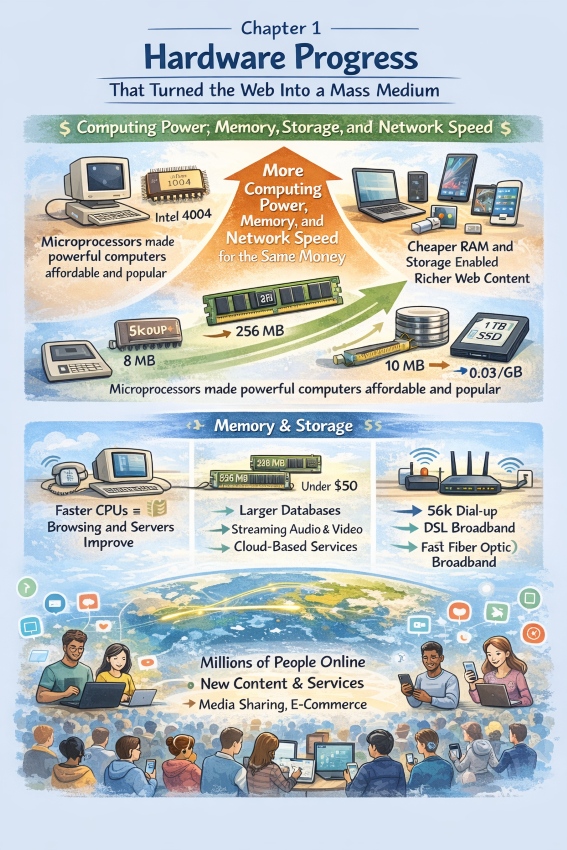
The Web became “big” because hardware became cheaper and more powerful. Three long-term trends mattered most:
- More computing power for the same money
- More memory and storage for the same money
- More network speed for the same money
When all three improved at the same time, the Web could grow from a small research system into an always-on platform used by millions, and later billions, of people.
Reference: Our World in Data; Intel; Georgia Tech (Hasler)
Processors and computers: from one CPU to computing everywhere
A major breakthrough was the microprocessor. It put a general-purpose CPU on a chip that could be mass-produced. This made computers smaller, cheaper, and easier to standardize. As a result, personal computers and workstations became common tools for browsing and creating content. Later, the same idea spread into laptops, smartphones, and many other devices.
References: Intel
An early milestone is the Intel 4004 (1971). By modern standards it was extremely simple, but it showed that a programmable CPU could be made small and produced at scale. That helped start the long shift from specialized machines to general-purpose computing.
References: Intel
Over time, microprocessors improved rapidly. This is often described using Moore’s Law, a historical pattern where transistor counts increased very quickly over many years. More transistors usually meant better performance and lower cost per computation. That mattered because both browsers and servers need large amounts of processing power.
References: Georgia Tech (Hasler); Intel
For the Web, faster CPUs improved two things at once:
- Better browsing: pages could render faster and handle more complex features
- Bigger websites: servers could handle more users and more requests without becoming too expensive
References: Intel; Georgia Tech (Hasler)
A well-known early example is the first web server at CERN, which ran on a NeXT computer. It showed that ordinary workstation hardware could run a web server in real use by the end of 1990.
References: CERN (home.cern)
RAM and storage: the cost drop that enabled databases, media, and scale
RAM is the computer’s short-term working memory. More RAM lets a server keep more activity “live” at the same time, such as open connections, cached pages, and application processes. As RAM became cheaper, websites could become more dynamic and responsive.
References: Our World in Data; Human Progress
Storage is long-term memory (where files and databases are kept). As storage capacity grew and the cost per byte fell, the Web could expand from small collections of pages to platforms hosting photos, user content, and eventually video and massive cloud libraries.
References: Our World in Data; Human Progress
A simple real-world illustration is the steady fall in hard drive cost per gigabyte over time, based on large-scale industry purchasing history. Falling storage costs made it practical to host huge amounts of content.
References: Backblaze
As the Web became more interactive, speed mattered more than just capacity. Slow storage can limit how fast databases and search systems respond. Flash memory (especially NAND) enabled SSDs, which improved response times and throughput for many web workloads.
References: KIOXIA Corporation