Early Commercialization—Access, Tools, and the First Revenue Model (1993–1996)
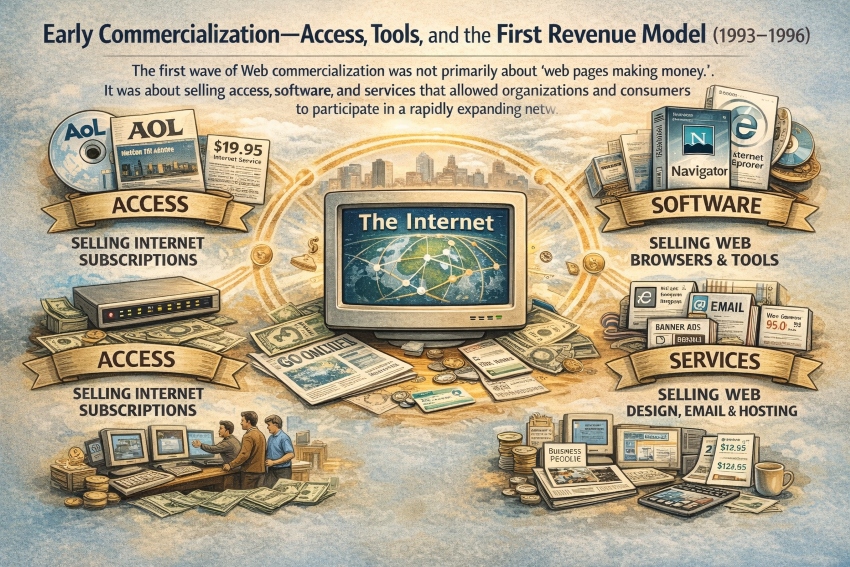
The first wave of Web commercialization was not primarily about “web pages making money.” It was about selling access, software, and services that allowed organizations and consumers to participate in a rapidly expanding network.
Sources
- Internet Society
Early monetization: access, tooling, and services
Once the Web was freely implementable, early commercial value concentrated in access providers (ISPs), software vendors (browsers and server software), and hosting/integration services for organizations moving online.
Sources
- Internet Society
A crucial structural change was the shift away from a single public backbone model toward commercial backbone networks, which enabled private-sector scaling of capacity and service offerings.
Sources
- Internet Society
- U.S. National Science Foundation (NSF)
A measurable adoption trend: website counts and server growth
A clear “trend line” becomes measurable in the mid-1990s. An ACM publication summarizing early Netcraft results notes that the first Netcraft Web Server Survey (August 1995) reported 18,957 websites/hosts.
Sources
- ACM Digital Library
- Netcraft
By December 1996, Netcraft reported Apache running on roughly 247,419 sites and holding about 41% share in its survey, signaling explosive growth in both site counts and production-grade infrastructure.
Sources
- Netcraft
Interpretation: by 1995–1996, the Web was no longer an R&D curiosity; it was a fast-scaling deployment platform attracting serious institutional and commercial adoption.
Sources
- Netcraft
- ACM Digital Library
Advertising becomes a scalable revenue model
A landmark early event was the first widely cited banner advertisement on HotWired (Wired’s early web property) on 27 October 1994, helping establish advertising as a core Web revenue engine.
Sources
- WIRED
Industry retrospectives often cite early Hot-wired banner placements at around $30,000 for three months, illustrating early price discovery and experimentation in digital media markets.
Sources
- Digiday
- WIRED