Late Roman and Late Antique Transformations: Inflation, Fiscal Rewiring, and the Gold Anchor (c. 200–700)
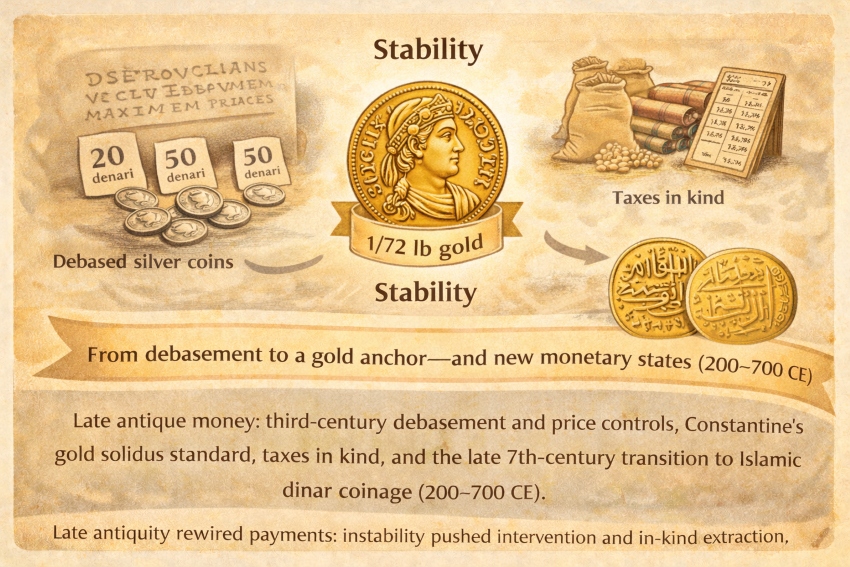
“Late antiquity rewired payments: instability pushed intervention and in-kind extraction, while gold coin standards and later Islamic reforms restored high-trust settlement at scale.”
Summary of events during the period
From roughly 200 to 700 CE, Mediterranean money and payment systems were reshaped less by a single invention than by repeated fiscal and political shocks: third-century debasement and inflation, Diocletianic tax and price interventions, Constantine’s creation of a durable gold standard, the fragmentation of imperial authority in the West, and (in the 7th century) major territorial and administrative disruption in the East followed by the consolidation of a distinct Islamic monetary system. The durable outcome was a two-tier reality: stable high-value gold for state, diplomacy, and long-distance settlement, alongside more volatile base-metal currency and widespread taxes and provisioning in kind.
Payment media (what people used to pay)
- Debased silver coinage (3rd century): The “money people touched” in many regions became increasingly debased and unstable during the third century, a context closely associated with price instability and monetary fragmentation.
- Gold solidus / nomisma (4th century onward): Constantine’s gold solidus was standardized at 1/72 of a Roman pound (about 4.5 g) and became the cornerstone of the Byzantine monetary system and long-distance high-trust payments for centuries.
- Bronze small change (Late Roman/Byzantine): Everyday retail exchange relied heavily on bronze issues; in the 7th century, the Byzantine bronze system simplified and contracted, with the follis (40 nummi) becoming the primary regularly issued bronze coin, often shrinking over time.
- Payments in kind (tax/provisioning): A significant share of fiscal extraction and provisioning operated through goods rather than coin, with documented cases showing taxes assessed and collected in kind and sometimes commuted into cash (adaeratio).
- Early Islamic gold dinar reform (late 7th century): After a period of imitative Arab-Byzantine issues, new Islamic dinars minted from 77 AH / 696–697 CE were issued with Arabic inscriptions and a new weight standard (around 4.25 g), marking a decisive monetary transition in the former Byzantine/Sasanian borderlands.
How prices were set (negotiated vs administered vs regulated)
Negotiated pricing (market reality)
- In most day-to-day exchange, prices still formed through bargaining and local conditions. The monetary challenge was that the “unit” people paid with could become unreliable when debasement and supply shocks intensified.
Administered pricing attempts (state intervention)
- Diocletian’s Edict on Maximum Prices (301 CE) is the clearest evidence of an empire-wide attempt to control inflationary dynamics through a comprehensive schedule of maximum prices and wages (enforcement appears uneven and the edict survives in fragments).
Regulation via fiscal design (tax assessment as “price-setting” of obligations)
- Diocletian’s fiscal reforms (commonly discussed through the iugatio/capitatio framework) reorganized how obligations were assessed across land and people, shaping how households experienced the “cost” of empire—often in kind, sometimes monetized.
How payments cleared (the “rails”)
- Third-century “friction” clearing: When coin quality is uncertain, clearing becomes costly—requiring discounting, refusal, price adjustments, or preference for alternative media. Scholarly discussion of third-century inflation emphasizes competing explanations but treats debasement and monetary instability as central features of the period’s payment environment.
- Gold-anchor clearing (4th–7th centuries): High-value settlement increasingly cleared through gold solidi, whose standard and reputation reduced verification costs and supported state payments, diplomacy, and long-distance exchange.
- Fiscal clearing through kind + receipts: Many state obligations cleared through deliveries (grain, cloth, etc.) with receipts and records; evidence from Egypt illustrates taxes collected in kind and the importance of documenting deliveries over time.
- Transition rails in the 7th century (Byzantine → Islamic): The late 7th century in the Eastern Mediterranean saw overlapping coin environments (imitations and hybrids) before reforms produced a distinctive Islamic tri-metal system (gold/silver/copper) tied to administrative consolidation.
Trust and governance (why anyone accepted it)
- State credibility as monetary technology: The solidus worked because the issuing authority defended its standard and because state demand (taxes, salaries, procurement) reinforced acceptance. Reference descriptions emphasize its 1/72-pound standard and long-run dominance in Byzantine monetary life.
- Documentation and enforcement for non-cash systems: In-kind taxation and requisitions depend on recordkeeping and enforcement mechanisms; late Roman documentation shows the administrative importance of receipts and persistent archives.
- Identity and legitimacy via coin design (late 7th century): Abd al-Malik’s reforms are widely treated as part of centralizing state formation, with the move toward epigraphic coinage (Arabic inscriptions) functioning as both monetary standardization and political messaging.
Revenue model (who made money from the system)
- Fiscal extraction dominates: The core “revenue engine” is taxation and requisitioning, increasingly systematized under Diocletianic reforms that sought predictable assessment across the empire.
- Seigniorage and recoinage (constrained but real): Debasement and re-minting can provide short-run fiscal relief, but the third-century record illustrates the trade-off: monetary instability and price disruption.
- Monetary consolidation as revenue capacity (late 7th century): Islamic monetary reform helped unify payments and administration across newly consolidated territories, strengthening the fiscal/payment “rails” of the state.
Failure modes and constraints
- Inflation and distrust spirals: When coin quality declines and prices rise, people defend themselves by raising prices, refusing coins, demanding “good” money, or shifting toward kind—amplifying transaction friction. Scholarly discussion of third-century inflation highlights precisely these dynamics and the difficulty of measuring them cleanly.
- Administrative burden and rigidity: Broad tax assessment systems can become brittle under shock (war, plague, harvest failure), especially where obligations are fixed in advance.
- 7th-century disruption and simplification: In the East, the contraction/simplification of bronze coinage and the emergence of new coin regimes reflect the stress of territorial and fiscal upheavals.
What scaled it (the scaling technology)
- The solidus standard (gold anchor): A credible gold standard scaled high-value settlement by lowering verification costs and stabilizing long-distance payments.
- Systematic tax assessment (fiscal infrastructure): The iugatio/capitatio framework scaled extraction by making obligations legible and repeatable across regions.
- Reformed coin identities (late 7th century): Islamic monetary reform scaled a new imperial payments system through standardization and administrative integration (including a shift away from imitative coin types).
Caption:
“Late antiquity rewired payments: instability pushed intervention and in-kind extraction, while gold coin standards and later Islamic reforms restored high-trust settlement at scale.”
Sources
- Butcher, Kevin. “Debasement and the decline of Rome” (PDF, University of Warwick).
- Arnaud, Pascal. “Diocletian’s Prices Edict” (PDF, 2007).
- Segrè, A. “Studies in Byzantine Economy: Iugatio and Capitatio” (Cambridge Core).
- Oxford Reference. “Solidus” (minted from 309 CE; 72 to the pound).
- Encyclopaedia Britannica. “Coinage in the Byzantine Empire / Solidus” (1/72 lb; ~4.5 g; long-run dominance).
- British Museum collection object (example solidus; inscription note referencing 72 to the pound; ~4.53 g example).
- Kato, H. “The Monetary History of the East Mediterranean in the Middle Ages” (PDF; Abd al-Malik reform context and transition from imitative coinage).
- Encyclopaedia Iranica. “DINAR” (77/696 reform; Arabic inscriptions; ~4.25 g standard).
- Treadwell, Luke. “Abd al-Malik’s Coinage Reforms: the Role of the Damascus Mint” (Persée).
- Soto Marín, I. “The Economic Integration of a Late Roman Province” (PDF; evidence for taxes in kind and commutation).